SCHD ETF: Dividend Yield, Total Return and What $10,000 Pays Today
SCHD ETF explained in plain English: live yield, fee, assets, total return, price decay and what $10,000 pays today. Who it fits and who should skip it.
The short version
- SCHD yields 3.0% today, costs 0.06% a year, and manages $112B. That makes it one of the cheapest and biggest dividend ETFs around.
- $10,000 in SCHD throws off about $300 a year at today's yield, paid Quarterly. It is built for dividend growth and quality, not for the highest possible payout.
- Total return since inception is 537% and our price decay flag says No. But SCHD will not beat the market every year, and its yield is modest next to covered call funds.
The SCHD ETF (Schwab U.S. Dividend Equity ETF) pays a 3.0% yield right now, charges just 0.06% a year, and has returned 537% in total since it launched on 10/20/2011. On $10,000, that works out to roughly $300 of dividends per year.
That is the quick answer. The more useful question is what you are actually buying for that yield, and whether it fits what you want from your money. Let's go through it.
SCHD vs. the funds people compare it to
What SCHD actually holds
SCHD tracks the Dow Jones U.S. Dividend 100 Index. In plain English, that means roughly 100 large U.S. companies picked for their dividends and for the health of their business, not just for the biggest yield.
To get in, a company generally needs a long record of paying dividends (at least ten straight years). Then the index ranks the survivors on a mix of factors: cash flow compared to debt, return on equity, current dividend yield and five-year dividend growth. REITs are left out. The index also caps how much any single stock or sector can take up, so no one name runs the show.
This is a quality screen, and that is the whole idea. You are not chasing the highest payer. You are buying profitable companies that have kept paying and growing their dividends.
How and when SCHD pays you
SCHD pays Quarterly, which means four dividend payments a year. The amount can move from one payment to the next, since it depends on what the underlying companies paid out.
The index is reconstituted once a year, usually in March. Companies that no longer pass the screen get dropped and new ones come in. That annual refresh is how SCHD tries to keep its quality bar high, and it is also why holdings and sector weights can shift noticeably from year to year.
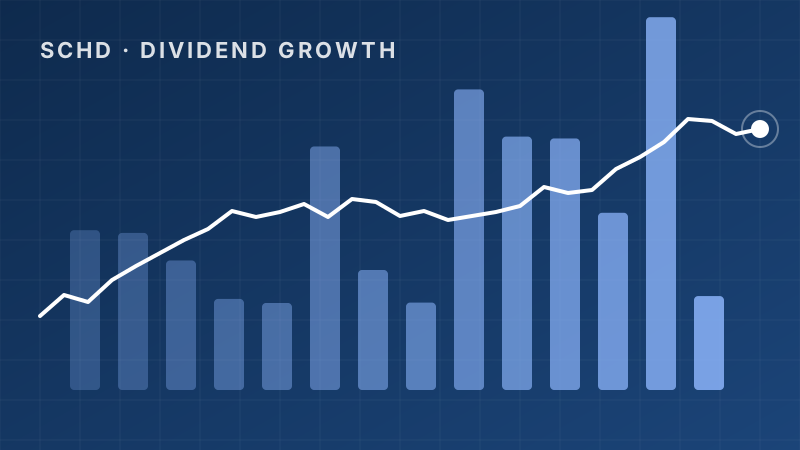
The SCHD ETF has also tended to raise its payout over time as its companies grow their dividends. That is a pattern, not a promise. Dividends can be cut, and the fund's payout can fall as well as rise.
What $10,000 and $100,000 pay today
Here is the real-world math at today's yield of 3.0%:
- $10,000 invested: about $300 per year, or around $25 a month if you spread it out.
- $100,000 invested: about $3,000 per year, or around $250 a month on average.
- To target $1,000 a month: you would need about $400,000 invested at this yield.
Remember that SCHD pays four times a year, not monthly. The monthly figure is just an average to help you plan. Your actual deposits come in larger chunks every quarter.
For context, the same $10,000 in VOO would pay about $110 a year, while JEPI would pay about $750. The JEPI number looks great, but it comes with different trade-offs, which I get into below.
What your money earns in SCHD and similar funds
Estimated annual income at each fund's current yield
Today's income only. Yields change and are not guaranteed.
Total return and price decay
Yield only tells you the cash. Total return tells you the whole story: price change plus dividends. SCHD's total return since inception is 537%, and our database shows price decay as No. That means the fund's share price has not been eroding over time.
Now the fine print. Funds started on different dates, so these numbers are not a fair race. SCHD launched 10/20/2011. VOO launched 9/7/2010 and shows 830%. SCHG, a growth fund, launched 12/11/2009 and shows 1,192%. VIG has the longest record of the group, launching 4/21/2006, with 606%.
The takeaway: SCHD has done well, but a plain S&P 500 fund and a growth fund have posted bigger numbers over their own histories. You are trading some upside for a higher dividend and a more defensive tilt. Whether that is a good trade depends on you. I go deeper on this idea in The Yield Trap: Why the Biggest Payout Isn't Always the Best Return.
The cost: why a low fee matters
The expense ratio is the yearly fee the fund takes out of your investment, taken automatically from the fund's assets so you never see a bill. SCHD charges 0.06%. Compare that to DVY at 0.38% or SDY at 0.35%, and the gap adds up over decades. If you want to see exactly how, read the expense ratio math, visualized.
Size matters too. With $112B in assets, SCHD is easy to trade and is not at risk of being quietly closed for lack of interest.
SCHD vs. the close alternatives
SCHD vs. VYM. VYM yields 2.5% and charges 0.04%. It owns a much broader basket of high-yielding stocks and leans less on a quality screen. SCHD yields 3.0%. They are close cousins, and I put them side by side with two others in SCHD vs. VYM vs. DGRO vs. VIG.
SCHD vs. VIG and DGRO. VIG yields 1.6% and DGRO yields 2.0%. Both focus on dividend growth rather than current yield, so you give up income today in exchange for a bigger emphasis on future growth.
SCHD vs. VOO. VOO yields only 1.1%, but it owns the whole large-cap U.S. market, including the big tech names that SCHD mostly avoids. If you just want the market, VOO does that. If you want a larger paycheck now, SCHD pays more.
SCHD vs. JEPI. JEPI yields 7.5%, paid Monthly, with an expense ratio of 0.35%. That higher yield comes from options income, and it usually means giving up some of the upside when markets rally. See Covered Call ETFs, Explained for how that works. It is a different tool, not a better or worse one.
The risks nobody should skip
- Concentration. About 100 stocks is still a focused list, and the screen can tilt heavily toward certain sectors in a given year.
- Lagging in big rallies. When a handful of mega-cap growth stocks lead the market, a dividend quality fund can fall behind the S&P 500.
- Dividends are not guaranteed. Companies can cut payouts, and the fund's income can drop. A past record is not a promise.
- Market risk. SCHD is still 100% stocks. In a bad year, it can fall, and the dividends will not fully cushion that.
- Annual reshuffle. The yearly reconstitution can change what you own, sometimes in ways you did not expect.
Who SCHD tends to fit (and who might skip it)
SCHD tends to suit investors who want a reasonable, growing paycheck from quality U.S. companies, at almost no cost, in one simple fund. It works for people building long-term income, and for people who like the idea of reinvesting dividends while they are still working. If that is you, reinvest or spend is worth a read.
It may not fit if you need the highest possible income today. At 3.0%, SCHD will not replace a paycheck on a small portfolio. It may also not fit if you want maximum growth, where a fund like SCHG (0.4% yield, 1,192% total return since its own launch) has a very different profile. And if you want broad international exposure, SCHD is U.S. only.
This isn't a buy or sell signal. It is a map of the trade-offs. To plan what your own income could look like over time, try Dividend Projection or our calculators. If you want to screen every income ETF side by side, TopDividendETFsPRO does that, and TopDividendETFs.com ranks the top 100 dividend funds.
FAQ
Does SCHD pay monthly?
No. SCHD pays Quarterly, so you get four payments a year. If you want monthly checks, you can mix it with a monthly payer or just budget using the average.
What is the SCHD dividend yield today?
The current yield is 3.0%. On $10,000 that is about $300 per year. Yields change as the share price and dividends change.
Is SCHD a good investment?
It depends on your goals. It offers a low fee of 0.06%, a quality dividend screen and solid long-term total return of 537% since inception. It can lag the broad market in strong growth rallies, so do your own due diligence.
SCHD vs. VOO: which is better?
They do different jobs. VOO owns the broad market with a 1.1% yield, while SCHD focuses on dividend quality with a 3.0% yield. Their total returns (830% vs. 537%) cover different time periods, so they are not a direct race.
Does SCHD have price decay?
Our database flags SCHD's price decay as No. That is a good sign, but past results do not guarantee future ones.
How much do I need in SCHD to earn $1,000 a month?
At today's yield, about $400,000. That number moves whenever the yield does.
My bottom line on the SCHD ETF
SCHD is popular for good reasons. It is cheap at 0.06%, big at $112B, simple to understand, and it has delivered 537% in total return since 10/20/2011. It pays a steady, growing-style dividend without reaching for a risky yield.
But it is not magic. The 3.0% yield will not make you rich on its own, it can trail the market in growth-led years, and dividends are never guaranteed. Know what you want from your money first, then decide if SCHD fits. Do your own homework, and please don't treat any of this as personal advice.
ETFs in this story
How this article was made: Benjie picks every topic based on what he finds useful as a dividend investor and what readers ask about. Parts of this article were drafted with help from AI tools, then edited, fact-checked and shaped by Benjie. All fund numbers come from the TopETFs database and update daily.
Disclaimer: TopETFs.com is published by Dividend Empire LLC for educational and entertainment purposes only. We are not financial advisors, and nothing on this site is financial advice, a recommendation, or a solicitation to buy or sell any security. ETF data is compiled from public sources and fund issuers, may be delayed, inaccurate or outdated, and may differ from the fund sponsor's own figures. Yields are trailing distribution yields, are not guaranteed, and distributions may include return of capital, which reduces your cost basis and is not a measure of performance. Total returns are since each fund's inception unless noted and are not comparable across funds with different start dates. Past performance does not guarantee future results. Investing carries risk, including loss of principal. Read each fund's prospectus and consult a licensed financial advisor before investing. Dividend Empire LLC receives compensation from ETF issuers for sponsored placements, which are labeled as such.