How Much Do You Need in SCHD to Make $1,000 a Month?
At today's SCHD yield, here's the exact amount you need for $1,000 a month, plus live income tables, a calculator, and the risks behind the math.
The short version
- At SCHD's current yield of 3.0%, you need about $400,000 invested to collect $1,000 a month on average.
- SCHD pays Quarterly, so the income arrives in bigger chunks every three months, not a steady $1,000 each month.
- The yield moves with the share price and the dividend, so treat that target as a moving number, not a fixed finish line.
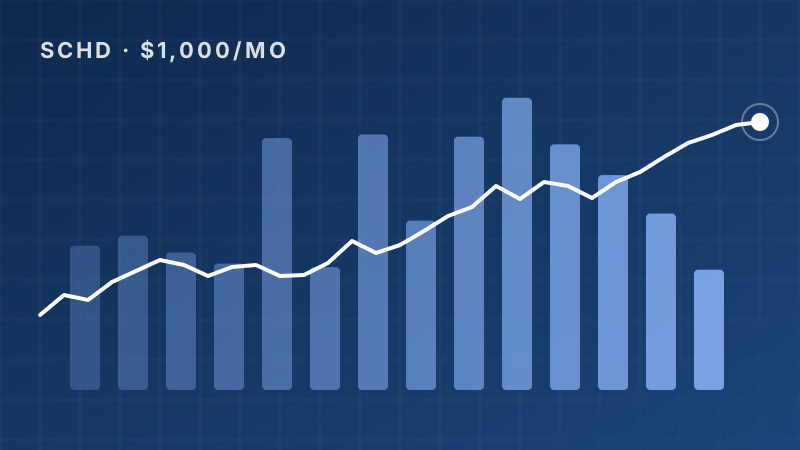
To make $1,000 a month from SCHD, you need roughly $400,000 at today's 3.0% yield. That works out to $12,000 a year, which is the target divided by the yield. It's a big number, and I'd rather show you the math honestly than pretend there's a shortcut.
Here's the thing: that figure changes every day. If the yield rises, you need less. If it falls, you need more. So let's go through how the number is built, what it looks like at different yields, and what can go wrong.
SCHD and the funds people compare it to
The simple formula behind the number
The math is one line. Take the yearly income you want and divide it by the yield. For $1,000 a month, that's $12,000 a year divided by 3.0%, which gives you $400,000.
Yield is just the last year of dividends divided by the share price. It's a snapshot, not a promise. A fund can pay the same dollars and still show a different yield if the price moves.
Here's how the target changes with the monthly income you're after, at SCHD's current yield:
| Monthly income goal | Amount needed in SCHD |
|---|---|
| $500 a month | $200,000 |
| $1,000 a month | $400,000 |
| $2,000 a month | $800,000 |
| $5,000 a month | $2,000,000 |
The target scales in a straight line. Double the income goal and you double the money needed.
What different portfolio sizes pay in SCHD
Maybe you're not starting from the goal. Maybe you're starting from the balance you actually have. Here's what SCHD would pay today at a few sizes, using the current yield.
| Amount invested | Estimated yearly income | Average per month |
|---|---|---|
| $50,000 | $1,500 | $125 |
| $100,000 | $3,000 | $250 |
| $250,000 | $7,500 | $625 |
| $500,000 | $15,000 | $1,250 |
Even $100,000 in SCHD pays a modest monthly average. That's not bad news, it's just reality. A 3.0% yield is built for growth of income over time, not for replacing a paycheck on day one.
SCHD pays quarterly, not monthly
This catches people off guard. SCHD pays Quarterly. So when I say $1,000 a month, I mean an average. In practice you'd get roughly $3,000 every three months, and nothing in between.
If you need cash on a monthly schedule, you can handle it two ways. Keep a small cash buffer and pay yourself monthly from the quarterly deposits. Or pair SCHD with a fund that pays monthly. Neither is wrong. It's just a planning detail you want to know before you count on the income.
How SCHD works, in plain English
SCHD tracks an index of U.S. dividend-paying stocks from SCHD's issuer, Schwab. The index screens for companies with a history of paying dividends, then looks at things like cash flow, balance sheet strength and return on equity. It's built around quality and dividend sustainability, not the highest possible yield.
That's why the yield sits where it does. The expense ratio (the yearly fee the fund takes out of your money) is 0.06%, which is very low. The fund has $112B in assets, so liquidity isn't a concern. Price decay, meaning the share price steadily eroding over time, is flagged as No in our data.
I like funds like this because the dividend comes from real company profits, not from options income or return of capital. If you want a deeper look at the fund itself, I wrote up SCHD's yield, total return and what $10,000 pays today.
How much would you need in other dividend funds?
The target depends entirely on the yield, so the fund you choose changes the answer a lot. Here's what you'd need for $1,000 a month in several alternatives, at each fund's current yield.
| Fund | Yield | Needed for $1,000 a month |
|---|---|---|
| SCHD | 3.0% | $400,000 |
| VYM | 2.5% | $480,000 |
| VIG | 1.6% | $750,000 |
| VOO | 1.1% | $1,090,909 |
| JEPI | 7.5% | $160,000 |
| JEPQ | 12.0% | $100,000 |
The gap is huge. JEPI and JEPQ are covered call funds, which sell options on their holdings to collect extra income. That's how they pay monthly and show much higher yields, and it means you need far less capital to hit $1,000 a month.
But a smaller target isn't automatically a better deal. Covered call funds usually give up some upside when markets rally. I explain the trade-off in Covered Call ETFs, Explained. For a straight comparison among the traditional dividend funds, see SCHD vs. VYM vs. DGRO vs. VIG.
Total return matters more than the yield number
It's tempting to chase the lowest target. I'd look at total return first, which is price change plus dividends together. Since inception, SCHD's total return is 531%, and its inception date is 10/20/2011.
For context, VYM is at 467% since 11/10/2006, and JEPI is at 93.0% since 5/20/2020. These funds launched in very different years, so the numbers are not a fair race. JEPI has a much shorter track record, and it hasn't been through as many market cycles.
The point is that a bigger yield doesn't mean you ended up with more money. A fund that pays a lot but grows slowly can leave you with less total wealth than a lower-yield fund that keeps growing. I go deeper on this in The Yield Trap.
The risks behind the $1,000 a month plan
- The yield moves. If SCHD's price rises faster than its dividend, the yield falls and your target grows. If the price drops, the yield rises, but your portfolio shrank.
- Dividends aren't guaranteed. Companies can cut payouts, and the fund's income follows what its holdings pay.
- Market drops are real. A $400,000-sized portfolio can lose a big chunk of value in a bad year, even while income keeps coming in. Make sure you could live with that.
- Concentration. SCHD holds a limited set of U.S. stocks, and certain sectors can be overweight at times. It's not the whole market.
- Taxes. Dividends are generally taxable in a regular brokerage account, and what you keep depends on your situation. Plan for that rather than counting the gross number as spendable.
None of this means SCHD is a bad choice. It means $1,000 a month is an estimate, and you should build in some room for the real world.
Ways to get closer to the target
Most people don't write one big check. They build up over time. Adding money regularly gets you there faster than waiting for the perfect entry point, and what you do with the dividends matters a lot along the way.
If you reinvest dividends while you build, your share count grows and so does the income. I walk through the long-term effect in Reinvest or Spend?. Then, once you reach your number, you can switch from reinvesting to spending.
You can also test your own numbers with the TopETFs calculators, or use Dividend Projection to model how your income could grow over time. If you want to screen other income funds, TopDividendETFsPRO covers every one in detail.
What your money pays in SCHD and three comparisons
Estimated annual income at each fund's current yield
Today's income only. Yields change and are not guaranteed.
FAQ
How much do I need in SCHD to make $1,000 a month?
At the current yield of 3.0%, you need about $400,000. The number changes whenever the yield changes.
Does SCHD pay monthly?
No. SCHD pays Quarterly, so the dividends come in larger amounts every three months. You can still budget it as a monthly average.
Is SCHD a good investment for income?
It's a popular choice for investors who want a quality-focused dividend fund with a low fee of 0.06%. Whether it fits you depends on your goals, timeline and how much income you need now versus later.
SCHD vs. JEPI: which needs less money for $1,000 a month?
JEPI needs far less, about $160,000 at its current yield, versus $400,000 for SCHD. But JEPI uses options and has a shorter history, so the trade-offs are different.
Will SCHD's yield stay the same?
No. The yield changes with the share price and with the dividends the fund collects. Never plan around today's yield as if it's permanent.
My bottom line
The honest answer is that SCHD needs a lot of capital to produce $1,000 a month today, about $400,000 at the current yield. That's the price of a quality, lower-yield dividend fund with a 0.06% fee.
You can lower the target with higher-yield funds, but you take on different risks, like capped upside or a shorter track record. Or you can build toward the number over time, let dividends compound, and watch the income grow along the way.
This isn't a buy or sell signal. It's the math, laid out so you can decide what fits your own plan. Do your own due diligence before you invest.
ETFs in this story
How this article was made: Benjie picks every topic based on what he finds useful as a dividend investor and what readers ask about. Parts of this article were drafted with help from AI tools, then edited, fact-checked and shaped by Benjie. All fund numbers come from the TopETFs database and update daily.
Disclaimer: TopETFs.com is published by Dividend Empire LLC for educational and entertainment purposes only. We are not financial advisors, and nothing on this site is financial advice, a recommendation, or a solicitation to buy or sell any security. ETF data is compiled from public sources and fund issuers, may be delayed, inaccurate or outdated, and may differ from the fund sponsor's own figures. Yields are trailing distribution yields, are not guaranteed, and distributions may include return of capital, which reduces your cost basis and is not a measure of performance. Total returns are since each fund's inception unless noted and are not comparable across funds with different start dates. Past performance does not guarantee future results. Investing carries risk, including loss of principal. Read each fund's prospectus and consult a licensed financial advisor before investing. Dividend Empire LLC receives compensation from ETF issuers for sponsored placements, which are labeled as such.