What Happens to Your Money When an ETF Closes or Liquidates?
If your ETF is shutting down, you get cash back at NAV. Here's the timeline, the tax hit, whether to sell early, and how to spot a fund at risk.
The short version
- When an ETF closes, you don't lose everything. The fund sells its holdings and pays you cash based on the final net asset value (NAV) per share.
- In a taxable account, the payout counts as a sale, so you owe tax on any gain (or can claim a loss). In an IRA or similar account, there is usually no immediate tax.
- You can sell on the market before the last trading day or wait for the cash payout. Neither is automatically better, but doing nothing is a choice too.
If your ETF closes, the issuer stops trading it on the exchange, sells everything the fund owns, and sends the cash to shareholders in proportion to how many shares they hold. You get back roughly what your shares were worth (the NAV) minus any wind-down costs. It is an annoying event, but it is usually not a disaster.
The real damage is rarely the closure itself. It's the surprise tax bill, the cash sitting uninvested, and the time you were out of the market. Here's how it works from announcement to payout, so you can plan around it.
Why ETFs close in the first place
ETFs close because they don't earn enough for the issuer to keep them running. Every fund has fixed costs: administration, legal, trading, and marketing. If the fund holds too little money, the fees it collects don't cover those costs.
So the issuer decides to shut it down. That's the most common reason by far. It has nothing to do with the fund holdings blowing up. Other reasons include an issuer merging or exiting a product line, an index provider ending an index, or a strategy that never caught on with investors.
One important point: your shares are not an IOU from the issuer. The fund's holdings are kept separate from the issuer's own business. If the company that runs the ETF shuts one fund down, your money is not tied to its corporate finances.
The closure timeline, step by step
Details differ by issuer and fund, so always read the actual notice. But most closures follow the same general pattern.
- Announcement. The issuer publishes a press release and often files a notice with the SEC. It names the fund, the last day of trading, and the expected liquidation date. Notice periods are commonly a few weeks, but this is not a fixed rule.
- Wind-down starts. The fund may stop accepting new creations of shares and may begin selling holdings and moving to cash. Because of this, the fund may stop tracking its index closely in the final days.
- Last trading day. This is the final day you can sell your shares on the exchange at the market price. After that, the shares are delisted and you can't trade them.
- Liquidation and payout. The fund finishes selling holdings and calculates a final NAV per share. Cash is paid out to shareholders, usually within days to a couple of weeks after the last trading day. Your broker deposits it in your account.
- Tax reporting. The payout shows up on your broker's tax forms for the year it was paid, typically as a sale of the shares.
You usually don't need to file anything or click anything. If you hold the shares through the last trading day, the broker normally handles the payout automatically. Still, check your broker's notices, because process details vary.
How the cash payout works
The payout is based on NAV, which is the total value of the fund's assets minus its liabilities, divided by shares outstanding. Think of NAV as the real worth of one share's slice of the portfolio.
Your payout is roughly your share count times the final NAV per share. Two things can make it a little different from what you saw on the screen:
- Wind-down costs. Some liquidation expenses may come out of fund assets, which can slightly reduce the final NAV. Often the issuer absorbs them, but it depends on the fund.
- Market price vs NAV. In the last days, a fund's market price can drift from its NAV, especially a small, thinly traded fund. If you want to understand that gap, see what it means when an ETF trades at a premium to NAV.
The payout comes as cash, not as shares of a different fund. If you want to stay invested, you'll need to buy something new yourself.
Taxes when an ETF liquidates
In a taxable brokerage account, a liquidation is generally treated like a sale. You compare the cash you receive with your cost basis (what you paid, adjusted for reinvestments). The difference is a capital gain or loss.
If you held the shares for more than a year, the result is generally long-term. If you held them a year or less, it is short-term. Rates and rules change, so confirm current treatment with the IRS or a tax professional.
A few more tax points worth knowing:
- Final distributions. A closing fund may pay a last distribution of income or capital gains along with the liquidation payout. Those can be taxable on their own. For the broader picture, see whether you pay taxes on ETFs every year.
- Retirement accounts. In a traditional IRA, Roth IRA or 401(k), the liquidation itself is normally not a taxable event. The cash simply lands inside the account. Just don't withdraw it by accident.
- Losses and wash sales. If you take a loss and quickly buy a substantially identical investment, the wash sale rule may come into play. Read how the wash sale rule applies to ETFs before replacing the fund.
- Tax year timing. If the closure straddles the end of the year, which tax year the sale lands in depends on when you sell or when the payout is made. Check the dates in the notice.
A worked example with real dollar amounts
Let's use a made-up fund. Say you own 400 shares of a small thematic ETF, bought at $25 each, so your cost basis is $10,000. The fund announces it's closing. These are hypothetical numbers for illustration only.
| Scenario | Payout | Basis | Result |
|---|---|---|---|
| Final NAV $22.50 | $9,000 | $10,000 | $1,000 loss |
| Final NAV $31.00 | $12,400 | $10,000 | $2,400 gain |
In the loss scenario, in a taxable account, the $1,000 loss may be usable against other gains, subject to the usual rules. In the gain scenario, you owe tax on $2,400. If you'd held a gain like that for years in a regular account, the closure forces you to realize it now.
Inside an IRA, both scenarios are the same from a tax view: you simply end up with $9,000 or $12,400 in cash in the account, with no tax due at that moment.
Sell early or wait for the payout?
This is the question I get most. Here's how I think about it.
Reasons to sell before the last trading day:
- You control the timing and the tax year of the sale.
- You get your cash immediately and can reinvest sooner, so you spend less time out of the market.
- You avoid the risk of delays or confusion at your broker over the payout.
Reasons to wait for the liquidation:
- You get NAV, the real value of the holdings, instead of a market price that might be off in a thin market.
- You avoid a wide bid-ask spread (the gap between buy and sell prices), which can be costly in a small, illiquid fund. Use limit orders if you sell.
- You may not need to do anything at all.
The catch with waiting is that you can sit in cash for days or weeks with no market exposure. If the market jumps in that window, you miss it. If it drops, you dodge it. Either way, you didn't choose it.
If you sell on the market, place a limit order and look at the fund's NAV first. Selling at the market in a thin fund can cost you more than the closure ever would. For how order timing works, see what happens when you try to sell an ETF after the market closes.
What to do once the cash arrives
Decide whether you want to replace the exposure. If the closed fund was a core holding, you might look for a similar, larger fund. That's a personal decision, and this isn't a buy or sell signal. Just compare fees, size, and how closely it matches what you had.
In a taxable account, remember that a loss followed by a near-identical purchase can trigger the wash sale rule. In a retirement account, you can reinvest freely inside the account. Use the ETF screener to compare replacement candidates on fees and size.
How to spot an ETF that might close
You can't predict a closure with certainty, but the warning signs are fairly consistent.
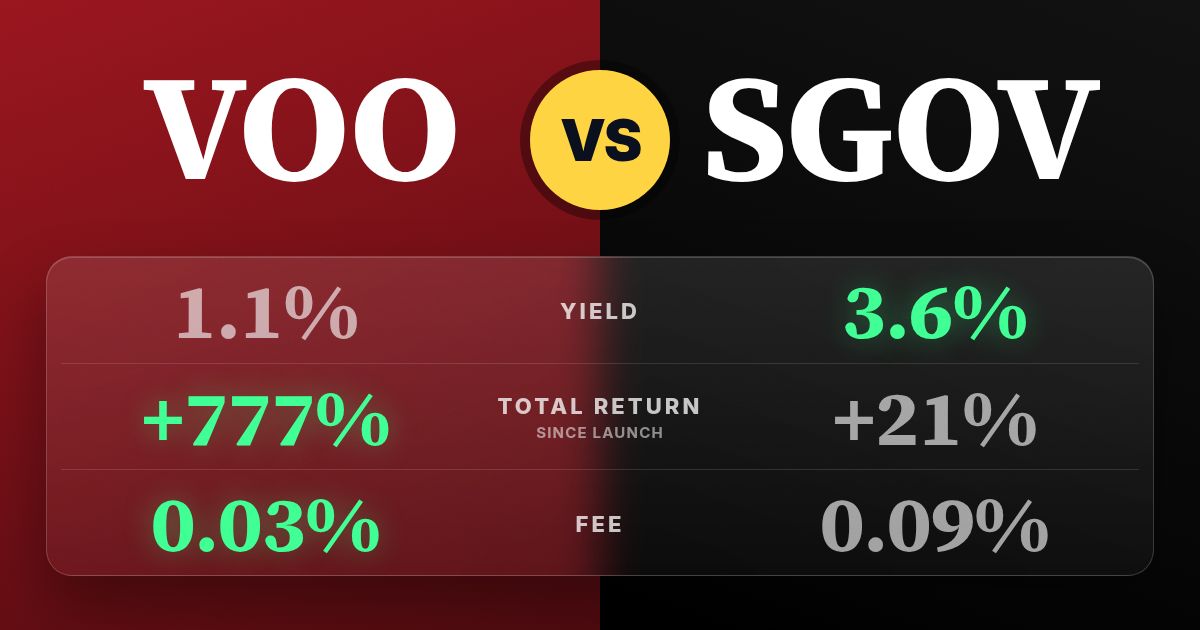
- Tiny assets. This is the biggest one. For perspective, VOO has $988B in assets and SGOV has $120B. A fund with only a few million or tens of millions is in a different world. There's no official cutoff, but small funds close far more often than large ones.
- Low trading volume. If few shares trade each day and spreads are wide, that's a sign few people want the fund.
- Shrinking assets. A fund that keeps losing money to redemptions is on a bad trend.
- Age without growth. A fund that has been around for a few years and still hasn't gathered much money may never get there.
- Narrow, trendy themes. Niche strategies launched at the peak of a fad often fade when the fad does.
- High fees relative to peers. A pricey fund in a crowded category has a hard time attracting assets. For why fees matter so much, see the expense ratio math. For comparison, VOO charges 0.03%.
None of this means any specific fund is about to close. I'm using big funds only as a size comparison. Also, the biggest, most widely held index funds are not typically closure candidates. For the related question of a fund losing all value, see whether an ETF can go to zero.
Common mistakes
- Ignoring the notice. The announcement email or letter has the dates that matter. Read it.
- Panic selling at a bad price. In a thin fund, a market order can fill well below NAV. Use a limit order.
- Forgetting the tax bill. The forced sale can realize a gain you were happy to defer.
- Leaving the cash idle. It's easy to forget about a payout sitting in the account for months.
- Triggering a wash sale. Rebuying a nearly identical fund right after taking a loss can defeat the point of the loss.
- Assuming a closure means a loss. If the fund went up since you bought, you could simply have a gain. Closing doesn't set the price.
Your checklist
- Find the official closure notice on the issuer's website or in your broker's messages.
- Write down the last trading day and the expected payout date.
- Check the fund's NAV and market price. Look at the spread.
- Look up your cost basis and holding period to estimate the tax result.
- Decide: sell early with a limit order, or wait for the payout.
- Note which account it's in. Taxable and retirement accounts behave very differently.
- Plan what, if anything, will replace it, and watch for wash sale issues.
- After payout, confirm the cash arrived and keep the tax form.
FAQ
Do I lose all my money if my ETF closes?
No. The fund sells its holdings and pays you cash equal to your share of the final NAV. You get back roughly what the underlying holdings are worth, not zero.
How long does it take to get paid after an ETF liquidates?
It is often a matter of days to a couple of weeks after the last trading day, but it varies by fund and broker. The closure notice usually gives an expected date.
Do I have to do anything when my ETF closes?
Usually not. If you hold through the last trading day, the cash is normally deposited automatically. You should still read the notice and decide whether to sell earlier.
Is an ETF liquidation a taxable event?
In a taxable account, generally yes, it's treated like a sale and you report a gain or loss. In an IRA or 401(k), it normally isn't taxable at the time. Confirm with a tax professional.
Can I still sell my ETF after it announces it's closing?
Yes, until the last trading day. After that, the shares are delisted and you wait for the liquidation payout.
Do big ETFs like S&P 500 funds close?
It is rare for very large, widely used funds, since they have the assets to cover their costs. Closures overwhelmingly hit small, niche funds.
Benjie's bottom line
An ETF closing is more of a hassle than a catastrophe. You get your money back at NAV, you may owe tax in a regular account, and you'll need to decide what to do next. The biggest risks are self-inflicted: ignoring the notice, selling at a bad price in a thin market, or forgetting about the tax bill.
The best protection is paying attention to fund size before you buy. Check assets, volume and fees, and compare options in the screener or the calculators. If you want to build around larger, established funds, GrowthETFs.com is a good place to look. This isn't a buy or sell signal, and your tax situation is your own, so talk to a tax professional if the numbers are big.
How this article was made: Benjie picks every topic based on what he finds useful as a dividend investor and what readers ask about. Parts of this article were drafted with help from AI tools, then edited, fact-checked and shaped by Benjie. All fund numbers come from the TopETFs database and update daily.
Disclaimer: TopETFs.com is published by Dividend Empire LLC for educational and entertainment purposes only. We are not financial advisors, and nothing on this site is financial advice, a recommendation, or a solicitation to buy or sell any security. ETF data is compiled from public sources and fund issuers, may be delayed, inaccurate or outdated, and may differ from the fund sponsor's own figures. Yields are trailing distribution yields, are not guaranteed, and distributions may include return of capital, which reduces your cost basis and is not a measure of performance. Total returns are since each fund's inception unless noted and are not comparable across funds with different start dates. Past performance does not guarantee future results. Investing carries risk, including loss of principal. Read each fund's prospectus and consult a licensed financial advisor before investing. Dividend Empire LLC receives compensation from ETF issuers for sponsored placements, which are labeled as such.