How to Pay Less Tax on ETF Dividends: Qualified Dividends and Account Placement
How to pay less tax on dividends: qualified vs ordinary rates, the holding period, and which ETFs belong in an IRA, with a worked dollar example.
The short version
- Qualified dividends are taxed at 0%, 15% or 20% in the US, while ordinary dividends and bond interest are taxed at your regular income tax rate. Getting more of your income into the qualified bucket is the first lever.
- You usually have to hold the shares for more than 60 days around the ex-dividend date for a payout to count as qualified. Short-term trading around dividends can quietly turn good income into ordinary income.
- Asset location is the second lever. Put bond funds, T-bill funds and other high ordinary income funds in an IRA or 401(k), and keep broad stock funds in your taxable account.
To pay less tax on dividends, hold stock ETFs whose payouts are mostly qualified dividends, keep them long enough to meet the holding period, and place the funds that throw off ordinary income (bonds, T-bills, high-income strategies) inside tax-advantaged accounts like an IRA. That combination can cut the tax on the same income by a third or more, without changing what you own.
This guide is written around US federal rules in general terms. Rates, income thresholds and state treatment change, so confirm current figures with the IRS or a tax professional before acting.
Qualified vs ordinary dividends: why the label matters
Every dividend you get in a taxable account is reported to you and the IRS on Form 1099-DIV. It lands in one of two buckets.
- Ordinary (non-qualified) dividends are taxed at your regular income tax rate, the same as wages.
- Qualified dividends get the lower long-term capital gains rates, which are 0%, 15% or 20% depending on your taxable income and filing status.
On the form, total dividends show up in box 1a and the qualified portion in box 1b. The gap between those two boxes is the part taxed at your higher ordinary rate.
Here's the thing most people miss: an ETF is a pass-through. The fund collects dividends and interest from what it holds, then reports to you how much of what it paid out was qualified. A fund full of US stocks usually passes through a large qualified share. A bond fund passes through interest, and interest is not a qualified dividend. Same word on your statement, very different tax.
The 0, 15 and 20 percent brackets in plain terms
The qualified rates stack on top of your other income. Think of it this way:
- 0% applies if your total taxable income is low enough, which can include some retirees living on modest income.
- 15% is where most middle and upper middle income investors land.
- 20% applies at the high end of income.
The exact dollar cutoffs change every year and depend on whether you file single, married filing jointly or another status, so I won't print numbers that could be stale. Look up the current thresholds on the IRS site. Higher earners may also owe an extra surtax on investment income called the net investment income tax, which applies above certain income levels. Check whether it applies to you.
The 0% bracket is a big deal for early retirees and anyone with a low income year. If your taxable income is under the threshold, qualified dividends can be taxed at zero. That is one reason to plan income across years instead of looking at one at a time.
The holding period rule
A dividend is only qualified if you also meet a holding period. For common stock and stock funds, the general rule is that you must hold the shares for more than 60 days during the 121 day window that starts 60 days before the ex-dividend date. Other types of shares, like certain preferred stock, have longer requirements.
In practice this means:
- If you buy a fund and hold it for months or years, you will meet the rule for nearly every payout.
- If you buy right before an ex-dividend date and sell a week later, that dividend likely will not qualify, even if the fund itself would have qualified.
- The fund also has to meet holding periods on the stocks it owns. Funds that trade heavily or use options can end up with a lower qualified share. That is why the number in box 1b varies from fund to fund.
For a buy and hold investor, the holding period is rarely a problem. It mostly bites traders and people who rotate funds often. For more on ex-dates and payout timing, the dividend sites in our network cover that in detail, for example TopDividendETFs.com.
Asset location: which funds go in which account
Asset allocation is how much you hold in stocks, bonds and cash. Asset location is which account holds each piece. Two portfolios can own identical funds and have different tax bills purely because of where they sit.
The idea is simple. Put the most tax-inefficient income where it is sheltered, and the most tax-efficient income where it is taxable.
- Good fits for an IRA or 401(k): bond funds, T-bill funds such as SGOV, and strategies that pay mostly ordinary income. Inside a traditional IRA you pay no tax on the income as it arrives. Inside a Roth IRA, qualified withdrawals later are tax free.
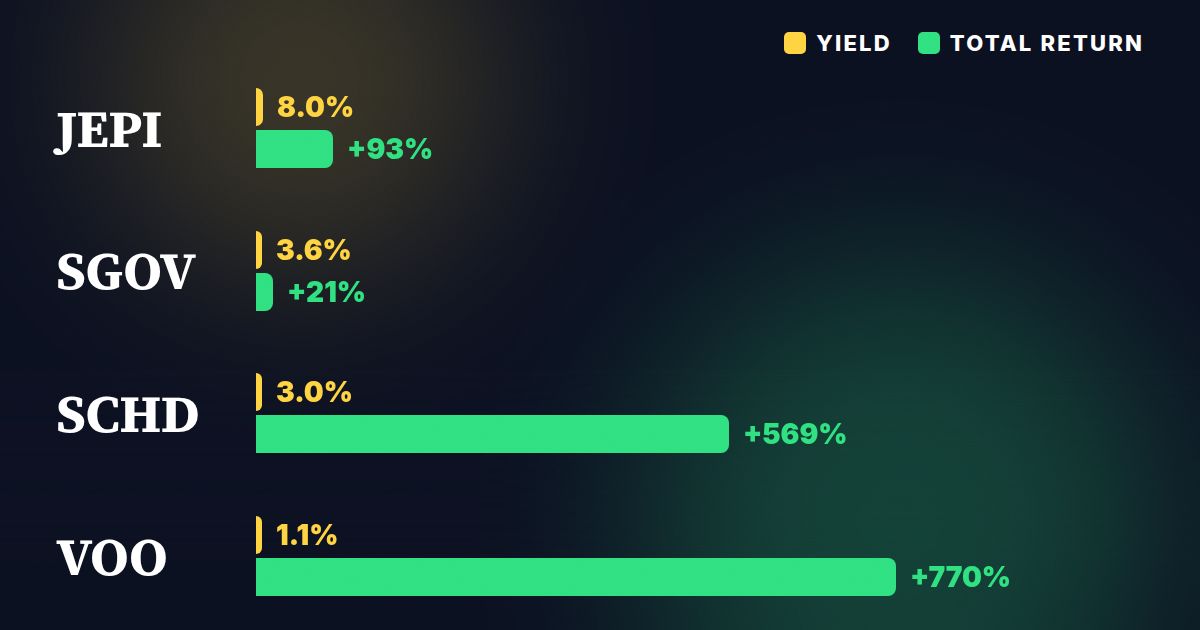
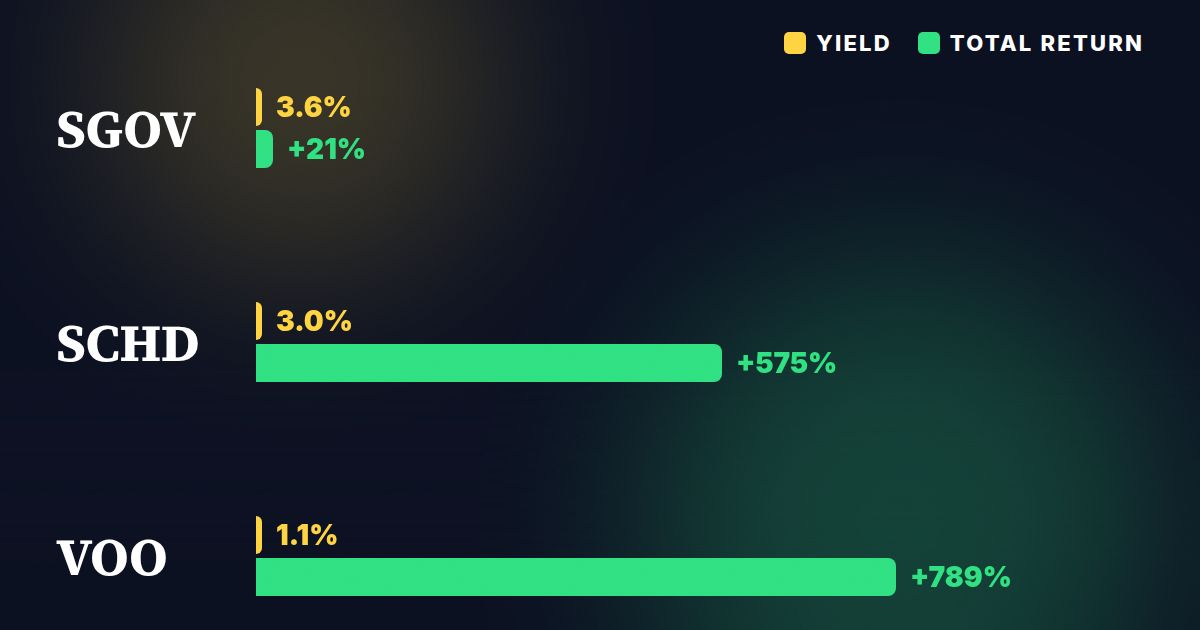
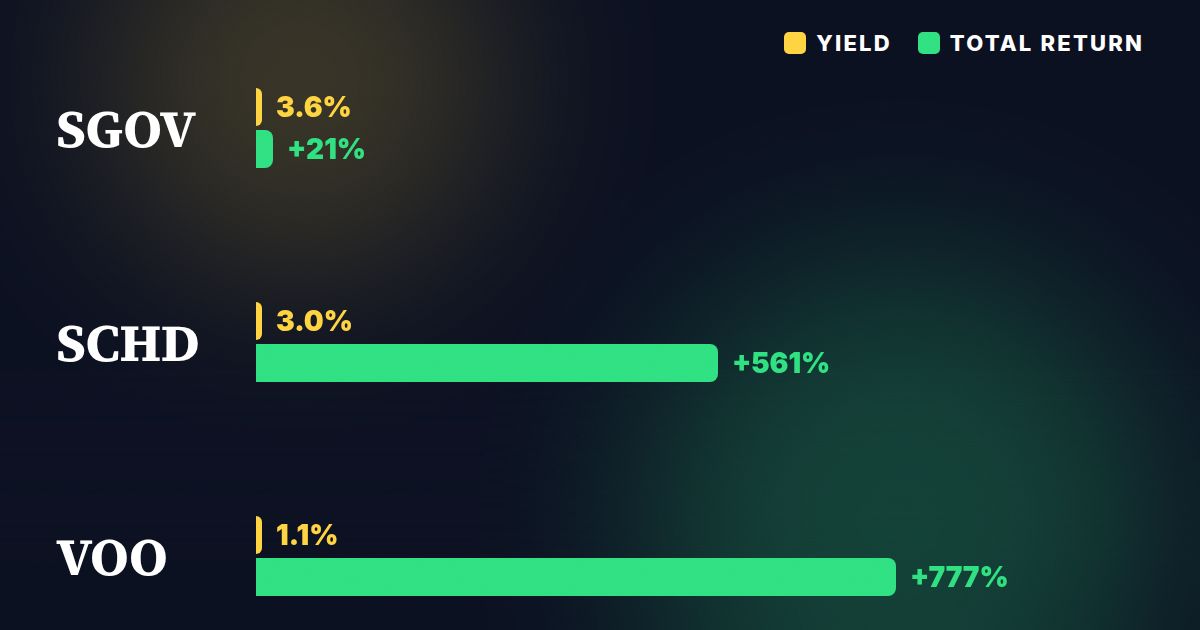
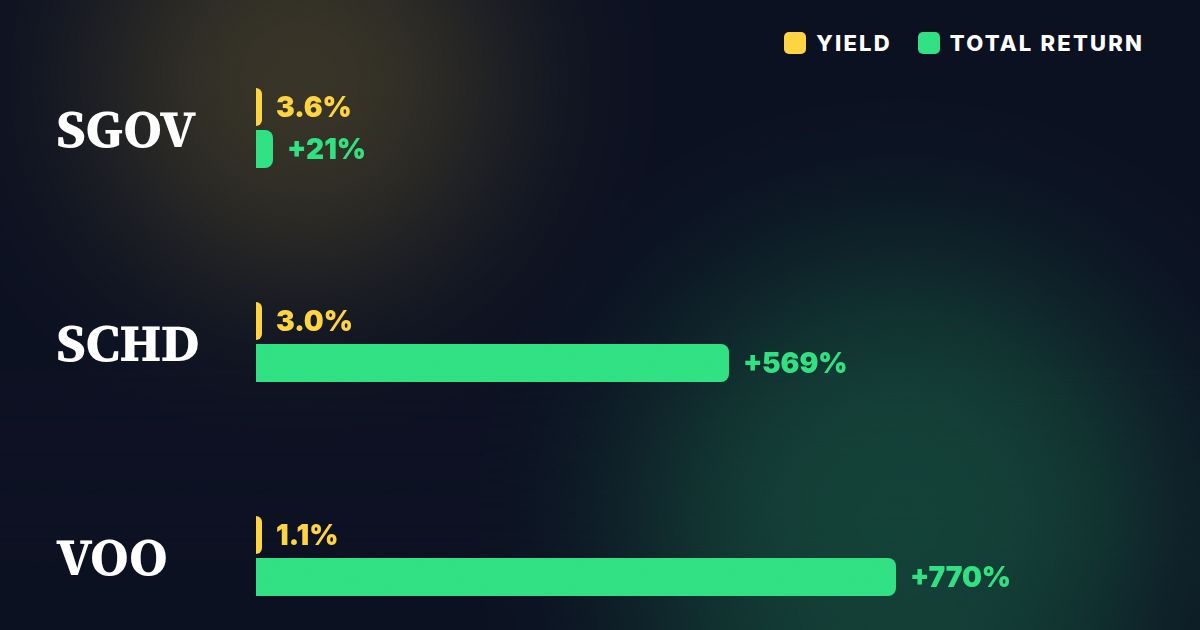
- Good fits for a taxable account: broad stock funds with modest yields and mostly qualified dividends, like VOO (yield 1.10%, fee 0.03%) or a dividend growth fund like SCHD (yield 3.00%, fee 0.06%). These are examples, not recommendations.
There is a trade-off to know about. Money inside a traditional IRA is eventually taxed as ordinary income when you withdraw, even if it came from stock gains that would have enjoyed lower rates in a taxable account. So the "stocks in taxable, bonds in IRA" rule is a starting point, not a law. Your tax bracket now versus later, your time horizon and how much you hold in each account all matter.
A few more details worth knowing:
- Interest from US Treasury funds is generally subject to federal income tax but often exempt from state and local income tax. Some states have conditions, so confirm yours. That can make a T-bill fund more attractive in a taxable account for people in high tax states.
- Municipal bond funds pay interest that is generally exempt from federal income tax, which can make them a fit for taxable accounts in high brackets. They are usually not useful inside an IRA, since the tax break is wasted there.
- Real estate funds and many covered call or option income funds often pay a larger share as ordinary income or return of capital. Read each fund's tax breakdown before deciding where it goes.
For how bond funds behave on the price side, see what happens to bond ETFs when interest rates fall or rise.
Step by step: how to cut your dividend tax bill
- Pull your last Form 1099-DIV or your broker's dividend report. Compare box 1a (total) to box 1b (qualified). That gap is your starting point.
- List every fund and the account it sits in. Mark each as mostly stock, mostly bond or cash, or mostly option income.
- Identify ordinary income funds in your taxable account. These are the first candidates to move into an IRA or 401(k).
- Move them the right way. Do not sell in the taxable account unless you have checked the gain. Instead, direct new contributions to the IRA to buy the bond fund, and use new taxable money for stock funds. Over time this rebalances the location without a big tax event.
- Hold long enough. Avoid buying and selling around ex-dividend dates so payouts stay qualified.
- Check your bracket each year. In low income years, you may be in the 0% qualified bracket and can plan around it. Confirm current thresholds before relying on them.
- Keep records. Note the cost basis of shares you buy through reinvestment, because reinvested dividends are still taxed in the year paid.
Worked example: same $100,000, different tax bill
These numbers are hypothetical assumptions to show the mechanics, not a forecast. Assume you are in the 24% ordinary tax bracket and the 15% qualified dividend bracket, and that every fund below generates $3,000 of income a year on a $100,000 position. Live yields today differ by fund, so treat the $3,000 as a round number. For reference, SCHD currently shows a yield of 3.00% and SGOV shows 3.64%.
| Setup | Income | Tax rate | Tax |
|---|---|---|---|
| Stock fund, taxable (qualified) | $3,000 | 15% | $450 |
| Bond or T-bill fund, taxable | $3,000 | 24% | $720 |
| Bond or T-bill fund, in IRA | $3,000 | 0% now | $0 now |
Now take a $200,000 portfolio split evenly: $100,000 in a stock fund and $100,000 in a bond fund, both producing $3,000 a year.
- Both in taxable: $450 plus $720 equals $1,170 of tax per year.
- Bond fund in IRA, stock fund taxable: $450 of tax per year.
That is $720 a year saved on identical holdings, or $7,200 over ten years if nothing changed, before counting growth on the money you did not send to the IRS. The catch: the IRA income is taxed later as ordinary income when withdrawn from a traditional IRA, so the benefit is mainly deferral, plus the chance that your bracket is lower at withdrawal. In a Roth IRA, the benefit can be permanent. Contribution limits and eligibility rules apply, so check current limits.
Common mistakes
- Chasing yield without checking the tax label. A higher yield can be mostly ordinary income. After tax, a smaller qualified yield can keep more in your pocket. Always look at total return and the tax breakdown, not just the headline yield.
- Selling a big winner in taxable just to relocate it. The capital gains tax from the sale can exceed what you save. Use new contributions instead.
- Forgetting that reinvested dividends are taxed. Automatic reinvestment does not make the dividend tax free. It just buys more shares with the after-tax payout, and you still owe the tax.
- Trading around ex-dividend dates. Short holds can disqualify payouts.
- Putting muni funds in an IRA. You give up a tax break you were not going to use.
- Ignoring state tax. Federal rates are only part of the picture. Treasury interest, municipal interest and state rules vary.
- Letting tax drive the whole decision. A fund that fits your goals and risk level matters more than saving a few hundred dollars.
Edge cases to know
- Foreign stock funds: Many pass through qualified dividends, but a portion can be non-qualified depending on the countries involved. Foreign tax paid may be claimable as a credit in a taxable account, though not usually in an IRA.
- Retirees: Dividend income raises taxable income, which can affect how much of your Social Security is taxed and may affect Medicare premiums. Plan withdrawals across accounts. Our guide on safe retirement withdrawals and the 3 bucket strategy show how to organize this.
- Low yield funds: A fund like VOO pays a small dividend relative to its price, so less of your return is taxed each year. Growth shows up as price gains, which are only taxed when you sell.
- Capital gains distributions: Some funds also pass out capital gains. ETFs tend to do this less than mutual funds, but it can happen. Check your 1099.
Checklist
- Compare box 1a and box 1b on your 1099-DIV.
- Label each fund as stock, bond or cash, or option income.
- Put ordinary income funds in IRAs or 401(k)s first.
- Keep qualified dividend funds in taxable accounts where it makes sense.
- Hold shares well past the 60 day mark.
- Use new contributions to fix location instead of selling winners.
- Confirm current brackets, thresholds and your state rules.
If you want to see what a given portfolio might pay before tax, try our calculators or Dividend Projection. For a side by side look at two common funds, see SCHD vs VOO.
FAQ
Are ETF dividends taxed as qualified dividends?
Often, if the fund holds US stocks and you meet the holding period. The fund reports the qualified share on your 1099-DIV, and it varies by fund. Bond and T-bill fund payouts are generally interest and taxed as ordinary income.
How long do I have to hold an ETF for dividends to be qualified?
In general, more than 60 days during the 121 day period that begins 60 days before the ex-dividend date, for common stock funds. Some other share types need longer. Confirm with the IRS or a tax professional.
Do I pay tax on dividends if I reinvest them?
Yes. In a taxable account, reinvested dividends are taxed in the year they are paid, just as if you had taken the cash.
Do I pay tax on dividends inside an IRA?
Not while the money stays inside. In a traditional IRA you pay ordinary income tax on withdrawals. In a Roth IRA, qualified withdrawals are generally tax free. Rules and limits apply.
Is there a way to pay 0% tax on dividends?
Yes, if your taxable income falls under the current 0% qualified dividend threshold for your filing status. That can happen in low income years. Check the current threshold on the IRS site.
Should I hold SCHD or a bond ETF in my IRA?
It depends on your situation. As a general rule, bond income is taxed more heavily than qualified stock dividends, so bond funds are common IRA holdings. This is not a buy or sell signal.
Benjie's bottom line
You do not need a complicated strategy to pay less tax on dividends. Know which of your payouts are qualified, hold long enough to keep them that way, and put the heavily taxed income in accounts that shelter it. That alone can save hundreds or thousands a year at the same level of risk.
But tax is one input, not the whole plan. Do not hold a fund you do not believe in just to save on taxes, and do not move big positions without checking the capital gains hit. This isn't tax advice, and rules change. Do your own due diligence and talk to a tax professional about your specific numbers.
ETFs in this story
How this article was made: Benjie picks every topic based on what he finds useful as a dividend investor and what readers ask about. Parts of this article were drafted with help from AI tools, then edited, fact-checked and shaped by Benjie. All fund numbers come from the TopETFs database and update daily.
Disclaimer: TopETFs.com is published by Dividend Empire LLC for educational and entertainment purposes only. We are not financial advisors, and nothing on this site is financial advice, a recommendation, or a solicitation to buy or sell any security. ETF data is compiled from public sources and fund issuers, may be delayed, inaccurate or outdated, and may differ from the fund sponsor's own figures. Yields are trailing distribution yields, are not guaranteed, and distributions may include return of capital, which reduces your cost basis and is not a measure of performance. Total returns are since each fund's inception unless noted and are not comparable across funds with different start dates. Past performance does not guarantee future results. Investing carries risk, including loss of principal. Read each fund's prospectus and consult a licensed financial advisor before investing. Dividend Empire LLC receives compensation from ETF issuers for sponsored placements, which are labeled as such.