Do You Pay Taxes on ETFs Every Year, Even If You Don't Sell?
Do you pay taxes on ETFs every year if you never sell? In a taxable account, often yes. See what gets taxed, what doesn't, and a 1099-DIV example.
The short version
- In a regular taxable brokerage account, you can owe tax every year on an ETF you never sold, because dividends and capital gain distributions are taxable when they are paid.
- Selling is a separate taxable event. The price gain on your shares is only taxed when you sell, not while you hold.
- Inside a traditional IRA, Roth IRA or 401(k), you do not owe yearly tax on ETF payouts. Taxes follow that account's own rules.
Yes, you can pay taxes on ETFs every year even if you never sell a single share. In a taxable brokerage account, the dividends your ETF pays and any capital gain distributions it makes are taxable for that year. The rising share price is not taxed until you sell.
That surprises a lot of people. They think "no sale, no tax." That's true for the price change on your shares. It is not true for the cash (or reinvested cash) the fund sends you along the way.
Let's walk through exactly what gets taxed, what doesn't, and what it looks like on a real tax form with dollar amounts.
What gets taxed every year in a taxable account
Three things can create a tax bill while you simply hold an ETF.
1. Dividends
Most ETFs collect dividends or interest from the stocks or bonds they own and pass that income to you. Even if you never touch that cash, it counts as income for the year it was paid. For a refresher on how those payments work, see how ETF dividends work.
Dividends come in two flavors for tax purposes:
- Qualified dividends are usually taxed at the lower long-term capital gains rates. Many dividends from U.S. stocks held long enough qualify.
- Ordinary (non-qualified) dividends are taxed like regular income. Interest from bond and Treasury ETFs generally falls here.
2. Capital gain distributions
Sometimes the fund itself sells holdings at a profit and has to pass those gains on to shareholders. That payout is a capital gain distribution. You owe tax on it even though you didn't sell anything. Most broad index ETFs make few or none, thanks to how ETFs create and redeem shares, but it can happen, and it happens more with actively managed or more complex funds. Don't assume it's zero. Check the fund's history.
3. Other pass-through items
Depending on the fund, you might also see foreign tax paid, return of capital, or special categories for REIT or option income. These are details, but they show up on your tax form, so they matter.
What is not taxed until you sell
The price appreciation of your shares. If you buy an ETF at $100 and it rises to $150, you owe nothing on that $50 while you hold. This is called an unrealized gain.
The tax shows up when you sell. Then you have a realized gain (or loss), and it's reported to the IRS by your broker. Hold for more than one year and it is generally a long-term gain, which usually gets lower rates than short-term gains. Hold a year or less and it is generally short-term, taxed like ordinary income. Confirm current rates and rules for your situation, since they change.
If you're wondering when you can use the cash from a sale, that's a different topic. I cover it in how long an ETF sale takes to settle.
What about reinvested dividends?
Reinvesting does not dodge the tax. If your broker automatically uses a dividend to buy more shares (a DRIP), the dividend is still taxable income that year. You just never saw the cash.
The good news: those reinvested dollars raise your cost basis (what you paid in total). A higher basis means a smaller taxable gain when you eventually sell. Most brokers track this for you, but it's smart to confirm they are.
Taxable account vs. IRA vs. Roth IRA
Where you hold the ETF changes everything.
| Account | Yearly tax on payouts? | Tax on selling? |
|---|---|---|
| Taxable brokerage | Yes | Yes, on gains |
| Traditional IRA / 401(k) | No | No, tax comes at withdrawal |
| Roth IRA | No | No, if qualified rules are met |
Inside an IRA you can generally buy, sell and collect dividends without creating a yearly tax bill. With a traditional IRA, withdrawals are taxed later. With a Roth IRA, qualified withdrawals are generally tax-free. Contribution limits and withdrawal rules apply, so check the current ones. If you're weighing income funds for a Roth, I wrote about that in which dividend ETFs make sense in a Roth IRA.
Worked example: a $10,000 holding and its 1099-DIV
Each January or February, your broker sends a Form 1099 with a 1099-DIV section listing what your funds paid you. Here's what that could look like for a $10,000 position. These are hypothetical assumptions to show the mechanics, not a forecast for any fund.
Assume: a broad stock index ETF yields 1.5% for the year, and 90% of that income is qualified. It makes no capital gain distribution. The price rises from $10,000 to $10,800, and you don't sell.
| Item | Amount | Taxed this year? |
|---|---|---|
| Total dividends paid | $150 | Yes |
| Of which qualified | $135 | Yes, lower rate |
| Price gain ($800) | $800 | No, not sold |
On the 1099-DIV, you'd see roughly $150 in Box 1a (total ordinary dividends) and $135 in Box 1b (qualified dividends). Box 2a (capital gain distributions) would be $0. You owe tax on the $150 of dividends, with $135 of it at the qualified rate. The $800 gain stays unrealized.
Now compare a bond-style holding. Assume a $10,000 Treasury or bond ETF pays 4% in interest-type dividends. That's $400, mostly ordinary dividends, taxed at your regular income rate. There's less price growth to defer, so more of your return gets taxed each year. Federal treatment of Treasury interest differs from state treatment (many states don't tax interest from U.S. Treasuries, with details that vary), so check your state.
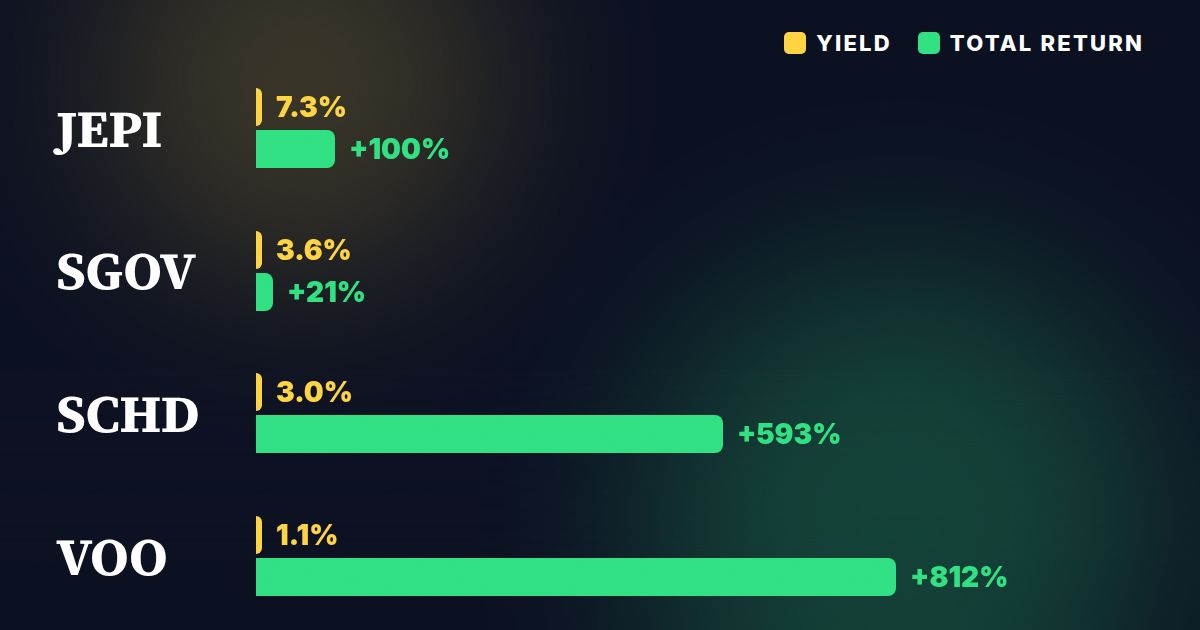
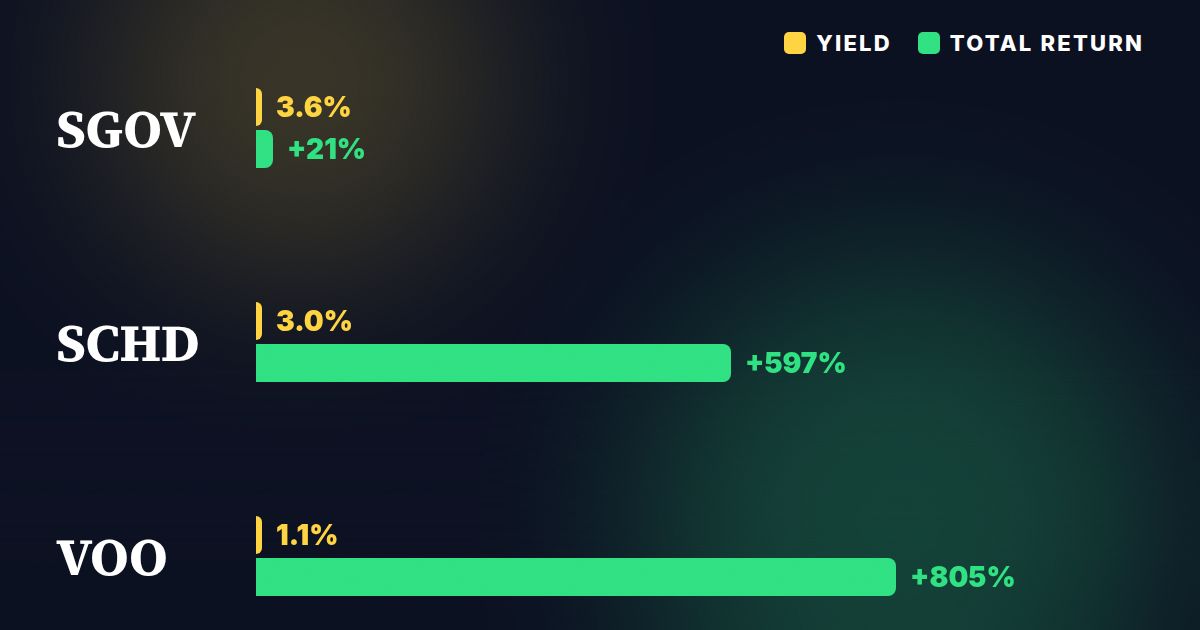
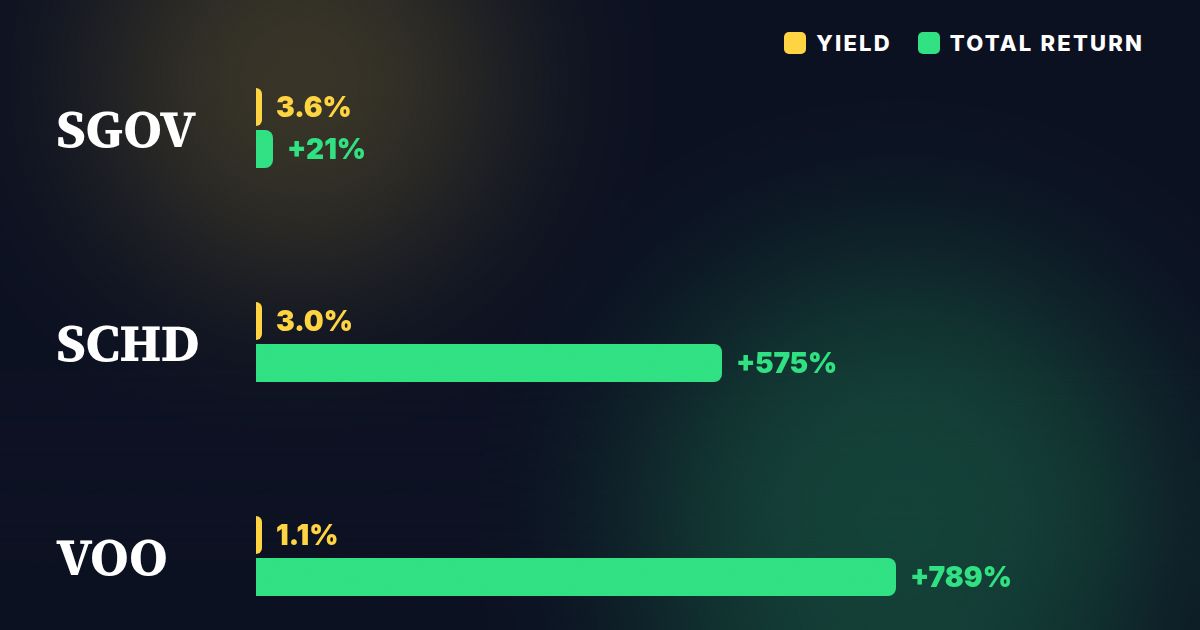
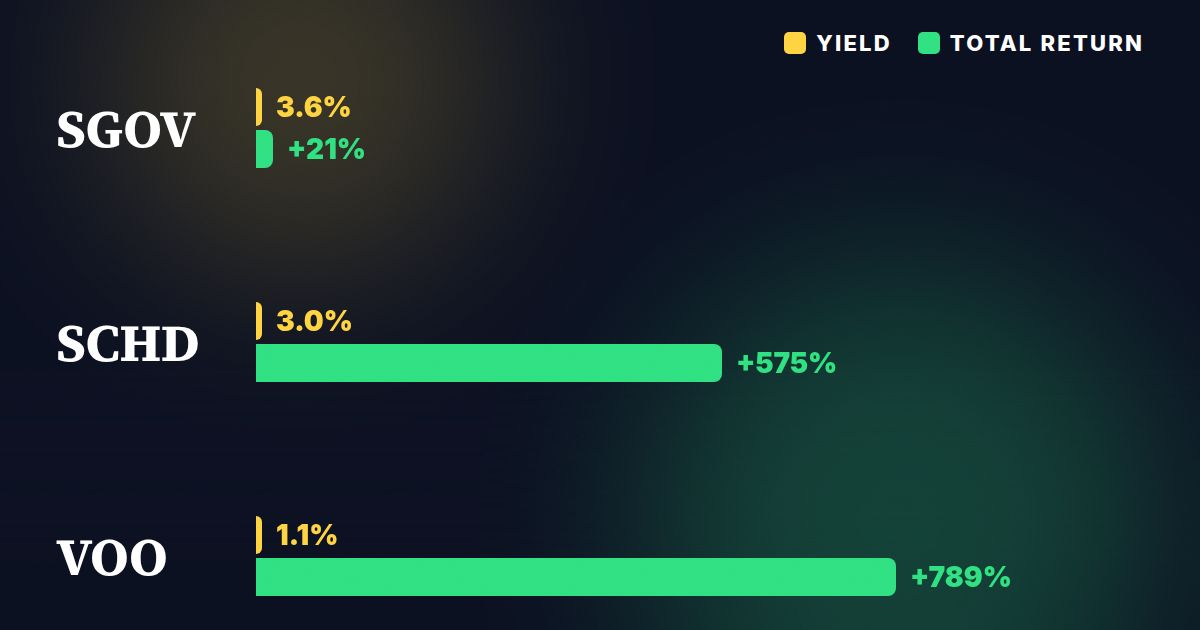
To give you a sense of how income levels differ across funds, as of today VOO shows a yield of 1.10%, SCHD shows 3.00%, and SGOV shows 3.64%. A higher yield generally means a bigger yearly taxable payout in a taxable account. That's not good or bad by itself. It's just the tax timing trade-off. This isn't a buy or sell signal.
And the year you sell
Say two years later you sell for $12,000. Your basis is $10,000 (plus any reinvested dividends). Suppose none were reinvested. Your gain is $2,000, reported on a 1099-B. Because you held more than a year, it's generally long-term. You'd owe tax on the $2,000 at the long-term rate that applies to you. The yearly dividend tax you already paid along the way is separate and was already settled.
Step by step: how to see and plan for your ETF tax bill
- Identify the account type. Taxable, IRA, Roth IRA or 401(k). Only the taxable account creates yearly tax on payouts.
- Find your forms. Look for the 1099 package from your broker, usually available in late January to March. Look at the 1099-DIV and 1099-B sections.
- Read the key boxes. Box 1a is total ordinary dividends. Box 1b is qualified dividends. Box 2a is capital gain distributions. Box 3 is nondividend distributions (often return of capital). Box 7 is foreign tax paid.
- Check your cost basis. Make sure reinvested dividends were added to the basis on your records.
- Estimate before the year ends. Add up your expected dividends and any planned sales to see roughly what you'll owe. If your payouts are large, ask a tax professional whether estimated payments make sense.
- Consider asset location. Where possible, some investors put higher-income funds in tax-advantaged accounts and lower-distribution funds in taxable accounts. This is a general idea, not advice for your situation.
Common mistakes
- Thinking reinvested dividends aren't taxed. They are. You just didn't get the cash to pay the tax, so keep some set aside.
- Ignoring the year-end capital gain distribution. Some funds pay these in December. Buying right before can leave you with a taxable payout on gains you didn't earn.
- Forgetting cost basis. If you don't track reinvested dividends, you may overpay when you sell.
- Chasing yield in a taxable account without checking the tax cost. A high yield can mean a bigger yearly tax bill, and a shiny number can hide price decay. Look at total return, not just income.
- Assuming an IRA is tax-free forever. A traditional IRA defers tax. You usually pay when you withdraw.
- Selling just to "lock in" and not thinking about taxes. A sale creates a taxable event in a taxable account.
Edge cases worth knowing
- Low-income years. Some people owe little or no tax on qualified dividends and long-term gains depending on income. Rules and thresholds change, so check the current numbers.
- Option income and special structures. Funds that use options, hold commodities or use futures can have different tax treatment. One example is covered in Section 1256 ETFs and taxes.
- Leveraged funds. Funds like TQQQ behave differently from plain index funds, and their tax picture can differ too. If you trade them often, short-term gains can add up fast.
- State taxes. Most states tax investment income too, with rules that vary widely.
- Fees. Costs like the expense ratio (VOO is 0.03%) are baked into the fund's returns, and they aren't a separate tax item. They just reduce what you earn. See expense ratio math for how that compounds.
Checklist
- Is the ETF in a taxable account or a retirement account?
- Did I get my 1099 and read Boxes 1a, 1b, 2a and 3?
- Are reinvested dividends included in my cost basis?
- Do I have cash set aside to cover the tax on payouts?
- Before selling, do I know whether the gain is short-term or long-term?
- Should I run this by a tax professional?
If you want to see how much income a portfolio might throw off (and so how much could be taxable), try Dividend Projection or the calculators on our tools page.
FAQ
Do I pay taxes on ETFs if I don't sell?
In a taxable account, yes, on the dividends and capital gain distributions the ETF pays. You don't pay tax on the price gain until you sell.
Do I pay taxes on reinvested ETF dividends?
Yes. Reinvested dividends are still taxable income for that year. They do increase your cost basis, which helps when you sell later.
Are ETFs taxed more than mutual funds?
Often ETFs distribute fewer capital gains because of how shares are created and redeemed, but that's a tendency, not a rule. Both are taxed on dividends in a taxable account.
Do I pay taxes on ETFs in a Roth IRA?
Not on yearly dividends or trades inside the account. Qualified Roth withdrawals are generally tax-free, but contribution and withdrawal rules apply.
How do I know how much ETF tax I owe?
Check the 1099-DIV and 1099-B your broker sends. Those forms list your dividends, capital gain distributions and any sales. A tax professional or tax software can finish the math.
Which ETF is more tax efficient?
Funds with lower yields and few distributions tend to create smaller yearly bills in a taxable account. Tax efficiency is only one factor, so look at the whole picture, including income funds and growth funds side by side.
My bottom line
Owning an ETF in a taxable account is not a tax-free wait. Dividends and capital gain distributions can create a bill every year, while price gains are deferred until you sell. In an IRA or Roth IRA, that yearly bill goes away.
So match the fund to the account, track your cost basis, and keep some cash aside for tax season. I'm not a tax professional, and this isn't a buy or sell signal. Rules, rates and thresholds change, so do your own due diligence and check with a tax pro about your specific situation. If you're new to all of this, start with what an ETF is and how ETFs work.
ETFs in this story
How this article was made: Benjie picks every topic based on what he finds useful as a dividend investor and what readers ask about. Parts of this article were drafted with help from AI tools, then edited, fact-checked and shaped by Benjie. All fund numbers come from the TopETFs database and update daily.
Disclaimer: TopETFs.com is published by Dividend Empire LLC for educational and entertainment purposes only. We are not financial advisors, and nothing on this site is financial advice, a recommendation, or a solicitation to buy or sell any security. ETF data is compiled from public sources and fund issuers, may be delayed, inaccurate or outdated, and may differ from the fund sponsor's own figures. Yields are trailing distribution yields, are not guaranteed, and distributions may include return of capital, which reduces your cost basis and is not a measure of performance. Total returns are since each fund's inception unless noted and are not comparable across funds with different start dates. Past performance does not guarantee future results. Investing carries risk, including loss of principal. Read each fund's prospectus and consult a licensed financial advisor before investing. Dividend Empire LLC receives compensation from ETF issuers for sponsored placements, which are labeled as such.