ETF Trading at a Premium to NAV: What It Means and When It Matters
An ETF trading at a premium to NAV means its price is above its holdings' value. Learn why it happens, how to check it, and how limit orders protect you.
The short version
- An ETF trades at a premium when its market price is above its NAV (the value of what it holds, per share). A discount is the opposite.
- For big, plain funds the gap is usually tiny and short-lived. It gets larger with illiquid holdings, closed overseas markets and market stress.
- You can check it on the issuer's fund page, and a limit order is the simplest way to avoid overpaying when a gap shows up.
An ETF trading at a premium to NAV means you would pay more per share than the underlying holdings are worth at that moment. NAV stands for net asset value, which is the total value of the fund's holdings (minus its liabilities) divided by the number of shares. Most of the time the premium is a few cents and does not matter. Sometimes it does, and it helps to know when.
NAV vs market price: two different numbers
An ETF has two prices, and people mix them up all the time.
NAV is what the basket of stocks or bonds inside the fund is worth, divided by shares outstanding. Most funds calculate it once a day, after the market closes, using closing prices of the holdings.
Market price is what the ETF shares trade for on the exchange right now. It moves every second, set by buyers and sellers, just like a stock. If you want a refresher on how that works, my guide on how an ETF actually works walks through it.
The premium or discount is just the gap between the two:
(market price minus NAV) divided by NAV
If the result is positive, the ETF trades at a premium. If it is negative, it trades at a discount. A fund can flip between the two several times in one day.
Why the gap stays small for most ETFs
ETFs have a built-in repair mechanism. Large financial firms called authorized participants can create or redeem big blocks of ETF shares by swapping them for the underlying holdings (or cash, in some funds).
Say an ETF's price drifts above the value of its holdings. An authorized participant can deliver the basket of holdings to the fund, receive new ETF shares, and sell those shares at the higher price. That extra supply pushes the price back toward NAV. The same trick works in reverse when the price falls below NAV.
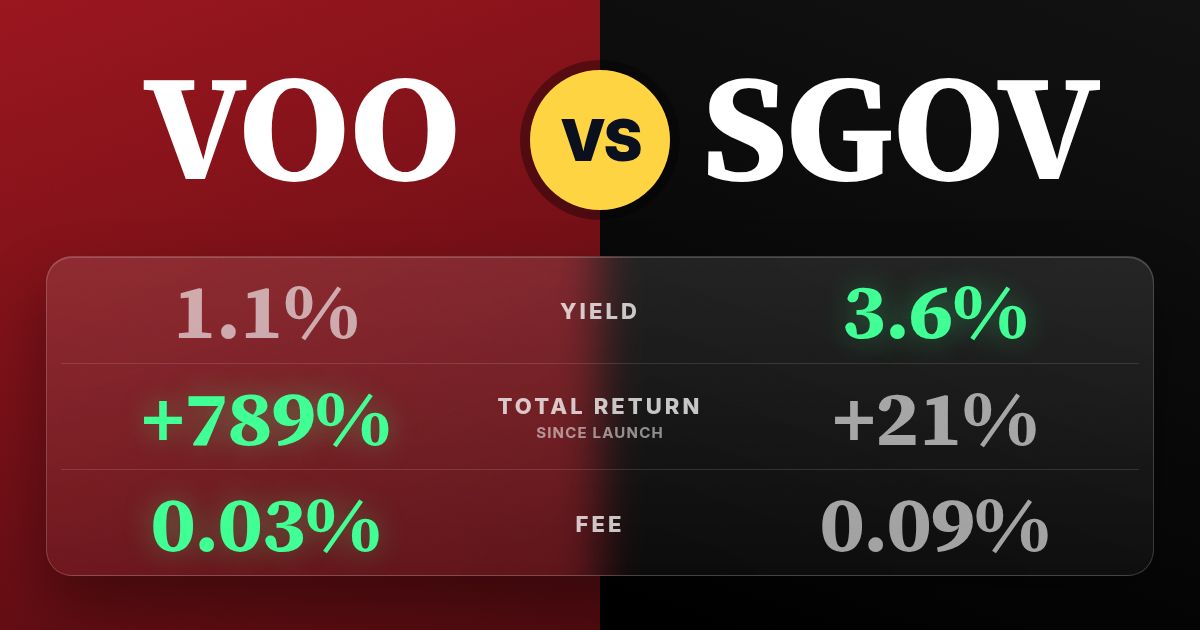
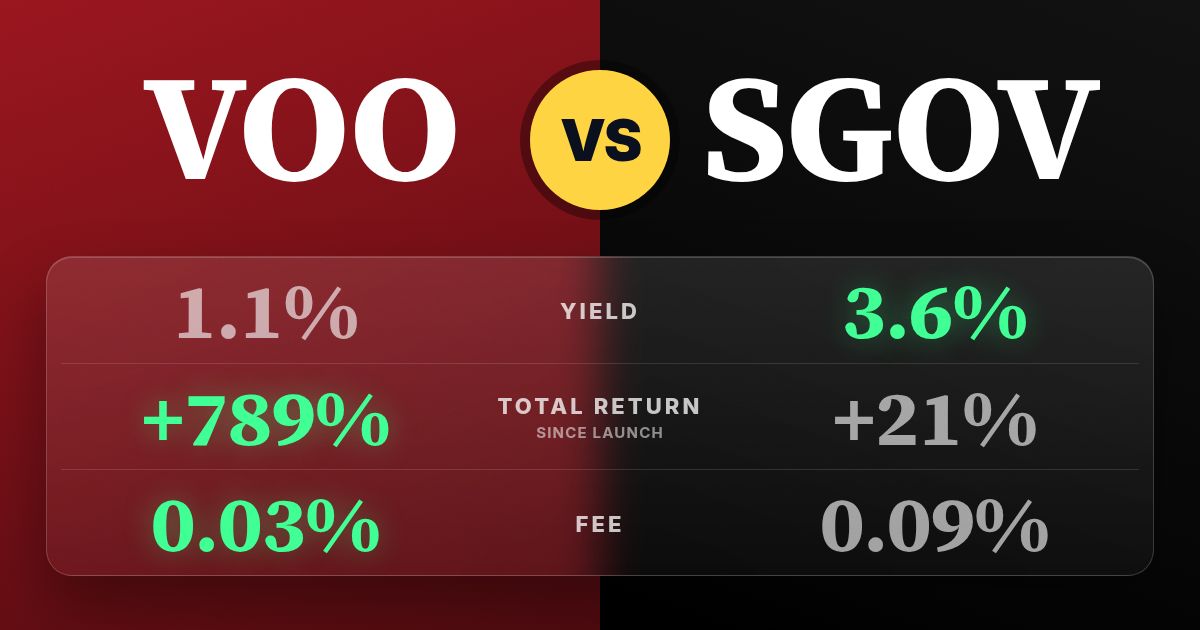
This is why a giant fund like VOO, with $1.07T in assets and holdings that trade constantly, tends to sit very close to its NAV. The arbitrage is easy, cheap and fast.
Why premiums (and discounts) appear
The repair mechanism works best when the holdings are easy to price and easy to trade. When they are not, the gap can widen. Here are the main causes.
1. The underlying assets are hard to trade
Bond funds are the classic example. Many individual bonds trade only a few times a day, and their prices are estimates. So the NAV itself is a best guess, and the ETF can trade a bit above or below it while the market decides what the bonds are really worth. High yield bonds, emerging market debt and niche assets show wider gaps than plain Treasury funds.
2. The overseas market is closed
Say you look at a Japan or Europe ETF during the US trading day. The foreign stocks inside are not trading, so the NAV is based on old prices. The ETF's US price, meanwhile, reflects fresh news. The gap you see is often not a real overpayment. It is a stale NAV catching up. The next morning, when the overseas market opens, the NAV usually moves toward the ETF price.
This is worth knowing before you panic about a premium on an international fund. Check whether the foreign market was open first.
3. Market stress
When markets get rough, buyers and sellers pull back, spreads widen and authorized participants have a harder time doing arbitrage. In sharp selloffs, some bond ETFs have traded at noticeable discounts to NAV because the ETF price reflected selling pressure faster than the bond prices behind the NAV did. Premiums can show up in the other direction too, when everyone rushes into one corner of the market.
4. Heavy demand for a niche fund
Small, specialized or thinly traded funds can drift from NAV when a wave of buyers hits and few shares are available at the best price. Leveraged and themed funds are more prone to this than broad index funds.
5. The opening and closing minutes
The first few minutes after the open are messy. Prices are still settling, spreads are wide and NAV may not line up. Trading in that window is a common way to get a worse price than you expected.
How to check the premium or discount, step by step
- Go to the issuer's page for the fund. Search the fund name on Vanguard, iShares, Schwab, Invesco or whichever company runs it. Do not rely on a random third-party site for this.
- Find the NAV section. Look for a heading such as "Price and NAV," "Premium/Discount" or "Fund data." Many issuers show the latest NAV, the market price at close and the difference.
- Look at the history, not just today. Funds are required to publish premium and discount information for the past year, often as a chart or table. One day tells you little. A year tells you what is normal for that fund.
- Check the bid-ask spread. Issuer pages usually show a median bid-ask spread. That is the typical gap between what buyers bid and sellers ask, and it is a real cost every time you trade.
- Compare with your broker's live quote. Pull up the current bid and ask. If the spread looks much wider than usual, wait or use a limit order (more on that below).
- Look for an intraday estimate if you need one. Some data providers show an indicative NAV that updates during the day. It is an estimate, so treat it as a rough guide, especially for international and bond funds.
A worked example with dollar amounts
Here is a simple hypothetical. These numbers are assumptions to show the math, not data on any real fund.
| Item | Fund A | Fund B |
|---|---|---|
| NAV per share | $100.00 | $100.00 |
| Market price | $100.03 | $100.60 |
| Premium | 0.03% | 0.60% |
| Cost of 100 shares | $10,003 | $10,060 |
| Holdings worth | $10,000 | $10,000 |
| Extra you paid | $3 | $60 |
Fund A is a rounding error. Fund B is a real cost: you paid $60 for $10,000 of holdings.
Now put that next to fees. A fund with a 0.03% expense ratio (the same as what VOO charges, at 0.03%) costs $3 per year on $10,000. A 0.60% premium is twenty times that, paid on day one. It can fade if the premium closes, which means you could lose it on the way out, or it can shrink if you were lucky on timing. Either way, the cost is real. If you want to see how fees add up over decades, check the expense ratio math guide.
Now the same trade with a limit order at $100.10. If the price never reaches that level, the order does not fill and you have lost nothing but a little time. If it does fill, you paid at most $10 over NAV, not $60.
Why limit orders matter here
A market order says "fill me at whatever price is available right now." A limit order says "fill me only at this price or better."
When the ETF is liquid and the spread is a penny wide, the difference between the two is tiny. When the spread is wide, the market is stressed or the fund is thinly traded, a market order can fill at a price you never expected. A limit order puts a ceiling on what you pay (when buying) or a floor on what you receive (when selling).
A few practical habits:
- Set your limit near the current ask for a buy, or near the current bid for a sell, then adjust if it does not fill.
- Avoid the first 15 to 30 minutes after the open and the last few minutes before the close for anything but the most liquid funds.
- Be careful with limit orders placed outside regular hours. Liquidity is thin and prices can look odd. I covered this in what happens when you try to sell after the market closes.
- For international and bond funds, pay extra attention on volatile days.
Premium to NAV: when it matters and when it does not
It usually does not matter if you hold a broad, heavily traded fund for years, you trade at a calm time of day and the premium is a few hundredths of a percent. The cost is small and random.
It matters more when:
- You are trading a bond, high yield, emerging market or niche fund.
- The market is moving fast, either up or down.
- You are placing a large order relative to the fund's normal volume.
- You plan to trade often, because small gaps repeat.
- The fund has a history of wider-than-normal premiums on its issuer page.
Short-term Treasury funds like SGOV (fee 0.09%) are meant to be boring, and their price usually tracks NAV closely. But I would still check the spread on any fund on the day I trade it. It takes a minute.
Common mistakes
- Confusing NAV with price. The number on a fund's fact sheet may be yesterday's NAV. Your trade happens at today's market price.
- Reading a premium on an international fund as a rip-off. Often the NAV is stale because the foreign market was closed.
- Using market orders in wide-spread funds. This is the most common way to overpay without noticing.
- Trading at the open. Prices are still settling and spreads are widest.
- Judging a fund by one day's gap. Look at the one-year history on the issuer page.
- Ignoring the spread because the fee is low. A 0.03% expense ratio does not help if you give up 0.5% on entry and exit.
Quick checklist before you place an ETF order
- Is this a broad, liquid fund or something niche?
- Are the underlying markets open right now?
- What does the issuer page say about the premium and discount history?
- How wide is the bid-ask spread on my broker's screen?
- Have I set a limit price instead of using a market order?
- Am I avoiding the first and last few minutes of the session?
If you want to compare funds on cost before you trade, the ETF screener lets you filter by fee and size. For a refresher on the basics, start with what an ETF is.
FAQ
Is it bad if an ETF trades at a premium to NAV?
Not automatically. A tiny premium is normal and usually disappears quickly. A large or persistent one means you may be overpaying, so it is worth checking the spread and using a limit order.
Can an ETF trade at a discount to NAV?
Yes. When the market price is below NAV, the ETF trades at a discount. It happens most with illiquid holdings and during stressed markets, and it can be a problem if you need to sell then.
Where do I find an ETF's NAV and premium?
On the issuer's fund page, usually under a heading such as price and NAV or premium/discount. Many issuers show the past year of history and the median bid-ask spread.
Do I lose money if I buy at a premium and the premium disappears?
You can. If you pay $100.60 for shares backed by $100.00 of holdings and the gap closes, that portion of the price is gone, apart from whatever the holdings did. That is why entry price matters.
Why is my international ETF at a premium when I check it?
Often because the foreign market is closed and the NAV is based on old prices, while the ETF has traded on newer information. It can look like a premium without being a real one.
Is an ETF premium the same as a closed-end fund premium?
No. Closed-end funds do not have the same creation and redemption process, so their premiums and discounts can last much longer and be much larger. ETFs have a mechanism that pulls the price back toward NAV.
Benjie's bottom line
For the big, boring funds most people own, the premium to NAV is a footnote. For bond, international and niche funds, or on volatile days, it can be a real cost, and it is easy to avoid with a quick look at the issuer page and a limit order.
This is not a buy or sell signal, just a way to avoid paying more than you have to. Check your own situation, and if taxes or account rules are part of your decision, talk to a qualified professional. If you are thinking about what else affects your results, my piece on how ETFs are taxed is a good next read, and the TopETFs calculators can help you test the numbers.
ETFs in this story
How this article was made: Benjie picks every topic based on what he finds useful as a dividend investor and what readers ask about. Parts of this article were drafted with help from AI tools, then edited, fact-checked and shaped by Benjie. All fund numbers come from the TopETFs database and update daily.
Disclaimer: TopETFs.com is published by Dividend Empire LLC for educational and entertainment purposes only. We are not financial advisors, and nothing on this site is financial advice, a recommendation, or a solicitation to buy or sell any security. ETF data is compiled from public sources and fund issuers, may be delayed, inaccurate or outdated, and may differ from the fund sponsor's own figures. Yields are trailing distribution yields, are not guaranteed, and distributions may include return of capital, which reduces your cost basis and is not a measure of performance. Total returns are since each fund's inception unless noted and are not comparable across funds with different start dates. Past performance does not guarantee future results. Investing carries risk, including loss of principal. Read each fund's prospectus and consult a licensed financial advisor before investing. Dividend Empire LLC receives compensation from ETF issuers for sponsored placements, which are labeled as such.