What Is an ETF? A Plain-English Guide for Your First Fund
What is an ETF? Learn how these funds work in plain English, see real examples like VOO and SCHD with live fees and yields, and what to check first.

The short version
- An ETF (exchange-traded fund) is a basket of investments, like stocks or bonds, that you buy and sell through a brokerage account just like a single stock.
- One share of a fund like VOO gives you a slice of hundreds of companies for a yearly fee of 0.03%, and SCHD pays a 3.2% yield on top of that.
- Before you buy any ETF, check what it holds, what it costs, how it has done in total return, and how it pays you.
So, what is an ETF? It is a fund that holds a collection of investments and trades on a stock exchange all day long. Instead of picking one company, you buy one share of the fund and own a small piece of everything inside it. VOO holds the biggest U.S. companies and charges 0.03% a year, while SCHD holds dividend-paying U.S. companies and currently yields 3.2%.
That's the whole idea. The rest of this guide is about how it works in real life, which numbers matter, and the mistakes I see beginners make. This isn't a buy or sell signal, just the homework I wish someone had handed me at the start.
Six ETFs, six different jobs, sorted by size
An ETF in one simple picture
Think of a fruit basket. You could buy one apple, one orange and one pear separately, or you could buy the basket in a single purchase. An ETF is the basket. The company that runs it (called the issuer or provider, like Vanguard or Schwab) decides what goes in, and you just buy a share of the whole thing.
The word "exchange-traded" simply means the fund's shares trade on a stock exchange. You can buy or sell during market hours at whatever the price is at that moment, the same way you would with Apple or Tesla stock.
Most ETFs follow an index. An index is a list of investments built by a rule, like "the 500 largest U.S. companies." A fund that copies the list automatically is called passive, which is a big reason its fees can be so low.
Why people use ETFs
There are three reasons ETFs became so popular, and they all matter for a first-time investor.
- Built-in diversification. Diversification means not putting all your eggs in one basket. If one company in the fund has a bad year, the rest can cushion the blow.
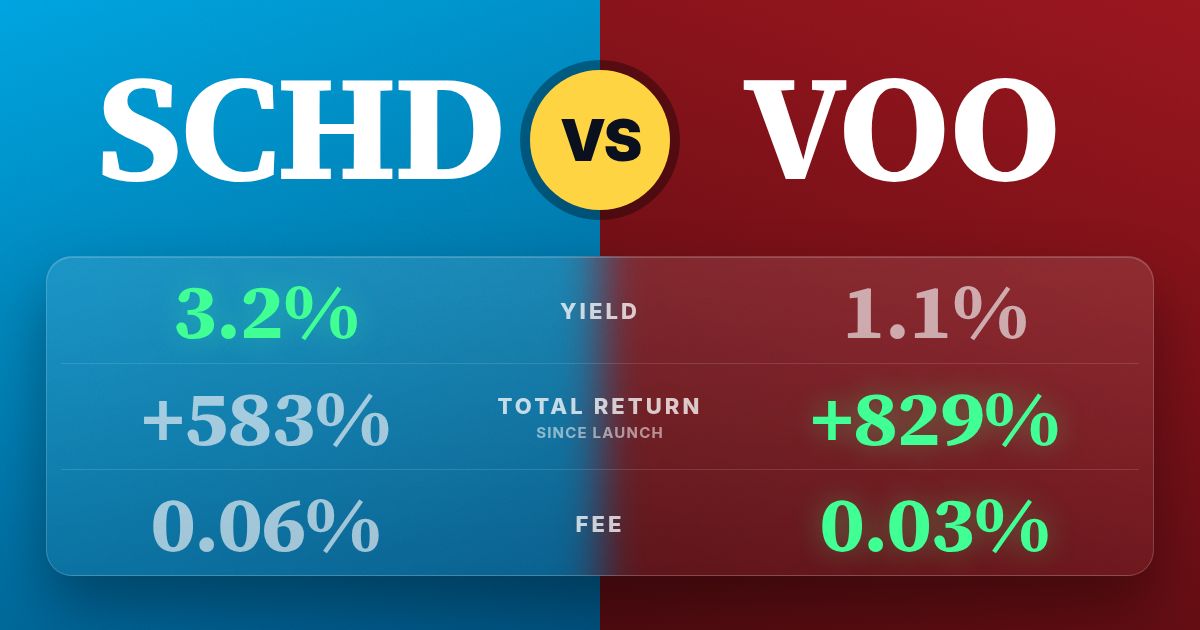
- Low cost. The expense ratio is the yearly fee, taken out of the fund automatically. VOO charges 0.03% and SCHD charges 0.06%. You never get a bill. It just comes out of the fund's returns.
- Simplicity. One ticker, one trade, one line in your account. A ticker is the short code a fund trades under, like VOO or SCHD.
If you want the mechanics behind the scenes, from your buy order to the fund itself, I walk through that in how an ETF actually works.
ETF vs stock vs mutual fund
A stock is a single company. An ETF is a basket of many. A mutual fund is also a basket, but it usually prices once a day after the market closes, and many charge higher fees or have minimum investments. ETFs trade all day and you can usually start with the price of a single share, or even a fraction of one at many brokers.
That's a simplification, since there are plenty of low-cost mutual funds too. But for most beginners opening a brokerage account today, ETFs are the easiest door in.
Real examples: what's inside the basket
Not every ETF does the same job. Here are four from our database so you can see how different they can be.
VOO: the broad U.S. market
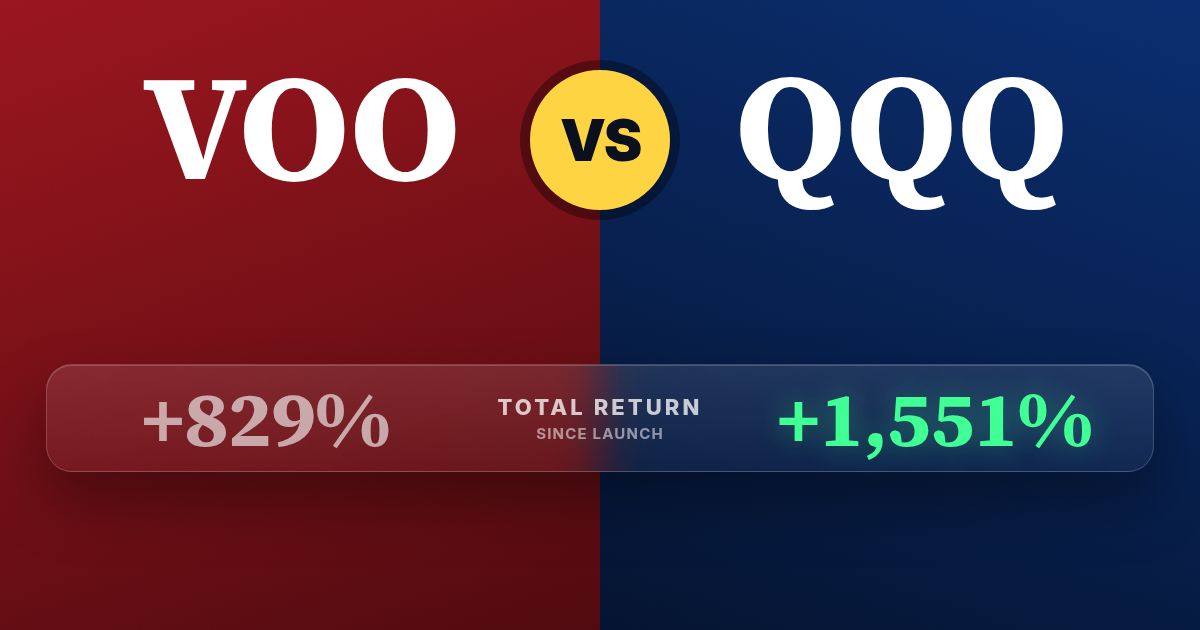
VOO (Vanguard S&P 500 ETF) follows the S&P 500, an index of 500 of the largest U.S. companies. It has about $1.06T in assets, which makes it one of the biggest funds out there. It yields 1.1% and pays Quarterly. Its total return since inception is 823%, and it launched on 9/7/2010.
SCHD: dividend-focused U.S. stocks
SCHD (Schwab U.S. Dividend Equity ETF) holds U.S. companies chosen for their dividend track record and quality. A dividend is a cash payment a company makes to its shareholders. The fund yields 3.2%, pays Quarterly, and has returned 590% in total since 10/20/2011. If you're weighing these two, I compare them head to head in SCHD vs VOO.
QQQ: a tilt toward big tech and growth
QQQ (Invesco QQQ Trust) follows the Nasdaq-100, an index of large companies listed on the Nasdaq exchange, with a heavy lean toward technology. It has about $487B in assets and a total return of 1,519% since inception. Remember that funds started at different times, so you can't line that number up directly against a younger fund.
SGOV: short-term Treasury bills
SGOV (iShares 0-3 Month Treasury Bond ETF) holds very short-term U.S. government debt instead of stocks. It yields 3.6%, pays Monthly, and has a total return of just 21.0% since 5/26/2020. That's a different job entirely: it is more about parking cash and earning interest than growing wealth. Same wrapper, completely different basket.
This is the key lesson. "ETF" describes the wrapper, not what's inside. The label tells you how it trades, not whether it's safe, risky, boring or exciting.
A worked example: $10,000 into your first ETF
Let's walk through how I would evaluate a fund, step by step, using VOO and SCHD as the examples and $10,000 as the amount.
- Decide the job. Are you after long-term growth, income, or a place to park cash? A broad index fund like VOO leans growth. SCHD leans income plus growth. SGOV is cash-like.
- Check the fee. On $10,000, VOO's 0.03% expense ratio costs about $3 a year. SCHD's 0.06% costs about $6. For comparison, a hypothetical fund charging 1% would cost $100 a year on the same money. Small gaps add up over decades, and I break that down in the expense ratio math.
- Estimate the income. At today's yield, $10,000 in VOO would produce about $110 a year. In SCHD it's about $320 a year, and in SGOV about $364. Yield is the yearly payout divided by the price, and it changes over time.
- Look at total return. Total return is price change plus all the payouts you received. VOO shows 823% since inception and SCHD shows 590%. They started on different dates, so treat this as context, not a scoreboard.
- Check for price decay. This means the fund's share price has been steadily eroding over time, which can quietly eat your money even when the payout looks big. The flag reads No for VOO and No for SCHD.
- Place the order. A market order buys right now at the current price. A limit order lets you set the highest price you're willing to pay. For big, popular funds the difference is usually tiny, but a limit order gives you control.
Want to see what it takes to live off dividends? To collect $1,000 a month from SCHD at today's yield, you would need about $375,000 invested. That's the kind of math that keeps expectations realistic. If you want to project future income, Dividend Projection is built for exactly that.
Yield is not the same as return
This is the number one trap for new income investors. A high yield looks great, but it only tells you the payout, not whether your total money grew or shrank.
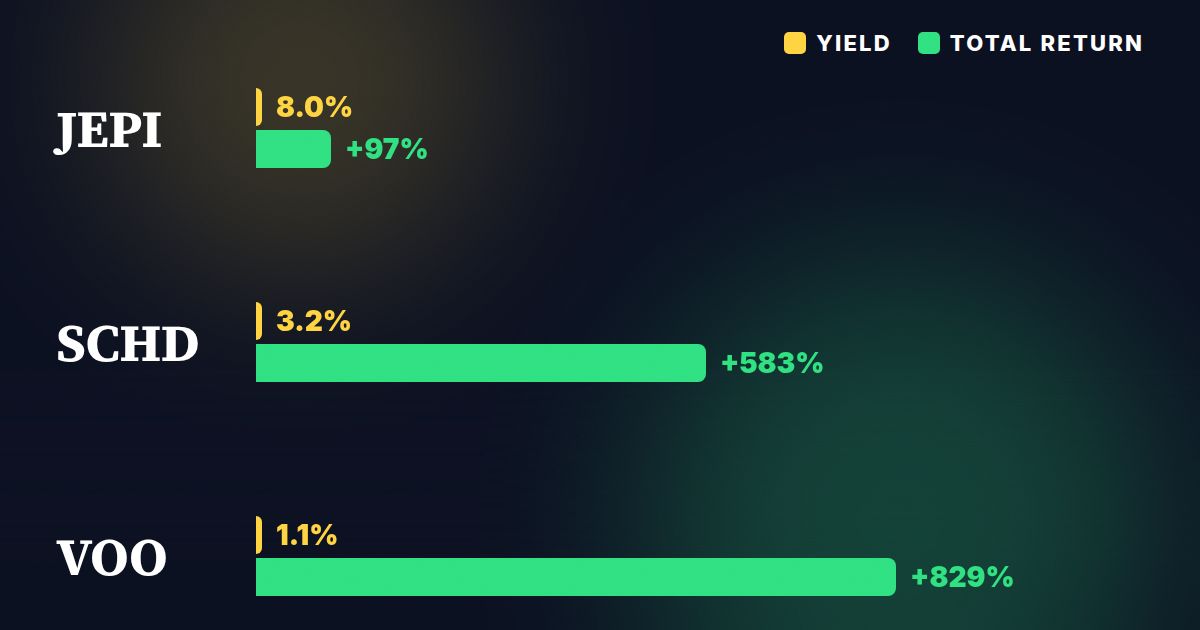
Take JEPI, which yields 8.0% and pays Monthly. That is a much bigger payout than VOO's 1.1%. But JEPI charges 0.35%, launched on 5/20/2020, and has a total return of 98.0% since then. VOO's 823% covers a far longer stretch, so they can't be compared one for one. The point is to look at both numbers together, and to know where the payout comes from. JEPI uses options (contracts that trade some upside for extra income), which is a different animal than a plain index fund.
My rule is simple. Yield tells you what you get paid. Total return tells you whether it was worth it.
Common beginner mistakes
- Chasing the biggest yield. A very high number can mean extra risk, higher fees or a falling share price. Always check total return and the price decay flag next to it.
- Assuming all ETFs are safe. An ETF can lose value. A basket of stocks still drops when stocks drop.
- Ignoring fees. The gap between a very low fee and a high one looks small each year, but it compounds.
- Buying overlapping funds. Owning several funds that all hold the same big companies feels diversified but often isn't.
- Comparing returns across different start dates. A fund launched years later has had a different market to work with. Always check the inception date.
- Buying without knowing what's inside. The name rarely tells the whole story. Read the fund's description and top holdings.
- Panic selling. Prices move every day. Decide your time horizon before the market tests it.
What to check before buying any ETF
Here's the checklist I run through every time.
- What does it hold? Stocks, bonds, options, a mix? Which index or strategy?
- What does it cost? Look at the expense ratio.
- How big is it? Larger funds like VOO (about $1.06T) are generally easier to trade and less likely to close. Very small funds carry more risk of shutting down.
- How does it pay? Monthly, quarterly, or not much at all? Check the yield and frequency.
- What's the total return and the inception date? Make sure you know how long the track record is.
- Is there price decay? If the flag says yes, dig deeper before going further.
- Does it fit my goal and time horizon? This is the question that matters most.
If you want to screen income funds with all of these filters in one place, TopDividendETFsPRO does that. For growth-focused funds, GrowthETFs is the place to look. And if you're starting with income specifically, I put together a simple starting lineup of dividend ETFs for beginners.
What your money could pay in four different ETFs
Estimated annual income at each fund's current yield
Today's income only. Yields change and are not guaranteed.
FAQ
What is an ETF in simple terms?
An ETF is a basket of investments, like stocks or bonds, that you buy as a single share through a brokerage account. It trades on an exchange all day, just like a regular stock.
Is an ETF safe for beginners?
ETFs are not risk free. A fund that holds stocks, like VOO, can fall when the market falls. Broad, low-cost funds are a common starting point because they spread your money across many companies, but you can still lose value.
Do ETFs pay dividends?
Many do. VOO pays Quarterly at a 1.1% yield, and SCHD pays Quarterly at 3.2%. Others, like SGOV, pay monthly. Payouts change over time and are never guaranteed.
What is the difference between an ETF and a mutual fund?
Both hold a basket of investments. ETFs trade throughout the day on an exchange like a stock, while mutual funds typically price once per day after the market closes. ETFs also tend to have low fees, though many mutual funds are cheap too.
How much money do I need to buy an ETF?
You need at least the price of one share, and many brokers also let you buy fractions of a share. That means you can start with a small amount and add over time.
How do ETFs make money for investors?
Two ways: the share price can rise, and the fund can pay out dividends or interest from what it holds. Add both together and you get total return.
Benjie's bottom line
An ETF is just a wrapper that lets you own a basket of investments with one click. The wrapper is simple. What's inside it is what decides whether it fits you. A broad fund like VOO at 0.03%, an income fund like SCHD at 3.2%, and a cash-like fund like SGOV at 3.6% are three very different tools.
Start by knowing your goal, then check the holdings, fees, total return and payout before you commit a dollar. Use the calculators on TopETFs to run your own numbers. None of this is personal advice, and yields and returns change, so do your own due diligence.
ETFs in this story
How this article was made: Benjie picks every topic based on what he finds useful as a dividend investor and what readers ask about. Parts of this article were drafted with help from AI tools, then edited, fact-checked and shaped by Benjie. All fund numbers come from the TopETFs database and update daily.
Disclaimer: TopETFs.com is published by Dividend Empire LLC for educational and entertainment purposes only. We are not financial advisors, and nothing on this site is financial advice, a recommendation, or a solicitation to buy or sell any security. ETF data is compiled from public sources and fund issuers, may be delayed, inaccurate or outdated, and may differ from the fund sponsor's own figures. Yields are trailing distribution yields, are not guaranteed, and distributions may include return of capital, which reduces your cost basis and is not a measure of performance. Total returns are since each fund's inception unless noted and are not comparable across funds with different start dates. Past performance does not guarantee future results. Investing carries risk, including loss of principal. Read each fund's prospectus and consult a licensed financial advisor before investing. Dividend Empire LLC receives compensation from ETF issuers for sponsored placements, which are labeled as such.