The Best Dividend ETFs for Beginners: A Simple Starting Lineup
The best dividend ETFs for beginners, explained in plain English: SCHD, VYM, DGRO, VIG and VOO compared on yield, fees and total return with income math.
The short version
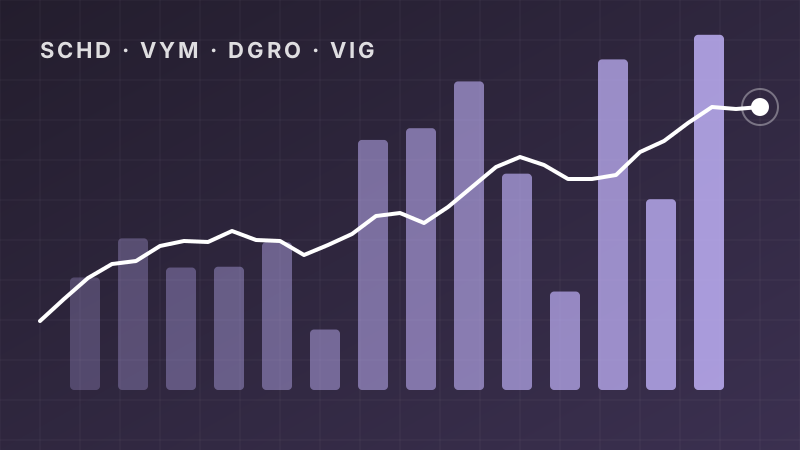
- A simple beginner lineup is SCHD, VYM, DGRO and VIG: broad, low cost dividend funds that hold hundreds of companies between them, with yields from 1.4% to 3.0% today.
- Yield is only half the story. Fees and total return tell you whether the fund actually grew your money, and the biggest yields usually come with the biggest trade-offs.
- You do not need to pick all of them. One or two core funds you understand beat a pile of high yielders you do not.
If you want the short answer to "what are the best dividend ETFs for beginners," start with plain, cheap, diversified funds: SCHD yields 3.0% with a 0.06% expense ratio, VYM yields 2.4% at 0.04%, and VIG and DGRO lean toward dividend growth with lower starting yields. That is where I would begin the homework. It is not a buy signal, just a sensible place to learn.
A beginner dividend ETF starting lineup
First, what is a dividend ETF?
An ETF (exchange-traded fund) is a basket of investments you buy with one click, just like a single stock. A dividend ETF is a basket made mostly of companies that pay dividends. A dividend is a slice of company profits paid out in cash to shareholders.
You own the basket, the companies send cash into it, and the fund passes that cash to you. Most of the funds here do that every quarter. If you want the full mechanics, I walked through them in ETFs 101: how an ETF actually works.
Two numbers show up everywhere, so let's define them now.
- Dividend yield: the yearly cash payout divided by the fund's price. A 3.0% yield means roughly $300 a year on $10,000 at today's numbers.
- Expense ratio: the yearly fee the fund charges, taken out of the fund automatically. You never get a bill, which is why people forget it exists.
Why these funds make a good starting lineup
For a beginner, I care about three things: the fund holds a lot of companies, it costs very little, and its strategy fits in one sentence. All of the funds below pass that test.
SCHD: the quality income pick
SCHD from Schwab screens for companies with a record of paying dividends and solid financial health, then holds a concentrated basket of them. It sits at 3.0% yield, $110B in assets, and it pays Quarterly. Since its start on 10/20/2011, total return is 537%. I go deeper in SCHD: dividend yield, total return and what $10,000 pays today.
VYM: the broad high yield option
VYM from Vanguard holds a wide set of larger U.S. companies with above average yields. It yields 2.4%, costs 0.04%, and has $80.2B in assets. Its inception date is 11/10/2006, so it has been through more market cycles than SCHD, and its total return since then is 476%.
DGRO and VIG: the dividend growth pair
Dividend growth funds care less about today's payout and more about companies that keep raising theirs. DGRO yields 1.9% and VIG yields 1.4%. Lower yield, yes. But VIG's total return since 4/21/2006 is 615%, which is a good reminder that a small payout can sit on top of strong growth.
VOO: not a dividend fund, but worth knowing
VOO tracks the S&P 500, the index of 500 of the largest U.S. companies. It yields only 1.0%, but many beginners use it as the base of a portfolio, with a 0.03% fee and $1.04T in assets. I include it as a yardstick. If a dividend fund cannot keep up over time, ask yourself why you own it.
For a side-by-side of the first four, see SCHD vs. VYM vs. DGRO vs. VIG.
A worked example, step by step
Let's say you have $10,000 and want to see what a simple dividend portfolio would pay. Here is how I would do the math.
- Pick one fund and find its yield. SCHD at 3.0% gives about $300 a year, or about $25 a month averaged out.
- Check the fee. At 0.06%, the yearly cost on $10,000 is about $6.00. Compare that with a fund charging 0.38%, like DVY, where the same $10,000 costs about $38.00 a year.
- Try a blend. Put $2,500 into each of SCHD, VYM, DGRO and VIG. The combined income is about $218 a year.
- Work backwards from a goal. To earn $1,000 a month ($12,000 a year) from SCHD alone at today's yield, you would need roughly $400,000 invested. With VIG's lower yield, it would take about $857,143.
That last step is the one that surprises new investors. Income goals take real capital, and no ETF changes that math. For a longer version of step four, try how much you need in SCHD to make $1,000 a month.
Yield is not the whole story: total return and price decay
Here's the thing most beginners miss. The yield is only the cash part of what you earn. The other part is the price of the fund going up or down.
Total return adds the two together: price change plus dividends. It is the honest scoreboard. Price decay means a fund's share price keeps drifting lower over time, which can quietly eat the income it pays you.
In our database, all five lineup funds show price decay as No. Compare that with a bond fund like SPHY, where the flag reads Yes despite its 7.4% yield. A high yield with decay is a trap for beginners, because the payout looks great while your original money slowly shrinks.
One caution when you compare total returns. They are measured since each fund's own start date. VYM launched on 11/10/2006 and DGRO on 6/10/2014, so DGRO's 315% and VYM's 476% are not an apples to apples race. Different start dates, different markets.
The shiny yields beginners get tempted by
Search for dividend ETFs and you will quickly find funds with huge numbers. JEPI shows 8.0%, JEPQ shows 11.2%, and QQQI shows 14.4%. They are monthly payers that use covered calls, which means the fund sells the right to buy its stocks at a set price to collect extra income, and in exchange it gives up some of the upside when markets rally.
These can be useful tools, and I cover them elsewhere. But they cost more (0.35% for JEPI, 0.68% for QQQI), most are newer, and their total return since inception (95.0% for JEPI, 65.0% for QQQI) covers a short window. They are not wrong, just harder to judge. If you are curious, read how much you need in JEPI to make $1,000 a month before deciding where they fit.
Common beginner mistakes
- Chasing the highest yield. A big yield can mean a falling price, a risky strategy, or both. Look at total return before you get excited.
- Ignoring fees. A fee difference looks tiny each year but compounds. I show the effect in the expense ratio math article.
- Buying five funds that own the same stocks. Many dividend funds overlap heavily. Owning four of them is not four times the diversification.
- Spending dividends too early. Reinvesting (often called DRIP) lets payouts buy more shares. See what DRIP does over 20 years.
- Expecting the payout to be fixed. Dividends can rise, fall or get cut. Yields change, and nothing here is guaranteed.
- Comparing returns across different start dates. A fund launched in a rough market looks very different from one launched in a calm one.
Which beginner is each fund for?
I never tell people what to buy, but I can say who each fund tends to fit.
- SCHD tends to fit someone who wants a higher yield than the market with a quality screen.
- VYM tends to fit someone who wants a broad, ultra cheap, high yield basket from a big issuer.
- DGRO or VIG tend to fit someone younger who cares more about growing payouts than today's cash.
- VOO tends to fit someone who mostly wants the whole market and treats dividends as a bonus.
If you want something even calmer for money you may need soon, funds like SGOV hold very short term Treasuries and yield 4.0% today. Its total return of 21.0% since 5/26/2020 shows it is built for stability, not growth. That is a different job entirely.
What would the beginner lineup pay you?
Estimated annual income at each fund's current yield
Today's income only. Yields change and are not guaranteed.
What to check before buying any ETF
Before you put a dollar into any fund, run this checklist. It takes five minutes.
- What does it own? Read the top holdings and the strategy in plain terms. If you cannot explain it to a friend, wait.
- What does it cost? Check the expense ratio. For core holdings, lower is better when everything else is equal.
- How big is it? Larger assets usually mean easier trading and less risk of the fund closing.
- How old is it? Look at the inception date and remember what market conditions it has seen.
- What is the total return, not just the yield? Compare it against a simple benchmark like VOO, keeping the start dates in mind.
- Is there price decay? If yes, understand why before trusting the income.
- How often does it pay? Monthly and quarterly both work, but know what to expect.
To screen every income ETF on those points, I use TopDividendETFsPRO. If you want to see how a portfolio could grow its payouts over time, Dividend Projection lets you model it.
FAQ
What is the best dividend ETF for a beginner?
There is no single best one, but SCHD, VYM, DGRO and VIG are common starting points because they are diversified and cheap. SCHD yields 3.0% and VYM yields 2.4% today.
Is SCHD good for beginners?
Many beginners like it because the strategy is simple and the fee is 0.06%. It still holds stocks, so the price can fall, and the yield is not guaranteed.
How much money do I need to start with dividend ETFs?
You can start with the price of one share, and many brokers allow fractional shares for less. Just know that at today's yields, $1,000 invested in SCHD pays roughly $30 a year.
Should I pick a high yield or a dividend growth ETF?
It depends on whether you need income now or want it to grow. VIG shows 1.4% yield but 615% total return since inception, while SCHD pays more today. Both are valid trade-offs.
Do dividend ETFs pay monthly?
Most of the core funds in this lineup, like SCHD and VYM, pay Quarterly. Monthly payers exist, such as JEPI, but they work differently and usually cost more.
Are dividend ETFs safe?
They are diversified, but they are not safe in the sense of a savings account. Prices move and dividends can change, so only invest money you will not need soon.
My bottom line
If I were starting from zero, I would not look for the biggest number on the screen. I would pick one or two boring, low cost funds, learn how they pay, and watch how total return compares with something like VOO. A fund you understand is the one you will hold through a bad year.
The lineup above is a place to start learning, not a prescription. Yields change, start dates differ, and your goals are your own. This isn't a buy or sell signal, so do your own due diligence. If you want to see more options, the top 100 dividend ETFs are a good next stop, and if growth interests you more than income, check out the growth ETF scoreboard.
ETFs in this story
How this article was made: Benjie picks every topic based on what he finds useful as a dividend investor and what readers ask about. Parts of this article were drafted with help from AI tools, then edited, fact-checked and shaped by Benjie. All fund numbers come from the TopETFs database and update daily.
Disclaimer: TopETFs.com is published by Dividend Empire LLC for educational and entertainment purposes only. We are not financial advisors, and nothing on this site is financial advice, a recommendation, or a solicitation to buy or sell any security. ETF data is compiled from public sources and fund issuers, may be delayed, inaccurate or outdated, and may differ from the fund sponsor's own figures. Yields are trailing distribution yields, are not guaranteed, and distributions may include return of capital, which reduces your cost basis and is not a measure of performance. Total returns are since each fund's inception unless noted and are not comparable across funds with different start dates. Past performance does not guarantee future results. Investing carries risk, including loss of principal. Read each fund's prospectus and consult a licensed financial advisor before investing. Dividend Empire LLC receives compensation from ETF issuers for sponsored placements, which are labeled as such.