Section 1256 ETFs and Taxes: How SPYI and QQQI Can Lower Option Income Tax
Section 1256 ETFs taxes explained in plain English: how SPYI and QQQI use index options that get a 60/40 tax split, with real income math and the catches.

The short version
- A Section 1256 contract is a type of option or futures contract the IRS taxes with a special 60/40 rule: 60 parts long-term and 40 parts short-term, no matter how long it was held. SPYI and QQQI trade index options that generally qualify.
- That can mean a lower tax bill on option income than a fund that pays out ordinary income, but it depends on how each year's distributions are actually classified. It is not automatic and not guaranteed.
- The tax edge only matters in a taxable account. In an IRA it does nothing, and a tax break never fixes a weak total return.
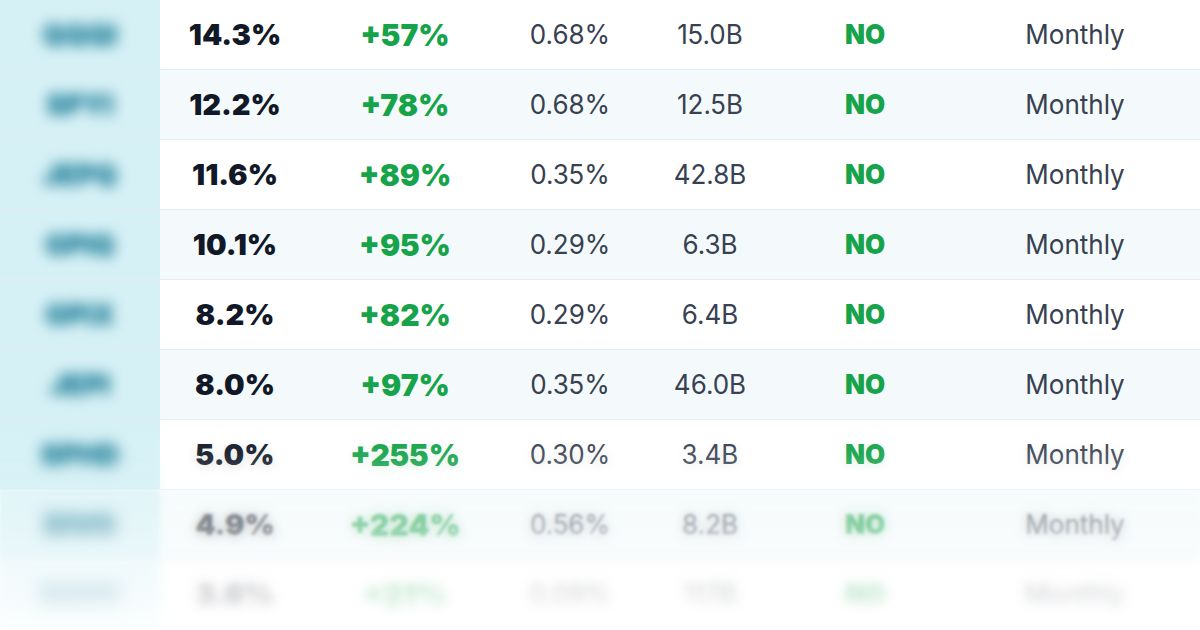
Section 1256 ETFs taxes work like this: the fund sells options on a broad index (like the S&P 500 or Nasdaq-100), and the IRS treats the gains on those options with a 60/40 split between long-term and short-term. SPYI yields 12.2% and QQQI yields 14.3% today, and this tax treatment is a big part of why people look at them instead of other covered call funds.
I'll keep this simple, because tax talk gets confusing fast. I'll define the terms, walk through a worked example, show the real risks, and give you a checklist for any ETF. This is education, not tax advice. Talk to a tax professional about your own situation.
Option income ETFs vs plain index and cash-like funds
What is a Section 1256 contract, in plain English?
Section 1256 is a part of the US tax code. It covers certain contracts, including regulated futures and options on broad-based indexes like the S&P 500 (SPX) and the Nasdaq-100 (NDX). These are often called index options.
The special rule is the 60/40 treatment. Whatever you earn on these contracts, 60 parts are taxed as a long-term capital gain and 40 parts as a short-term capital gain. It does not matter if the fund held the option for three weeks or three minutes.
Why is that a big deal? Short-term gains are usually taxed like ordinary income, which is the highest rate bracket. Long-term gains are taxed at lower rates. Normally you only get the lower rate by holding an investment for more than a year. Section 1256 gives you a blend automatically.
The other piece is called mark-to-market. At the end of the tax year, open Section 1256 contracts are treated as if they were sold at that day's price. That means gains and losses are counted every year, not postponed.
How SPYI and QQQI use this
Both funds come from NEOS. SPYI owns a portfolio tied to the S&P 500, and QQQI does the same for the Nasdaq-100. Each sells call options on its index to collect premium (the cash a buyer pays for the option). That premium is the main fuel behind the high payouts, and both pay Monthly.
If you want the full mechanics, my covered call ETF explainer covers where the big yields come from. The short version: a call option gives the buyer the right to purchase the index at a set price. The fund collects cash upfront, but gives up some of the upside if the market surges.
The key tax point is what kind of options they use. Because they sell options on broad indexes rather than on individual stocks or ETFs, those options generally fall under Section 1256. Many other covered call funds sell options on ETF shares or single stocks, which are taxed differently, usually as short-term gains.
What about JEPI and JEPQ?
JEPI and JEPQ reach their option income differently. They generally use equity-linked notes (ELNs), which are debt-like instruments that bundle the option exposure. The income from those is generally treated as ordinary income. That is a general description, so check the fund's own tax disclosures. The point is that the structure changes the tax, even when the strategy looks similar on the surface.
A worked example, step by step
Let's use made-up but reasonable numbers so you can see the mechanics. These are illustrations, not your actual tax rates. Imagine you have $1,000 of option gains. At your ordinary income rate, the tax takes $320 of it. At your long-term capital gains rate, the tax takes $150 of it.
- Ordinary income case: the whole $1,000 is taxed at the ordinary rate, so the tax is $320.
- Section 1256 case: 60 parts ($600) are taxed at the long-term rate, which is $90. The other 40 parts ($400) are taxed at the ordinary rate, which is $128. Total tax: $218.
- The gap: $320 minus $218 is $102 more that you keep out of every $1,000 of option gains.
Now put real yields on it. On $100,000 in SPYI, the current yield implies about $12,210 in annual income. If all of it were taxed at the ordinary rate from the example ($320 per $1,000), the tax would be about $3,907. At the blended rate ($218 per $1,000), it would be about $2,662. That is roughly $1,245 a year saved in this simplified case.
Same exercise for QQQI: about $14,300 in annual income on $100,000, with a tax of roughly $3,117 at the blended rate versus $4,576 at the ordinary rate.
Here's the honest caveat. This is a best-case simplification. Real distributions are a mix, and not every dollar the fund pays comes from Section 1256 gains. Your actual result will differ.
Why the real-world result is messier
A fund's payout is not one clean bucket. Several things can be mixed in:
- Stock dividends from the shares the fund owns, which may or may not be taxed at lower qualified rates.
- Option gains, some of which can flow through with the 60/40 character.
- Return of capital, which is a payout that is treated as getting your own money back. It is not taxed right away, but it lowers your cost basis. I break that down in what return of capital means in an ETF.
The fund reports the actual split after year-end on Form 1099-DIV. Until then, any estimate is a guess. That also means the tax result can change from one year to the next, because it depends on how the options performed that year.
Also remember that option losses count too. If the fund loses money on options in a strong rally, those losses are part of the same tax picture.
Total return still comes first
Here's where I slow people down. A lower tax rate on a payout is nice, but it only applies to money you actually earn. A fund that pays a big yield while its share price sinks is not saving you anything.
So let's look at the numbers. SPYI has a total return of 77.0% since its inception on 8/30/2022. QQQI shows 55.0% since 1/20/2024. Those are different start dates, so you cannot line them up directly. QQQI is a much younger fund, with less history to judge.
For context, JEPI shows 98.0% since 5/20/2020, and JEPQ shows 86.0% since 5/3/2022. Again, different start dates and different market conditions. And a plain index fund like VOO shows 823% since 9/7/2010, a far longer stretch that includes a lot of bull market.
Price decay flags are all clean here: SPYI is No, QQQI is No, JEPI is No and JEPQ is No. That is a good sign, but these funds have not been through a long, ugly bear market. Covered call funds give up some upside in big rallies, and they still take most of the downside in a crash. That trade-off matters more than the tax rate. My piece on the yield trap goes deeper on this.
Fees matter too
The two NEOS funds charge 0.68% (SPYI) and 0.68% (QQQI). The JPMorgan funds charge 0.35% (JEPI) and 0.35% (JEPQ). A plain index fund like VOO charges 0.03%.
On $100,000, that means about $680 a year in fees for SPYI, versus about $350 for JEPI. If a tax edge saves you a few hundred dollars but the fee costs more than a cheaper alternative, you need to do the full math. I cover how that compounds in the expense ratio math article.
Common mistakes beginners make
- Assuming a 60/40 label means your whole payout is taxed lightly. It applies to the option gains, not necessarily every dollar of distribution.
- Holding it in an IRA and expecting a tax benefit. Inside a tax-advantaged account, this rule does nothing. In that case, the tax angle is irrelevant and you should compare on yield, total return and fees. See dividend ETFs for a Roth IRA.
- Chasing the biggest yield. A bigger yield does not mean a better return. Check total return and price decay first.
- Forgetting that rules change. Tax law and fund strategies can both change, and past tax treatment is not a promise.
- Ignoring state taxes. Your state may not treat these gains the same way as federal tax does.
Who tends to fit a Section 1256 ETF
These funds tend to fit people who hold income investments in a regular brokerage account and are in a higher tax bracket, where the gap between ordinary and long-term rates is largest. They also suit people who want monthly cash flow and accept that upside is capped in exchange for a high payout.
They tend to fit less well for someone investing inside an IRA, someone who wants maximum long-term growth, or someone who needs stable principal. For those goals, look at a growth fund like SCHG or a cash-like option such as SGOV, which has a yield of 3.6% today. If you are using income to plan a withdrawal, a dividend income projection tool can help you stress-test the numbers.
Estimated annual income: SPYI, QQQI, JEPI and JEPQ
Estimated annual income at each fund's current yield
Today's income only. Yields change and are not guaranteed.
The calculator shows pre-tax income. To estimate what you keep, subtract the tax using your own rates and the fund's actual distribution breakdown. Remember that the gross number is the yield, not your take-home.
What to check before buying any ETF
Whether it is a Section 1256 fund or not, here is the checklist I would run through:
- What is the strategy? Know where the payout comes from, and what you give up to get it.
- What is the total return since inception, and when did it start? A short history means less proof.
- What does it cost? Look at the expense ratio and compare it with similar funds.
- What kind of account will hold it? Taxable, IRA or Roth changes which funds make sense.
- How is the payout taxed? Read the fund's tax disclosures and past 1099 breakdowns.
- Is there price decay? Check whether the share price has been eroding.
- How big is it? Larger funds tend to trade more easily, though size is not a quality guarantee.
You can screen income ETFs on these points at TopDividendETFsPRO, and if you want a refresher on how a fund works under the hood, start with how an ETF actually works.
FAQ
What is a Section 1256 ETF?
It is a common label for an ETF that uses Section 1256 contracts, such as options on broad market indexes. Gains on those contracts get the 60/40 split between long-term and short-term tax treatment.
Are SPYI and QQQI taxed as 60/40?
They use index options that generally qualify for that treatment, but what reaches you depends on each year's distribution breakdown. Check the fund's reporting and your Form 1099-DIV.
Does SPYI pay monthly?
Yes. SPYI pays Monthly, and so does QQQI. The current yields are 12.2% and 14.3%, and they can change.
Do Section 1256 ETFs help in an IRA?
No. Inside an IRA or Roth IRA the tax rules on distributions work differently, so the 60/40 benefit generally does not matter there.
Is SPYI better than JEPI because of taxes?
Not automatically. SPYI yields 12.2% with a 0.68% fee, and JEPI yields 8.0% with a 0.35% fee. Taxes are one factor, and total return, fees and your account type matter too.
Benjie's bottom line
The Section 1256 angle is one of the more interesting tax features in income investing. Selling index options can produce gains taxed at a blended rate, and that can leave more money in your pocket in a taxable account. On paper, it is a real advantage.
But it is a tax tool, not a return engine. I would still start with total return, fees and how the fund behaves when markets fall, then use the tax treatment as a tiebreaker. SPYI and QQQI are both young funds with limited history, so give that real weight.
This isn't a buy or sell signal. Check the latest tax reporting, run the numbers for your own bracket, and do your own due diligence. If you want to see more of the income landscape, the top 100 dividend ETFs list is a good next stop.
ETFs in this story
How this article was made: Benjie picks every topic based on what he finds useful as a dividend investor and what readers ask about. Parts of this article were drafted with help from AI tools, then edited, fact-checked and shaped by Benjie. All fund numbers come from the TopETFs database and update daily.
Disclaimer: TopETFs.com is published by Dividend Empire LLC for educational and entertainment purposes only. We are not financial advisors, and nothing on this site is financial advice, a recommendation, or a solicitation to buy or sell any security. ETF data is compiled from public sources and fund issuers, may be delayed, inaccurate or outdated, and may differ from the fund sponsor's own figures. Yields are trailing distribution yields, are not guaranteed, and distributions may include return of capital, which reduces your cost basis and is not a measure of performance. Total returns are since each fund's inception unless noted and are not comparable across funds with different start dates. Past performance does not guarantee future results. Investing carries risk, including loss of principal. Read each fund's prospectus and consult a licensed financial advisor before investing. Dividend Empire LLC receives compensation from ETF issuers for sponsored placements, which are labeled as such.