Best Monthly Dividend ETFs: Ranked by Yield, Fees and Total Return
The best monthly dividend ETFs ranked by yield, fees and total return, with real monthly income math on $100,000 and the risks behind the big payouts.
The short version
- On yield alone, QQQI (14.3%) and SPYI (12.2%) lead this group, with JEPQ (11.6%) right behind. All three pay monthly.
- The cheapest option-income funds here are GPIQ and GPIX at 0.29%. The NEOS funds charge 0.68%.
- Yield is only half the story. DIVO and SPHD pay less, but they have much longer track records, and total return since inception tells a different story than yield does.
The best monthly dividend ETFs depend on what you want the money to do. If you want the biggest monthly check today, the option-income funds like QQQI (14.3%), SPYI (12.2%) and JEPQ (11.6%) lead on yield. If you want a lower payout with a longer history, DIVO (4.9%) and SPHD (5.0%) are worth a look. Here is how they stack up, and what each one really pays.
Monthly dividend ETFs ranked by yield
What I mean by a monthly dividend ETF
A monthly dividend ETF is simply a fund that pays its distributions every month instead of every quarter. That is a payout schedule, not a quality stamp. Plenty of great funds pay quarterly, and plenty of monthly payers have been mediocre.
Monthly pay matters if you are living off your portfolio and want your income to line up with your bills. It also makes budgeting easier and lets you reinvest sooner. But I always tell people: the schedule is the least important part. What matters is where the payout comes from and whether the share price holds up.
The funds in the table fall into three buckets:
- Option-income funds: JEPI, JEPQ, SPYI, QQQI, GPIQ and GPIX. They hold stocks and sell call options (a contract that gives someone else the right to buy at a set price) to collect extra cash. That option premium is what creates the big yield.
- Dividend-stock funds with an options twist: DIVO holds dividend-paying companies and sells calls on some of them.
- Plain high-dividend funds: SPHD tracks an index of high-yielding, lower-volatility stocks and does not sell options.
If you want the full mechanics, I broke them down in Covered Call ETFs, Explained.
The best monthly dividend ETFs ranked by yield
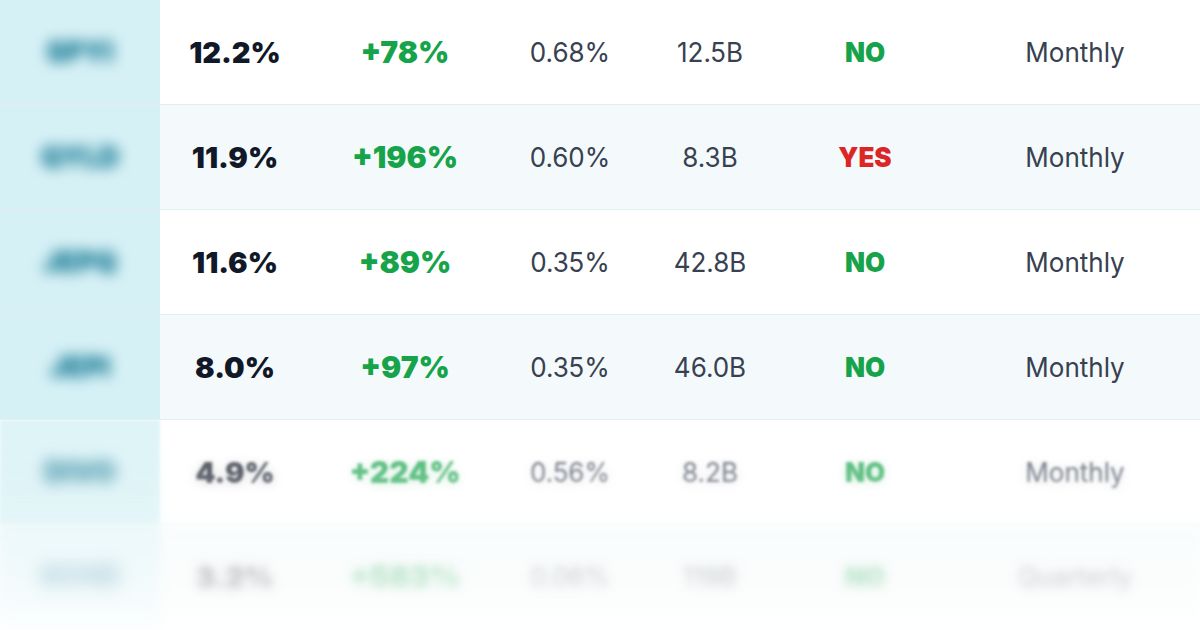
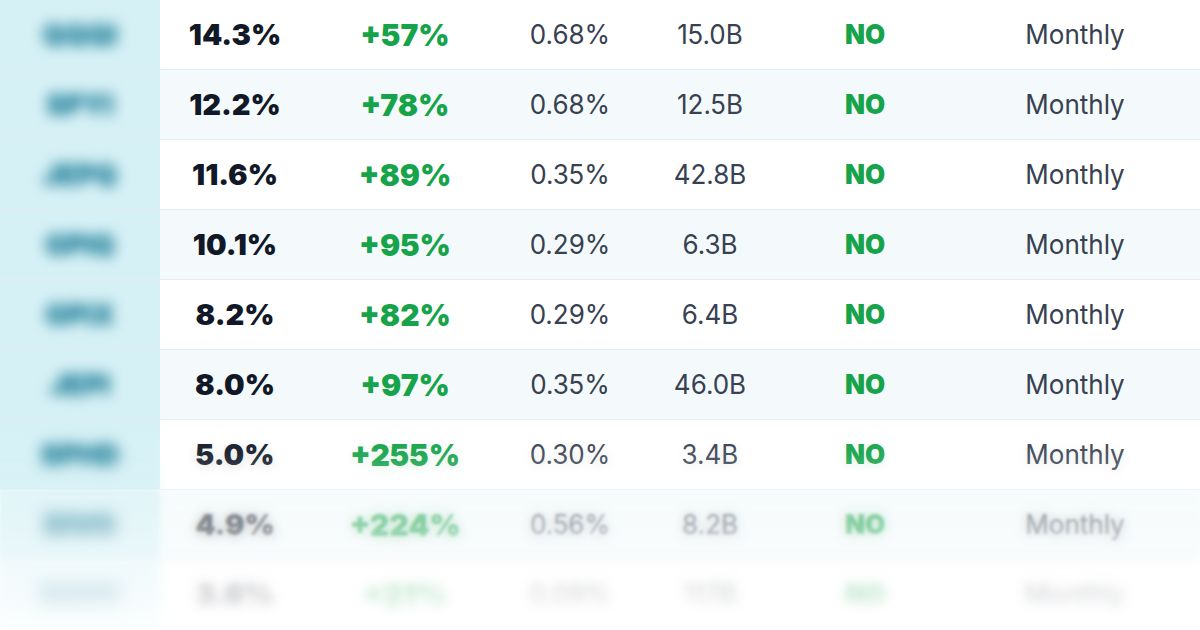
At today's numbers, the order from highest yield to lowest looks like this.
- QQQI (14.3%): NEOS Nasdaq 100 High Income. The top yield here, tied to Nasdaq-100 stocks.
- SPYI (12.2%): The S&P 500 version from the same issuer.
- JEPQ (11.6%): JPMorgan's Nasdaq-focused income fund.
- GPIQ (10.1%): Goldman Sachs Nasdaq-100 Premium Income.
- GPIX (8.2%): Goldman Sachs S&P 500 Premium Income.
- JEPI (8.0%): JPMorgan's S&P 500-style income fund and the largest of the group by a wide margin.
- SPHD (5.0%): Invesco's high dividend, low volatility fund.
- DIVO (4.9%): The lowest yield of the eight, with the strongest dividend-growth flavor.
Yields move. Treat this as a snapshot, not a permanent ranking. Funds that sell options will see their yield swing with market volatility, and a high number today can be lower in a few months.
Fees: what you pay for the income
Expense ratio is the yearly fee taken out of the fund, shown as a percent of your money. It comes out of returns automatically, so you never see a bill, but you feel it.
GPIQ and GPIX are the cheapest option-income funds here at 0.29%. JEPI and JEPQ sit at 0.35%. SPYI and QQQI are the priciest at 0.68%. DIVO is at 0.56%, and SPHD is at 0.30%.
On $100,000, the difference between 0.29% and 0.68% is about $390 a year. That is not nothing. But the NEOS funds also pitch a tax angle, which can matter more than the fee gap for some investors. I cover that in Section 1256 ETFs and Taxes. Taxes depend on your situation, so check with a pro.
What each fund actually pays: the income math
This is the part that matters when you are planning a real budget. Here is what $100,000 pays per month at today's yields.
- QQQI: about $1,192 per month
- SPYI: about $1,018 per month
- JEPQ: about $967 per month
- GPIQ: about $842 per month
- JEPI: about $667 per month
- SPHD: about $417 per month
- DIVO: about $408 per month
Flip it around. To collect $1,000 a month from JEPI at today's yield, you would need roughly $150,000. Doing the same with DIVO takes about $244,898. From QQQI it is about $83,916. I walk through the JEPI version in How Much Do You Need in JEPI to Make $1,000 a Month?
That gap in required capital is the whole trade-off in one line. A higher yield means less money needed up front. It does not mean the income is safer, and it does not mean your original investment stays intact.
Total return: the reality check
Yield tells you what you are collecting. Total return tells you whether you are actually getting richer. Total return combines the dividends you received with the change in share price, so it shows if the payouts are being paid for by a shrinking fund.
One important caveat: our total return data runs since each fund's inception, and these funds started on very different dates. JEPI launched on 5/20/2020, JEPQ on 5/3/2022, SPYI on 8/30/2022, QQQI on 1/20/2024, and GPIQ on 10/24/2023. DIVO goes back to 12/14/2016 and SPHD to 10/18/2012. A longer clock usually means a bigger number, so do not compare them head to head as if they ran the same race.
With that in mind, here is what stands out:
- DIVO shows 223% since inception and SPHD shows 258%. Both lower-yield funds have long records and have grown investor money well over time.
- JEPI is at 98.0% and JEPQ is at 86.0%. These are solid results for funds that have lived through a limited stretch of market history.
- QQQI is at 55.0% in a much shorter time, and SPYI is at 77.0%. Young funds with big yields still need more time to prove themselves across a full market cycle.
Right now, our database flags price decay as No for JEPI, No for QQQI, No for SPYI and No for DIVO. That is encouraging, but a short history is not a guarantee. Option-income funds can lag in strong rallies, because the calls they sell cap some of the upside. I dig into this idea in The Yield Trap.
Monthly payers that are not option funds
Not every monthly payer sells options. A few others show up in our database and are worth knowing about as comparisons.
- SGOV holds ultra-short Treasury bills and yields 3.6% with a tiny 0.09% fee. It is a cash-like parking spot, so its total return of 21.0% is modest by design.
- DGRW pays monthly with a 2.1% yield and a focus on quality dividend growers. Its total return is 416% since 5/22/2013.
- SCHP holds inflation-protected Treasuries and yields 5.1%, paying monthly.
- SPHY is a high-yield bond fund at 7.4%. Our data flags price decay as Yes here, which is a reminder that a high yield can come with a sliding share price.
And if you do not need monthly pay, quarterly funds like SCHD (3.2% yield, 0.06% fee, 590% total return since 10/20/2011) have a long record of strong results. Even VOO yields only 1.1%, but it shows 823% since 9/7/2010. Again, different start dates, so take the comparison with a grain of salt. The point is that you can build your own monthly paycheck from quarterly payers by mixing a few of them. Monthly is convenient, not required. Here is the SCHD version of the income math: How Much Do You Need in SCHD to Make $1,000 a Month?
The risks nobody should skip
I like income. I also like honest math. Here is what can go wrong.
- Capped upside: Selling calls means you give up some gains in a hot market. That is the price of the extra yield.
- Variable payouts: Option income depends on market volatility. When markets get calm, premiums shrink and the monthly check can shrink too. Do not treat a monthly amount as fixed.
- Not all payouts are income: Some of what you receive can be return of capital, which means a piece of your own money handed back. Read What Is Return of Capital in an ETF? before assuming a big yield is all profit.
- Short track records: QQQI, GPIQ and GPIX are relatively young. We simply have not seen how they behave through a long bear market.
- Stock market risk is still there: These funds hold stocks. If the market falls hard, the share price will fall too, and the options income only cushions part of it.
Who each type tends to fit
This is not a buy or sell signal, just how I think about fit.
Higher yield, shorter history (QQQI, SPYI, JEPQ): These tend to fit people who want large monthly cash flow now and accept the trade-offs. Nasdaq-based funds usually carry more swing than S&P-based ones.
Middle ground (JEPI, GPIX, GPIQ): JEPI has the biggest asset base and a more conservative feel. The Goldman funds are the lowest-cost options with solid income.
Lower yield, longer record (DIVO, SPHD): These can suit investors who care about total return and a track record that has seen several market conditions, even if the monthly check is smaller.
Many investors blend two or three of these rather than picking one. If you want to screen every income ETF side by side, TopDividendETFsPRO is built for that. If you want a broader list, check the top 100 dividend ETFs, and if you want to model future income, Dividend Projection can help.
What your money could pay in monthly dividend ETFs
Estimated annual income at each fund's current yield
Today's income only. Yields change and are not guaranteed.
FAQ
What is the best monthly dividend ETF?
It depends on your goal. For the highest current yield, QQQI, SPYI and JEPQ lead this list. For a longer track record and growth, DIVO and SPHD stand out. There is no single best fund for everyone.
Which monthly dividend ETF has the highest yield?
Right now QQQI has the highest yield in this group at 14.3%, followed by SPYI at 12.2%. Yields change over time, so check the live table above.
Does JEPI pay monthly?
Yes. JEPI pays Monthly, and its current yield is 8.0%. The amount can vary from month to month because it depends on option income.
How much do I need to make $1,000 a month from dividends?
At today's yields, about $150,000 in JEPI or about $244,898 in DIVO would produce roughly $12,000 a year. Higher yield means less capital, but also different risks.
Are monthly dividend ETFs better than quarterly ones?
Not automatically. Monthly pay helps with budgeting, but quarterly funds like SCHD have strong long-term records. Total return and fees matter more than the payout schedule.
Are high-yield monthly ETFs safe?
They are not risk-free. Option-income funds can cap upside, their payouts can change, and some distributions may include return of capital. Always check total return, not just yield.
My bottom line
If you search for the best monthly dividend ETFs, you will usually find lists sorted by yield. I get why, and I did the same thing at the top of this article. But the yield is where the homework starts, not where it ends.
The biggest payers here, QQQI, SPYI and JEPQ, give you a lot of cash flow, with shorter histories and capped upside. DIVO and SPHD pay less but have long track records. JEPI and the Goldman funds sit in between. The right pick comes down to whether you need cash now, growth over time, or some mix of both.
This isn't a buy or sell signal. Run the numbers on your own amount, look at total return and fees, and do your own due diligence. You can also try the calculators in our tools section to see what your own portfolio could pay.
ETFs in this story
How this article was made: Benjie picks every topic based on what he finds useful as a dividend investor and what readers ask about. Parts of this article were drafted with help from AI tools, then edited, fact-checked and shaped by Benjie. All fund numbers come from the TopETFs database and update daily.
Disclaimer: TopETFs.com is published by Dividend Empire LLC for educational and entertainment purposes only. We are not financial advisors, and nothing on this site is financial advice, a recommendation, or a solicitation to buy or sell any security. ETF data is compiled from public sources and fund issuers, may be delayed, inaccurate or outdated, and may differ from the fund sponsor's own figures. Yields are trailing distribution yields, are not guaranteed, and distributions may include return of capital, which reduces your cost basis and is not a measure of performance. Total returns are since each fund's inception unless noted and are not comparable across funds with different start dates. Past performance does not guarantee future results. Investing carries risk, including loss of principal. Read each fund's prospectus and consult a licensed financial advisor before investing. Dividend Empire LLC receives compensation from ETF issuers for sponsored placements, which are labeled as such.