What Is Return of Capital in an ETF? Why Some Payouts Aren't Income
What is return of capital in an ETF? Learn how part of a payout can be your own money handed back, with live yield data on QYLD, MSTY, SPYI and JEPI.
The short version
- Return of capital (ROC) means part of your distribution is not profit. It is your own invested money being handed back to you.
- ROC is not automatically bad, but a big yield with ROC and a falling share price can quietly shrink your account while the payout looks great.
- Always check the fund's tax breakdown, the share price trend and total return, not just the yield on the screen.
Return of capital is a distribution that does not come from the fund's earnings. Instead of paying you profit, the fund is returning a piece of the money you put in. It still lands in your account looking like a normal payout, and that is exactly why beginners miss it. A fund like QYLD shows a 11.7% yield, but the yield number alone does not tell you how much of that is real income.
Think of it this way. You hand a friend $100 to invest. A year later they give you $8 and say "here is your dividend." But they only earned $5. The other $3 was your own $100, just coming back. You now have $8 in your pocket and your friend is holding $97 for you. That is return of capital in one paragraph.
High payouts vs. plain dividend funds
Where return of capital comes from
A fund can send you money from only a few places. Dividends from the stocks it holds. Interest from bonds. Option premiums (cash it collects by selling options, which I explain in my covered call ETF guide). Gains from selling holdings at a profit. And, finally, your own principal.
The first four are earnings. The last one is return of capital. In the US, a fund tells you after the fact how each payout was classified. During the year you just see cash arrive. At tax time, the fund reports how much was ordinary income, how much was capital gains and how much was ROC.
Here is the part that surprises people: ROC does not always mean something is wrong. Sometimes it is a timing issue. A fund may collect cash during the year that does not count as earnings under tax rules yet, so part of the payout gets labeled ROC. That can be fairly harmless. The problem is the other version, where a fund pays out more than it truly earns just to show a big yield, and the share price slowly pays the bill.
Why ROC matters for your taxes
Two plain-English terms first. Cost basis is what you paid for your shares, and it is the number used to figure out your gain or loss when you sell. Capital gain is the profit when you sell for more than your cost basis.
In general, in a regular US taxable account, ROC is not taxed the year you receive it. Instead it lowers your cost basis. So if you paid $100 a share and received $3 of ROC, your basis becomes $97. You pay no tax today, but you will have a bigger gain when you eventually sell. If the basis ever reaches zero, further ROC is typically taxed as a capital gain. Tax rules have details and exceptions, and your situation is your own, so check with a tax professional. Inside a Roth IRA or similar account, the basis tracking matters much less, which is one reason people ask about dividend ETFs for a Roth IRA.
The takeaway: ROC is tax deferral, not tax free. It also reminds you that you are spending your own money.
A worked example, step by step
Let's use a made-up fund so the math stays clean. This is a hypothetical, not any fund in the table above.
- You buy. You invest $10,000 at $100 a share. That is 100 shares. Your cost basis is $100 a share.
- The fund pays. Over the year it pays $8 per share, which is $800 to you. The yield on your cost is 8%.
- You check the breakdown. The fund reports that only $5 per share came from real earnings. The other $3 per share, or $300, was return of capital.
- Your basis drops. Your cost basis falls from $100 to $97 a share.
- You check the share price. Suppose the market was flat that year. The fund still handed back $3 per share of principal, so NAV (net asset value, the per-share worth of everything the fund owns) slid from $100 toward $97.
- You do the real math. You received $800 in cash. Your shares are worth $9,700. Your total is $10,500, a 5% gain. The 8% headline was never really 8%.
That is the whole concept. The yield said 8%. The economic result was 5%. The gap was return of capital.
What this looks like with real funds
Here is how I think about it with funds people actually own. I am not telling you which payouts at any given fund were ROC, because that changes year to year and shows up on the fund's own tax documents. What I can show you is which funds have the kind of yield that makes you ask the question.
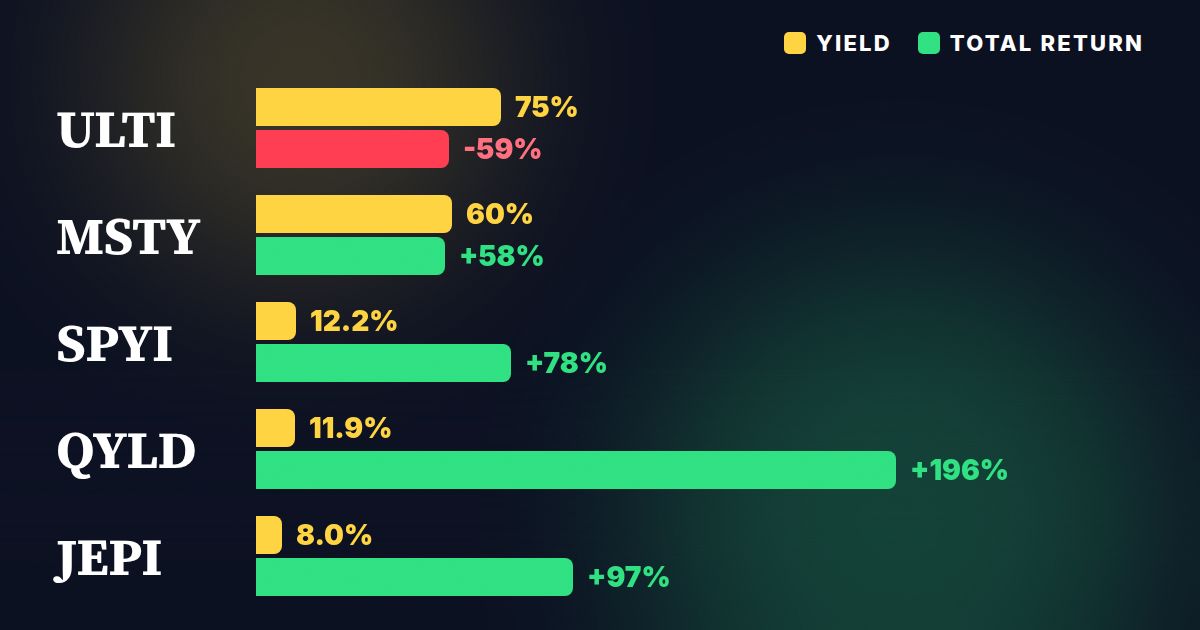
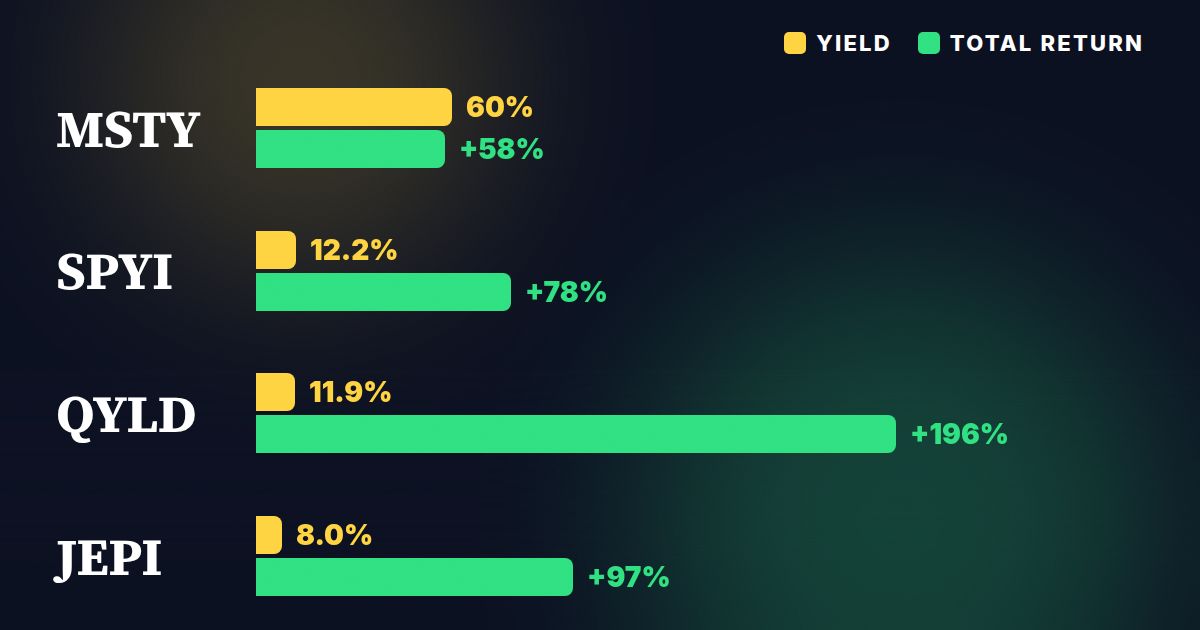
MSTY shows a 60.0% yield. On $10,000, that is $6,000 a year at today's yield. That sounds incredible until you remember a fund cannot reliably earn 83% a year from steady income. The money comes from option premiums tied to a very volatile stock, plus, at times, principal. Total return since inception is 44.0%, and the price decay flag in our data says Yes. Since it launched on 2/22/2024, it is a short track record, so I would never lean on it.
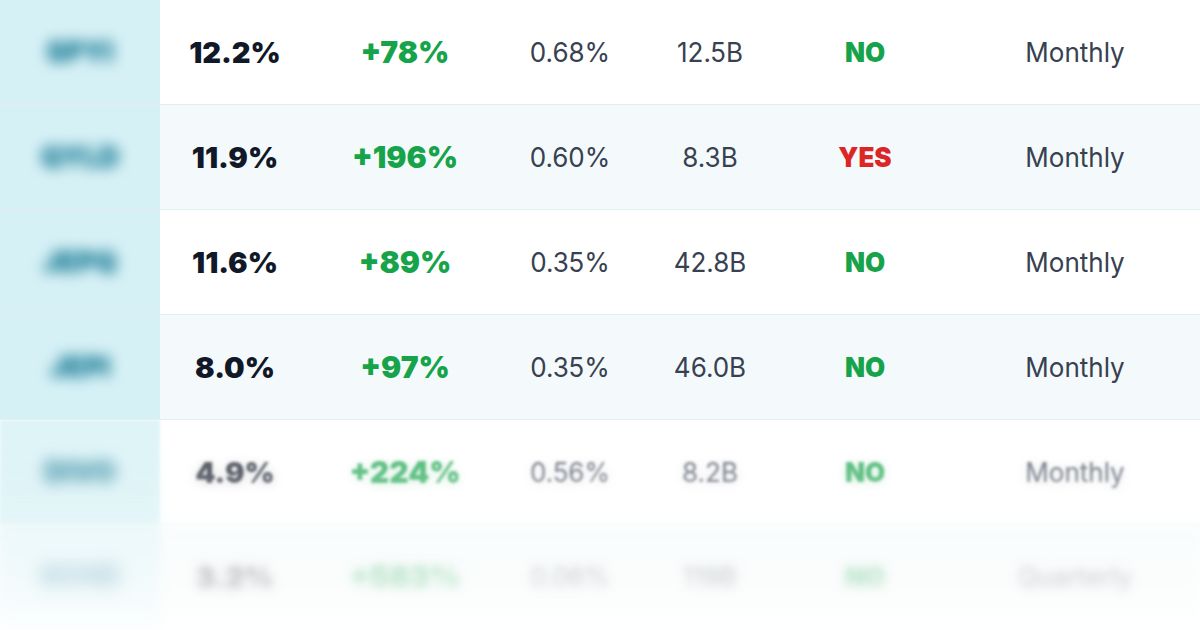
QYLD is the classic case study. It yields 11.7%, and $10,000 at today's yield pays about $1,170 a year. Its total return since 12/12/2013 is 194%. That is a positive number, but the price decay flag says Yes. A fund can have a big payout and a shrinking share price at the same time. Part of that is how covered call funds work: they cap upside, so the share price struggles to grow while the payouts keep flowing.
Now compare two funds with a similar style that our data flags differently. SPYI yields 12.2% with price decay at No. JEPI yields 8.0% with price decay at No. Different funds, different structures, different launch dates. The point is that a high yield alone does not tell you whether the payout is being earned or borrowed from your principal.
For contrast, SCHD yields 3.2% and VOO yields 1.1%. Those payouts are small, but they come from the dividends of the companies the fund holds, and the share price has room to grow. Total return since inception is 590% for SCHD and 823% for VOO. Careful here: those funds started in different years, so you cannot compare those numbers one to one with funds that launched in 2022 or 2024.
Is return of capital always bad?
No, and I want to be fair about it. There are three cases.
- Timing ROC. Rules about when income is recognized can make part of a payout look like ROC even though the fund's holdings did fine. Not much to worry about.
- Tax-efficient ROC. Some investors like that ROC defers tax. That is a real benefit in a taxable account, as long as you track your basis.
- Destructive ROC. The fund pays out more than it earns, NAV keeps falling and the payout eventually has to be cut. This is the one to avoid being surprised by.
The way to tell them apart is not the label. It is what happened to the share price and total return over time. I go deeper on this in The Yield Trap.
Common mistakes beginners make
- Treating every dollar as income. If you spend all of a high payout, you may be spending principal without realizing it.
- Chasing the yield column. A 14.3% yield on QQQI or 11.6% on JEPQ looks attractive next to 3.6% on SGOV. But yield is only one piece. Look at total return, fees and price trend too.
- Ignoring the tax form. Funds publish a breakdown of each year's distributions. If you never read it, you do not know what you were paid.
- Forgetting cost basis. ROC lowers your basis. Your broker usually tracks it, but check that it does.
- Assuming a past breakdown repeats. The ROC share can change a lot from year to year.
- Comparing funds with different start dates. A fund launched in 2024 has not been through the same market as one launched in 2013.
If you reinvest payouts automatically, the same logic applies. I walked through what that does over time in Reinvest or Spend?
The income math, with a reality check
Let's do the usual math at today's yields. On $100,000, JEPI would pay roughly $667 a month at its current yield. SPYI would pay about $1,018 a month. SCHD would pay about $267 a month, though it actually pays quarterly. And SGOV would pay about $303 a month.
Now the reality check. If you wanted $1,000 a month ($12,000 a year), you would need about $150,000 in JEPI at today's yield, or about $375,000 in SCHD. The higher yield means a smaller check to write. But it does not tell you how durable that $1,000 is, or whether your starting amount will still be worth the same in ten years. Yields also move, so treat these as snapshots.
What the same money pays at different yields
Estimated annual income at each fund's current yield
Today's income only. Yields change and are not guaranteed.
How to spot a payout that may be eating principal
You cannot see ROC on a live quote, but you can look for clues.
- Share price trend. Pull up a long chart. A steady slide while the fund pays a big yield deserves attention.
- Total return vs. yield. If you add up the price change plus the payouts and the result is weak, the yield was flattering you.
- The strategy itself. Funds that sell options on volatile assets, like MSTY, have to pay out large amounts that do not come from steady dividends.
- The fund's distribution notices and annual tax breakdown. This is the only direct evidence. The fund's own website is where to find it.
You can screen income funds with these checks at TopDividendETFsPRO, and project what a portfolio might pay with Dividend Projection. For the basics of how shares and fund price work underneath all this, my ETF 101 explainer helps.
What to check before buying any ETF
- The yield, and where it comes from. Dividends, interest, option premiums or something else?
- Total return since inception. And remember the start date. MSTY began on 2/22/2024, QYLD on 12/12/2013.
- Price decay. Does the share price drift lower over time?
- Expense ratio. This is the yearly fee. For example, 0.60% for QYLD and 0.99% for MSTY, versus 0.03% for VOO. My expense ratio math piece shows how that compounds.
- The distribution breakdown. How much was income, gains and ROC in recent years?
- Which account you hold it in. Taxable, IRA or Roth changes how ROC and cost basis matter.
FAQ
What is return of capital in an ETF?
It is a distribution that is not paid from the fund's earnings. It is a return of part of your original investment, which lowers your cost basis for tax purposes.
Is return of capital taxable?
Generally, ROC is not taxed when you receive it in a regular US taxable account. It reduces your cost basis, so you may owe more tax when you sell. Tax rules vary, so check with a tax professional.
Does a high-yield ETF always pay return of capital?
No. It depends on the fund and the year. Funds with very large yields, such as MSTY at 60.0%, are the ones to look at closely, and the fund's own tax breakdown is the only way to know for sure.
Is return of capital the same as price decay?
Not exactly, but they are related. ROC is a tax label on a payout. Price decay is the share price falling over time. A fund that pays out more than it earns can show both. Our data lists QYLD's price decay flag as Yes.
Should I avoid ETFs that pay return of capital?
Not automatically. Timing-related ROC can be harmless. What matters is whether total return, meaning price change plus payouts, holds up over time.
Bottom line
Return of capital is one of those ideas that sounds technical but is really about one question: is the money landing in my account earned, or is it my own money coming back? Sometimes it is a harmless tax-timing quirk. Sometimes it is a high yield funded by your own principal. The yield number cannot tell you which.
So I always do the same thing. Look at the yield, then total return, then the share price trend, then the tax breakdown. If those four tell the same story, I feel better about the payout. If they do not, I slow down. This is not a buy or sell signal, just a way to read what you are looking at. Do your own due diligence, and if you want to browse more income funds, the top 100 dividend ETFs list is a good place to start.
ETFs in this story
How this article was made: Benjie picks every topic based on what he finds useful as a dividend investor and what readers ask about. Parts of this article were drafted with help from AI tools, then edited, fact-checked and shaped by Benjie. All fund numbers come from the TopETFs database and update daily.
Disclaimer: TopETFs.com is published by Dividend Empire LLC for educational and entertainment purposes only. We are not financial advisors, and nothing on this site is financial advice, a recommendation, or a solicitation to buy or sell any security. ETF data is compiled from public sources and fund issuers, may be delayed, inaccurate or outdated, and may differ from the fund sponsor's own figures. Yields are trailing distribution yields, are not guaranteed, and distributions may include return of capital, which reduces your cost basis and is not a measure of performance. Total returns are since each fund's inception unless noted and are not comparable across funds with different start dates. Past performance does not guarantee future results. Investing carries risk, including loss of principal. Read each fund's prospectus and consult a licensed financial advisor before investing. Dividend Empire LLC receives compensation from ETF issuers for sponsored placements, which are labeled as such.