How Many ETFs Should You Own in a Roth IRA? (Usually Fewer Than You Think)
Wondering how many ETFs to hold in your Roth IRA? See the overlap math and a worked example comparing 2, 3 and 6 fund portfolios before you add another.
The short version
- Most Roth IRAs work well with 1 to 3 ETFs. Past that, you are usually adding complexity, not diversification.
- A new fund only helps if it does a different job: a new asset class, a new region or a different risk level. Another US large cap fund mostly repeats what you already own.
- Count the jobs, not the tickers. If you cannot say in one sentence what a fund does for your portfolio, it probably does not need to be there.
For most people, the right number of ETFs in a Roth IRA is between one and three. One broad fund can be a complete portfolio, and three funds (US stocks, international stocks, bonds or cash) cover almost every need. Owning six or ten does not make you safer if they all hold the same companies.
I see this a lot: someone opens a Roth, buys five ETFs because five feels safer than one, and later finds out they own the same ten stocks five times. Let's walk through the overlap math, the common setups, and a worked example so you can pick your own number.
Why the number of funds is the wrong thing to count
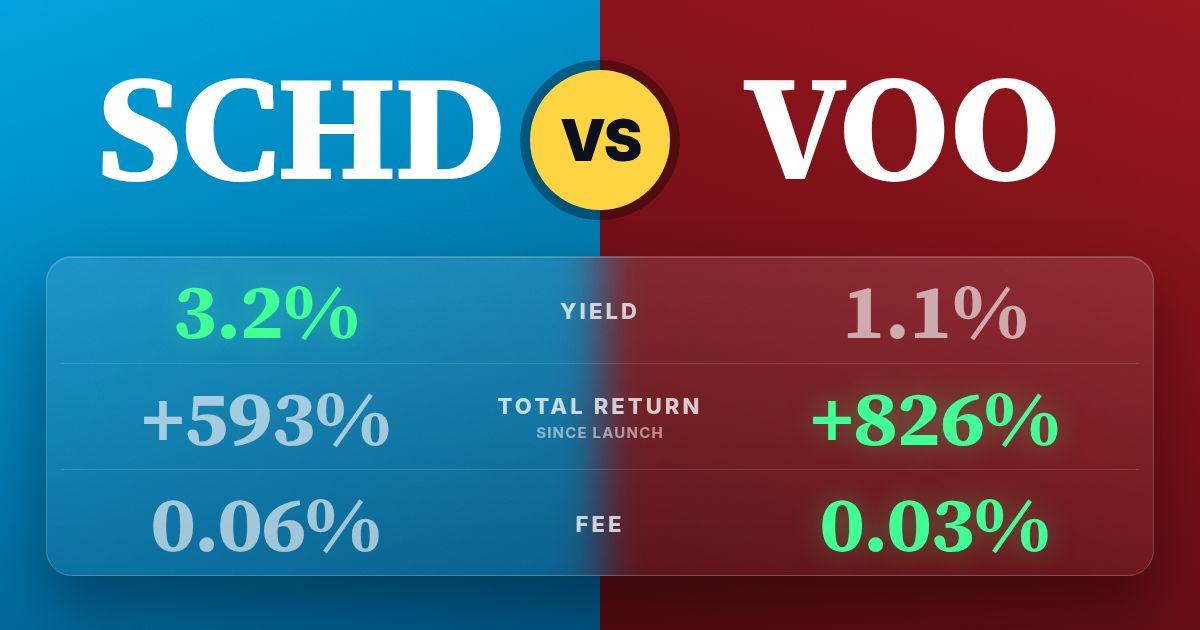
An ETF is already a basket. A fund like VOO holds hundreds of large US companies in one ticker. It has a fee of 0.03% and about $1.06T in assets, so you are not exactly taking a fringe bet by owning one fund.
Diversification comes from owning things that behave differently, not from owning more ticker symbols. Ten funds that all track big US growth companies will rise and fall together. Two funds that hold very different things (say, US stocks and short term Treasuries) will not.
So the real question is: how many different jobs does my Roth need done? Usually the answer is one to three.
The overlap math, with a simple example
Overlap is when two funds hold the same stocks. When you combine funds, your true exposure to any one stock is the weighted average of each fund's weight in it.
Here is a hypothetical to show the idea. These are assumptions for illustration, not real fund weights:
- Fund A holds a big tech stock at 7% of the fund.
- Fund B holds the same stock at 9% of the fund.
- You put 50% of your money in each.
Your exposure to that one stock is (50% x 7%) + (50% x 9%) = 8%. Compare that to holding only Fund A, where it is 7%. You added a second fund and your concentration in that stock went up, not down.
This is why pairing VOO with QQQ is a common surprise. QQQ tracks the Nasdaq 100, and many of its biggest holdings are also among the biggest names in the S&P 500 that VOO tracks. Some people like the extra tilt toward growth, and that is a legitimate choice, but it is a tilt, not new diversification. I go deeper on that in VOO vs QQQ.
A quick overlap test: look up the top 10 holdings of each fund (your broker or the fund company's page shows them). If the same names show up in both lists, the second fund is mostly a repeat.
One fund, two funds, three funds: what each setup really means
One fund
A single broad stock fund, or a target date or balanced fund, can be an entire Roth. It is hard to mess up, there is nothing to rebalance if you choose an all in one fund, and the fee is low. The trade-off is that you have one risk level and one set of holdings, so you give up fine tuning.
Two funds
A common version is a US stock fund plus an international stock fund, or a stock fund plus a bond or Treasury fund. Two funds let you set your own mix while keeping rebalancing simple: you only ever adjust one percentage.
Three funds
The classic three fund setup is US stocks, international stocks and bonds. Each does a clearly different job. It is simple enough to maintain for decades and covers most of the global market and most risk levels.
Four or more
Past three, each extra fund has to earn its spot. Reasonable reasons include a short term Treasury fund like SGOV as a cash bucket (yield 3.64%, fee 0.09%), or a deliberate tilt toward a strategy you understand. Unreasonable reasons include "it looked good on a list" or "I wanted to spread it around."
When adding another fund actually adds diversification
Adding a fund helps when it passes at least one of these tests:
- Different asset class. Stocks versus bonds versus cash. These tend to behave differently in a downturn.
- Different geography. US stocks versus international stocks.
- Different purpose. A cash bucket you plan to spend from soon, versus money you will not touch for 25 years.
- Low overlap with what you own. Check the top holdings. If they are mostly different companies, it is doing something new.
It does not help when the new fund is another US large cap fund with a slightly different label. A dividend focused fund like SCHD (yield 3.20%, fee 0.06%) holds a different mix than VOO, so it does diversify the style of your stock exposure, but it is still US stocks. It changes the flavor of your portfolio, not the category.
Worked example: a 2, 3 and 6 fund Roth
Let's say you have $50,000 in a Roth IRA and a long time horizon. All percentages and blended fees below are hypothetical assumptions to illustrate the math, not recommendations.
| Setup | Holdings (assumed mix) | Jobs done | Assumed blended fee | Fee on $50,000 per year |
|---|---|---|---|---|
| 2 funds | 70% VTI, 30% VXUS | US stocks, international stocks | 0.05% | $25 |
| 3 funds | 60% VTI, 25% VXUS, 15% BND | US stocks, international stocks, bonds | 0.06% | $30 |
| 6 funds | 30% VOO, 20% QQQ, 15% SCHD, 20% VXUS, 10% BND, 5% SGOV | US stocks (three overlapping funds), international stocks, bonds, cash | 0.09% | $45 |
Look at what the six fund version really is. 65% of the money (VOO, QQQ and SCHD) sits in US large companies, so those three funds are doing roughly one job with three tickers. Then you have three small pieces (international, bonds, cash) that are each small enough that they barely move the result.
The 2 fund and 3 fund versions get you to the same place with fewer moving parts. The fee gap is small in dollars ($25 versus $45 a year in this example), so I would not choose based on fees alone. The bigger cost of the six fund version is time, rebalancing across six lines, and the temptation to tinker.
That said, the six fund version is not wrong if you understand why each piece is there. It is just rarely better. If you want the growth tilt of QQQ, you can add it on purpose as a small satellite on top of a core fund. The point is to choose the tilt, not stumble into it.
How to pick your number: step by step
- List everything you own across all accounts. Include your 401(k), taxable brokerage and any other IRA. Your Roth is one part of one portfolio, so judge diversification across all of it.
- Decide your stock and bond or cash split. This is the biggest decision, and it depends on your age, goals and how you handle market drops. Be honest about the second part.
- Pick one fund per job. One for US stocks, one for international if you want it, one for bonds or cash if you want it. Stop there unless you have a clear reason.
- Run the overlap check. Compare the top holdings of any two funds that sound similar. If the lists look alike, drop one or accept that it is a tilt.
- Set target percentages. Write them down. A simple plan beats a clever one you abandon.
- Choose a rebalancing rule. For example, check once or twice a year, or when a fund drifts a set number of percentage points from target. Inside a Roth you generally do not owe tax for rebalancing trades, which is one of its quiet advantages, but confirm the current rules for your situation.
Roth IRA specifics that affect this decision
A Roth IRA is the account where your money can grow tax free, and qualified withdrawals are tax free too. Because there is no yearly tax on dividends and trades inside it, you do not need to worry about tax drag when choosing between funds, and you can rebalance freely. The rules on contribution limits and income limits change over time, so check the current numbers on the IRS website or with your broker.
Another practical point: your contribution limit caps how much you can add each year, so a small Roth balance is another reason to keep things simple. Splitting $500 across five funds can mean tiny positions that are annoying to rebalance. Many brokers offer fractional shares and commission free trades, but check yours.
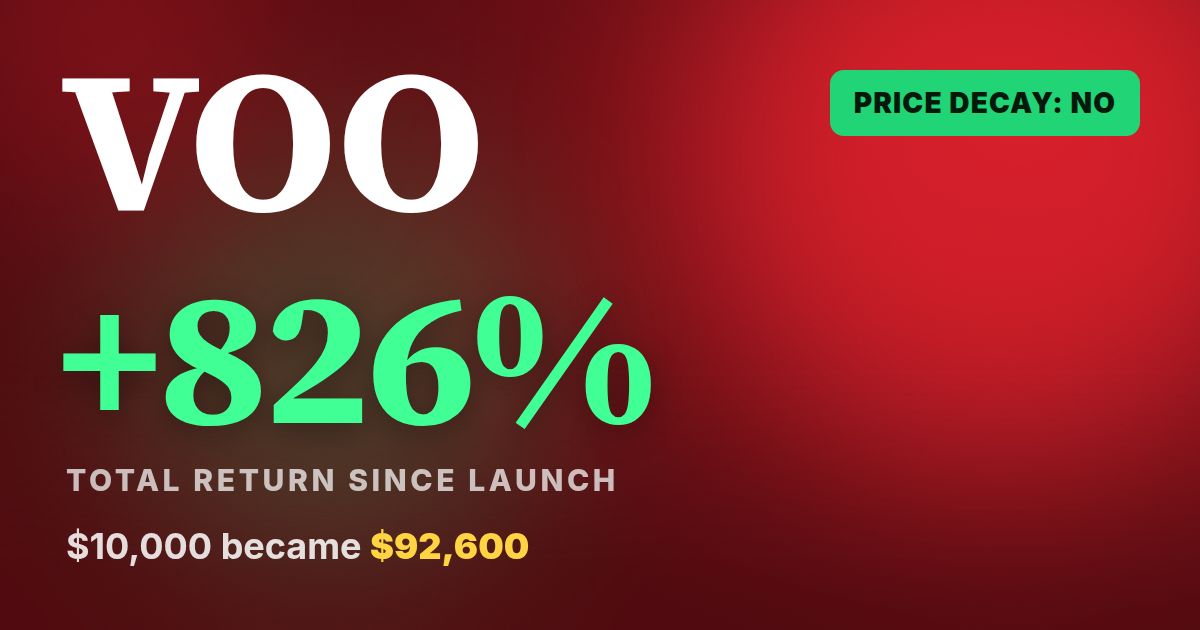
Because Roth money is often your longest-term money, people lean toward growth here. If that is you, look at the options in the best growth ETFs by total return, fees and size, and remember that total returns depend on when each fund launched. For example, QQQ shows 1,522% since inception and VOO shows 826% since inception, but they started at different dates, so they are not a fair head to head.
Common mistakes
- Buying overlapping funds and calling it diversification. Same top holdings, different tickers. Always check.
- Adding a fund every time you contribute. Funds pile up over the years. Put new money into the funds you already have, according to your target percentages.
- Chasing last year's winner. A new fund because it did well recently is a return chase, not a plan.
- Using leveraged funds as a core holding. Funds like TQQQ reset their leverage daily and can lose money over time even when the index rises. I explain how in leveraged ETF decay. If you use one at all, it should be a small, deliberate piece, not the foundation.
- Ignoring your other accounts. If your 401(k) already holds a big US index fund, a second US index fund in your Roth is probably duplicate exposure.
- Overcomplicating with niche funds. Sector, theme and strategy funds can be fine as small additions, but they are not a replacement for a core.
Edge cases
- You want income too. A dividend fund like SCHD can be a style choice, but a Roth does not need dividends to work. Reinvested growth compounds just the same. For income focused ideas, see the best dividend ETFs for beginners.
- You are close to retirement. You may want a bond or short Treasury fund as a cash buffer. That is a good reason for a second or third fund.
- You hate rebalancing. A single target date or balanced fund can handle it for you. You trade control for simplicity.
- You hold several Roth IRAs. Treat them as one portfolio. Do not assume each one needs its own full set of funds.
Quick checklist
- Can I explain each fund's job in one sentence?
- Have I checked the top holdings of any two similar funds for overlap?
- Do I have no more than one fund per job?
- Are my target percentages written down?
- Do I have a simple rebalancing rule and a date to check?
- Have I looked at my full portfolio, not just the Roth?
If you want to explore fund options, the ETF screener lets you compare funds by fee and size, and the calculators help you test how different mixes might play out. For more growth fund ideas, GrowthETFs.com is worth a look.
FAQ
Can I own just one ETF in my Roth IRA?
Yes. A single broad market ETF or an all in one fund can be a complete portfolio. You give up the ability to fine tune your stock and bond mix, but you gain simplicity.
Is 10 ETFs too many for a Roth IRA?
For most people, yes. Unless each fund does a clearly different job, ten funds usually means heavy overlap, extra rebalancing and more chances to second guess yourself.
Should I hold the same ETFs in my Roth and my taxable account?
You can, but look at the whole picture. Many people put their growth heavy or highest taxed holdings in the Roth and keep the rest elsewhere. Tax rules vary, so check with a tax professional about your situation.
Do I need a bond ETF in my Roth IRA?
Not necessarily. It depends on your time horizon and how you handle drops. Some younger investors hold only stocks, while others add a bond or Treasury fund for stability.
Should I add a new ETF each year when I contribute?
Usually not. It is simpler to put new money into the funds you already own, in line with your target percentages. Add a fund only when it fills a gap.
Does owning more ETFs lower my risk?
Only if the funds behave differently. Several funds holding the same large US stocks move together, so your risk barely changes.
Benjie's bottom line
Here's the thing: more funds feels safer, but it is the mix that does the work. For most Roth IRAs, one to three ETFs, each with a clear job, is plenty. Check overlap before you add anything, write down your percentages, and let time do the heavy lifting.
This isn't a buy or sell signal, and the mixes above are hypothetical examples, not advice. Your age, goals and other accounts matter, so do your own due diligence and talk to a tax professional or financial advisor if you are unsure.
ETFs in this story
How this article was made: Benjie picks every topic based on what he finds useful as a dividend investor and what readers ask about. Parts of this article were drafted with help from AI tools, then edited, fact-checked and shaped by Benjie. All fund numbers come from the TopETFs database and update daily.
Disclaimer: TopETFs.com is published by Dividend Empire LLC for educational and entertainment purposes only. We are not financial advisors, and nothing on this site is financial advice, a recommendation, or a solicitation to buy or sell any security. ETF data is compiled from public sources and fund issuers, may be delayed, inaccurate or outdated, and may differ from the fund sponsor's own figures. Yields are trailing distribution yields, are not guaranteed, and distributions may include return of capital, which reduces your cost basis and is not a measure of performance. Total returns are since each fund's inception unless noted and are not comparable across funds with different start dates. Past performance does not guarantee future results. Investing carries risk, including loss of principal. Read each fund's prospectus and consult a licensed financial advisor before investing. Dividend Empire LLC receives compensation from ETF issuers for sponsored placements, which are labeled as such.