Target-Date Fund vs. Index Funds: Which Is Better in Your 401(k)?
Target date fund vs ETF or index funds: compare fees, rebalancing, control and behavior with a 2055 fund against a DIY 80/20 VTI, VXUS and BND mix.
The short version
- A target-date fund is a one-fund, hands-off portfolio that shifts from stocks to bonds as your retirement year gets closer. A DIY index mix gives you control, but you do the rebalancing and you own the behavior risk.
- The real difference is usually fees and discipline. A low-cost target-date fund can match a DIY mix almost exactly. A pricey one can quietly cost you tens of thousands of dollars over decades.
- Inside a 401(k) you often can't buy ETFs at all, so the DIY version usually means index mutual funds. Check your plan's menu before you decide anything.
A target-date fund is better if you want one fund that handles allocation and rebalancing for you and you would otherwise tinker. A DIY mix of index funds or ETFs is better if you want a specific stock and bond split, lower costs than your plan's target-date option, or more control. Neither one wins on investment skill. It comes down to cost, control and what you will actually stick with.
What a target-date fund actually is
A target-date fund (like a 2055 fund) is a single fund that holds a mix of stock and bond funds inside it. You pick the year closest to when you expect to retire, and the fund does the rest.
The "glide path" is the schedule it follows. When you are far from retirement, the fund holds mostly stocks. As the date approaches, it gradually moves toward bonds and cash-like holdings to lower the swings. You never place a trade. The fund rebalances internally and shifts the mix for you.
Two things to know up front. First, glide paths are not standardized. One company's 2055 fund can hold noticeably more stock than another's, and that is a real difference, not a rounding error. Second, some target-date funds are built from low-cost index funds and some use more expensive actively managed funds. Same label, very different price tags.
What the DIY version looks like
Building your own means choosing a few broad index funds and deciding the percentages yourself. For this comparison I'll use a simple 80/20 mix of three funds:
- VTI: a total U.S. stock market fund
- VXUS: a total international stock fund (non-U.S.)
- BND: a total U.S. bond market fund
One common way to split 80% stocks is roughly 70% U.S. and 30% international, which works out to about 56% VTI, 24% VXUS and 20% BND. That split is an example, not a recommendation. Plenty of reasonable investors choose different ratios.
Here is how that looks on a $100,000 balance:
| Fund | Role | Weight | On $100,000 |
|---|---|---|---|
| VTI | U.S. stocks | 56% | $56,000 |
| VXUS | Intl stocks | 24% | $24,000 |
| BND | U.S. bonds | 20% | $20,000 |
That is three holdings and three percentages to maintain. Simple, but not zero work.
Side-by-side: 2055 target-date fund vs. DIY 80/20
Here is the honest comparison. The 2055 column describes how these funds generally work. The exact numbers vary by provider, so look at your plan's fact sheet.
| Factor | 2055 target-date | DIY 80/20 | Edge |
|---|---|---|---|
| Setup | Pick one fund | Pick and size three | Target-date |
| Rebalancing | Automatic | You do it | Target-date |
| Allocation shift | Automatic glide path | You change it | Target-date |
| Fees | Varies, can be high | Can be very low | DIY, often |
| Control | Low | Full | DIY |
Notice that a 2055 fund and an 80/20 mix are not the same risk level. Many 2055 funds hold more in stocks than 80% this far from retirement, often well into the 80s or 90s as a percentage, depending on the provider. So an 80/20 DIY mix is a bit more conservative than a typical 2055 fund today. If you compare returns without noticing that, you are comparing different risk levels, not just different products.
Fees: where the gap really shows up
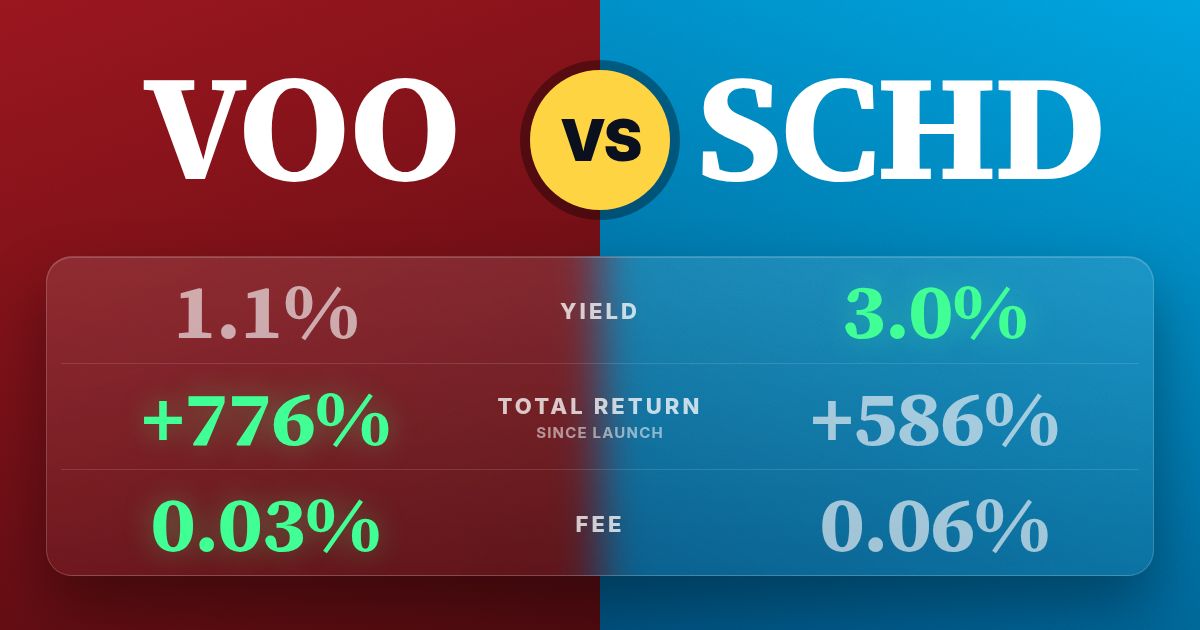
The expense ratio is the yearly fee taken out of the fund, shown as a percentage of your balance. Broad index funds have gotten extremely cheap. For perspective, a major S&P 500 ETF like VOO charges 0.03% a year.
Target-date funds built from index funds can also be cheap. But funds built from actively managed holdings can cost several times more. The fee is stated right on the fund's page in your 401(k) portal.
Here is a worked example. These fees are assumptions for illustration only, not quotes from any real fund. Say you have $100,000 today, no new contributions, and a 7% yearly return before fees over 25 years:
| Assumed fee | Cost in year 1 | Net return | After 25 years |
|---|---|---|---|
| 0.05% | $50 | 6.95% | about $536,000 |
| 0.15% | $150 | 6.85% | about $524,000 |
| 0.75% | $750 | 6.25% | about $455,000 |
The gap between the cheapest and priciest rows is roughly $80,000, and that is on a single $100,000 with no added contributions. Real 401(k) savers keep adding money, so the dollar gap is usually bigger.
The takeaway is not "DIY always wins." It is that a cheap target-date fund beats an expensive DIY setup, and a cheap DIY setup beats an expensive target-date fund. Look at the number, not the label.
Rebalancing and behavior: the part people underestimate
Rebalancing means selling a little of what has grown and buying a little of what has lagged, so you return to your target percentages. Without it, a stock-heavy mix drifts even more stock-heavy after a good run. I wrote a full breakdown in how often to rebalance an ETF portfolio, but the short version is once or twice a year is plenty for most people.
Inside a 401(k), rebalancing doesn't trigger taxes, so it is easy mechanically. The hard part is emotional. When stocks drop 25%, rebalancing means moving money into the thing that just fell. Many people can't make themselves do it. Some stop contributing or sell everything instead.
This is where target-date funds earn their keep. They remove the decisions. If you know you would be tempted to tinker, a single fund that you never have to touch is a real feature, not a compromise. If you want to understand what losses actually look like, I covered that in can you lose money in index funds.
Keep in mind that a target-date fund can still fall hard in a bad market, especially a 2055 fund this far from retirement. It is automatic, not protected.
The 401(k) catch: you may not be able to buy ETFs
Most 401(k) plans offer a fixed menu of mutual funds, not ETFs. So in a 401(k), "DIY" usually means picking index mutual funds from the plan's list, such as a total U.S. stock index fund, an international index fund and a bond index fund. Some plans offer a brokerage window that unlocks ETFs, but many don't.
Also, your plan's menu may not include cheap index options at all. In that case, a low-cost target-date fund might simply be the best thing on the list. If you want to use ETFs like VTI, VXUS and BND directly, an IRA at a brokerage is the usual place. For how the two structures compare outside retirement accounts, see ETF or index mutual fund in a taxable account.
There are also target-date ETFs now, so the "target date fund vs ETF" question is not always either/or. The structure (ETF or mutual fund) and the strategy (target-date or DIY) are separate choices.
How to decide in five steps
- Look up your plan's fund menu. Find the target-date option closest to your retirement year (2055 in this example) and note its expense ratio.
- Check what's inside it. Open the fact sheet. See whether it uses index funds or active funds, and what percent is in stocks today.
- Price the DIY version. Find the plan's broad index funds for U.S. stocks, international stocks and bonds. Add up the weighted fees for your intended split.
- Be honest about your habits. Will you rebalance on schedule and stay calm in a crash? If not, the automatic option has real value.
- Pick one approach and automate it. If you go DIY, set a calendar reminder to rebalance once or twice a year. If you want to automate contributions, see how to automatically buy ETFs every month.
Common mistakes
- Holding a target-date fund plus other funds. The fund is already a complete portfolio. Adding a stock fund on top quietly changes your allocation and defeats the point.
- Picking the fund by your age instead of your retirement year. Choose the year you plan to retire, not your birth year.
- Ignoring the expense ratio. Two 2055 funds can differ a lot in cost. Check it.
- Assuming all glide paths are the same. They are not. Compare the stock percentage, not just the year in the name.
- Overlapping funds in a DIY mix. If you hold several stock funds that own the same companies, you are less diversified than you think. See how to check ETF overlap.
- Not rebalancing at all. A DIY 80/20 mix can drift to 90/10 after a long bull market without you noticing.
Quick checklist
- I know my target-date fund's expense ratio.
- I know roughly what percent of it is in stocks.
- I priced a DIY alternative using my plan's actual menu.
- I picked one approach, not both.
- If DIY, I have a rebalancing date on my calendar.
- I'm not double-counting other funds on top of a target-date fund.
If you want to explore other options outside your 401(k), the ETF screener and GrowthETFs.com are good places to compare funds, and the calculators can help you run your own fee and growth math.
FAQ
Is a target-date fund better than index funds?
Not automatically. A target-date fund is better for convenience and avoiding behavior mistakes. Index funds can be better for lower cost and control. A cheap target-date fund and a DIY mix can end up nearly identical.
Are target-date funds just index funds?
Some are built from index funds and some from actively managed funds. Either way, a target-date fund is a bundle of other funds with an automatic glide path on top. Check the fact sheet to see which kind yours is.
Can I hold ETFs in my 401(k)?
Only if your plan allows it, usually through a brokerage window. Most plans offer a set menu of mutual funds. Your plan documents or HR portal will tell you.
Is an 80/20 mix too aggressive or too conservative for a 2055 target?
It depends on the person. It is more conservative than many 2055 target-date funds, which tend to hold more stock this far out. The right mix depends on your timeline and how much of a drop you can tolerate.
Should I own a target-date fund and a separate index fund?
Usually not. The target-date fund is already a full portfolio, so adding another fund changes your allocation away from what the fund is designed to do.
Do I pay taxes when a target-date fund rebalances?
Not inside a 401(k) or IRA, since the account is tax-sheltered. In a regular taxable account, fund activity can create taxable distributions, so confirm with a tax professional.
Benjie's bottom line
Here's the thing: this is less about which product is smarter and more about which one fits you. If your 401(k) has a cheap target-date fund and you know you would tinker, using it is a perfectly good decision. If your plan has low-cost index funds and you will rebalance on schedule, a DIY mix can save you money and give you control.
What I would avoid is paying a high fee for either one without knowing it. Look up the expense ratio, check the stock percentage, and pick the setup you can stick with for 25 years. This isn't a buy or sell signal, and your plan, taxes and timeline are your own, so do your own due diligence and talk to a tax or financial professional if you're unsure.
How this article was made: Benjie picks every topic based on what he finds useful as a dividend investor and what readers ask about. Parts of this article were drafted with help from AI tools, then edited, fact-checked and shaped by Benjie. All fund numbers come from the TopETFs database and update daily.
Disclaimer: TopETFs.com is published by Dividend Empire LLC for educational and entertainment purposes only. We are not financial advisors, and nothing on this site is financial advice, a recommendation, or a solicitation to buy or sell any security. ETF data is compiled from public sources and fund issuers, may be delayed, inaccurate or outdated, and may differ from the fund sponsor's own figures. Yields are trailing distribution yields, are not guaranteed, and distributions may include return of capital, which reduces your cost basis and is not a measure of performance. Total returns are since each fund's inception unless noted and are not comparable across funds with different start dates. Past performance does not guarantee future results. Investing carries risk, including loss of principal. Read each fund's prospectus and consult a licensed financial advisor before investing. Dividend Empire LLC receives compensation from ETF issuers for sponsored placements, which are labeled as such.