How Do ETFs Avoid Capital Gains? The In-Kind Trick, Explained
ETFs rarely send you capital gains bills thanks to in-kind creation and redemption. Here's how it works, a dollar example, and which ETFs still pay gains.
The short version
- Most stock ETFs avoid capital gains distributions because they hand out shares of stock (in kind) instead of selling them for cash when big investors redeem.
- Mutual funds usually have to sell holdings to pay departing investors, which creates gains that get passed to everyone who stayed.
- The protection is not perfect. Active, bond, leveraged and some option-based ETFs can still distribute gains, and you still owe tax on your own gain when you sell.
ETFs avoid capital gains mostly because of how shares are created and destroyed. When large institutions redeem ETF shares, the fund usually pays them with a basket of securities instead of cash, so the fund never sells anything and never books a taxable gain. That gain stays unrealized, and you don't get a surprise tax bill from the fund.
That's the short answer. The longer one is worth knowing, because it explains why some ETFs are great in a taxable account and why a few are not. Let's walk through it in plain English.
First, what is a capital gains distribution?
When a fund sells a holding for more than it paid, that profit is a realized capital gain. Funds are required to pass realized gains on to shareholders, usually once a year near the end of the year. That payout is a capital gains distribution.
Here's the part that annoys people. You owe tax on that distribution in a regular taxable brokerage account even if you never sold a single share and even if you reinvested it. Someone else's selling created your tax bill.
If you want the full picture of what gets taxed and when, I covered it in Do You Pay Taxes on ETFs Every Year, Even If You Don't Sell?
Why mutual funds distribute more gains
A traditional mutual fund deals directly with its investors. When you want out, you sell your shares back to the fund, and the fund pays you cash. If the fund doesn't have enough cash on hand, it has to sell some of its holdings.
Say a fund bought a stock years ago at $20 and it's now worth $100. If heavy redemptions force the fund to sell it, that $80 gain is realized. The fund then distributes it to all remaining shareholders, including people who bought last month and never saw that $80 of growth.
This gets worse when the market is falling and lots of people head for the exits at once. Remaining holders can get a gain distribution in a year when the fund itself lost money.
The ETF trick: creation and redemption baskets
An ETF works differently because most people never deal with the fund directly. You buy and sell ETF shares on an exchange from other investors, the same way you trade a stock. Your trade doesn't force the fund to sell anything.
The fund itself only deals with a small group of large firms called authorized participants (APs). These are typically big banks and market makers. They are the only ones who can create or redeem ETF shares directly with the fund. Here's how it works:
- Creation: An AP gathers the securities the ETF holds (a basket that mirrors the fund) and delivers them to the fund. In return, the fund issues a block of new ETF shares, called a creation unit. The AP then sells those shares on the market.
- Redemption: When there are too many ETF shares around, the AP buys them on the market, hands a creation unit back to the fund, and receives a basket of the underlying securities in return.
The key phrase is in kind. Securities go in, securities come out. The fund doesn't sell stock for cash, so it doesn't realize a gain on the stock it hands over.
Why the fund sends out its lowest-basis shares
Here's the clever part. When an ETF redeems shares in kind, it gets to choose which specific lots of stock go into the basket. Funds tend to send out the lots with the lowest cost basis, meaning the ones with the biggest built-in gains.
Think of it as a washing machine for gains. The old, highly appreciated shares leave the fund with the AP, and the fund is left holding shares with a higher cost basis. Over time, that keeps the fund's embedded gains low and its distributions close to zero.
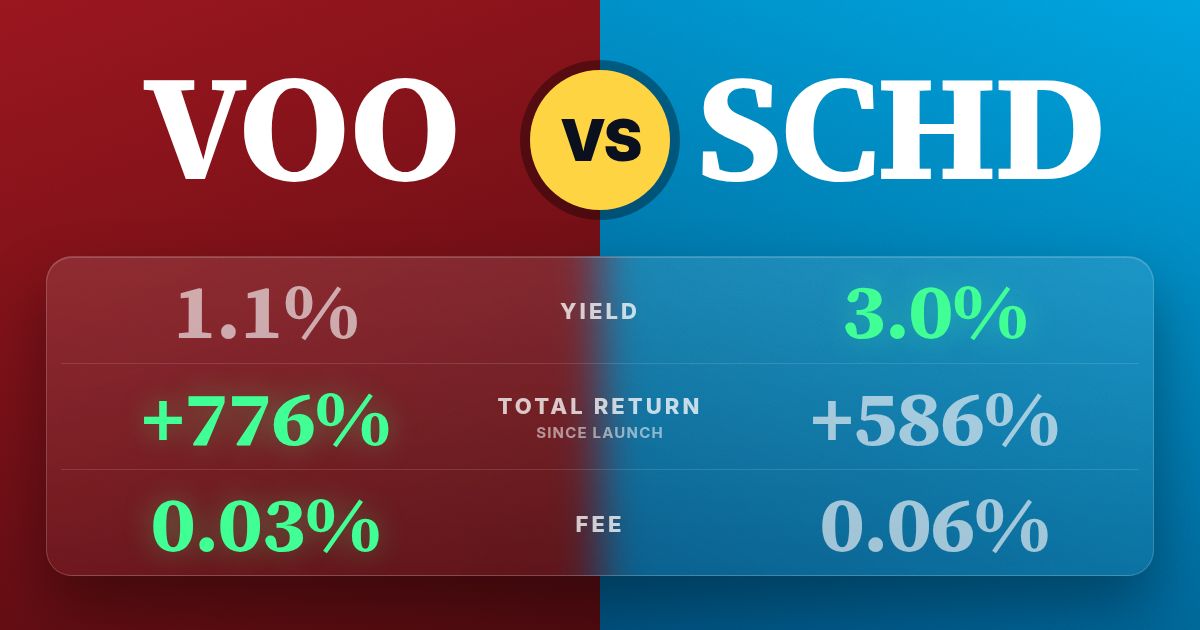
This is why a giant index ETF like VOO, with $1.04T in assets, can go years without sending its holders a capital gains bill. I'm using it as an example of how the structure works, not as a recommendation. Always check a fund's own distribution history rather than assuming.
Worked example: the same $50,000 in two structures
Let's put dollars on this. These numbers are hypothetical assumptions to show the mechanics, not the history of any real fund.
| Assumption | Mutual fund | Typical stock ETF |
|---|---|---|
| Amount invested | $50,000 | $50,000 |
| Gain distributed in year | 5% = $2,500 | 0% = $0 |
| Tax rate (assumed) | 15% | 15% |
| Tax due this year | $375 | $0 |
That $375 isn't a fee. It's tax paid earlier than you needed to. The money gets reinvested, so your cost basis goes up, but you've still handed over cash years before you chose to sell.
Now the honest part. The ETF investor doesn't escape the tax forever. If your $10,000 grows to $15,000 and you sell, you owe tax on the $5,000 gain. What the ETF structure does is let you decide when that happens, instead of a fund manager or strangers' redemptions deciding for you.
Which ETFs still distribute capital gains
The in-kind process is a strong shield, but it's not magic. Here are the places where gains still show up.
Bond ETFs
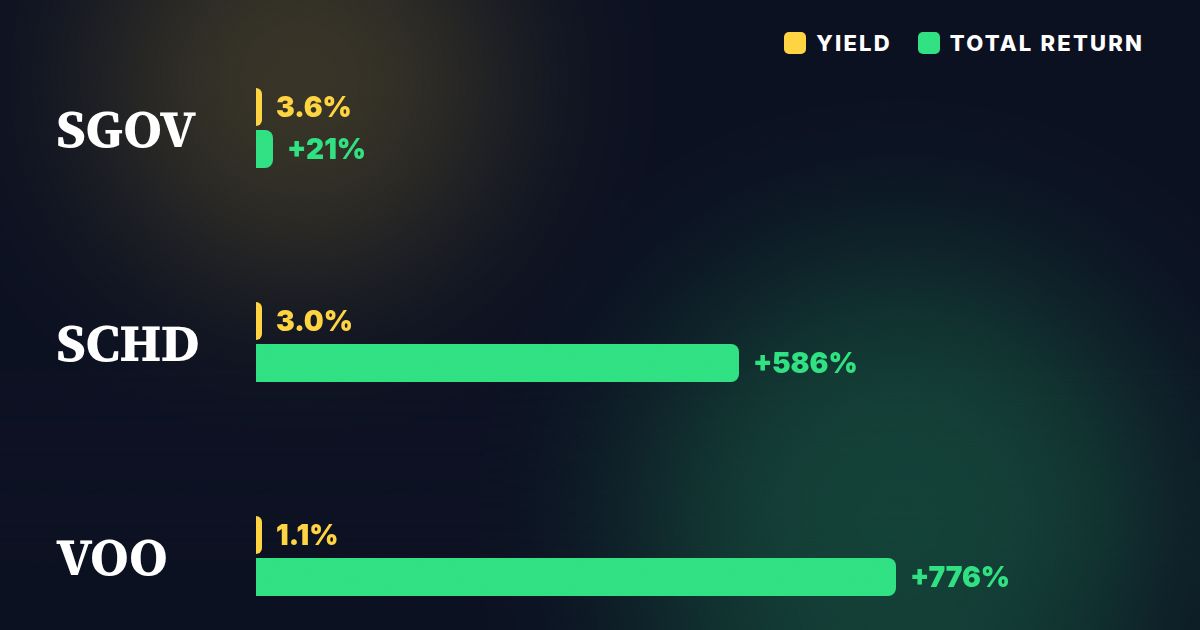
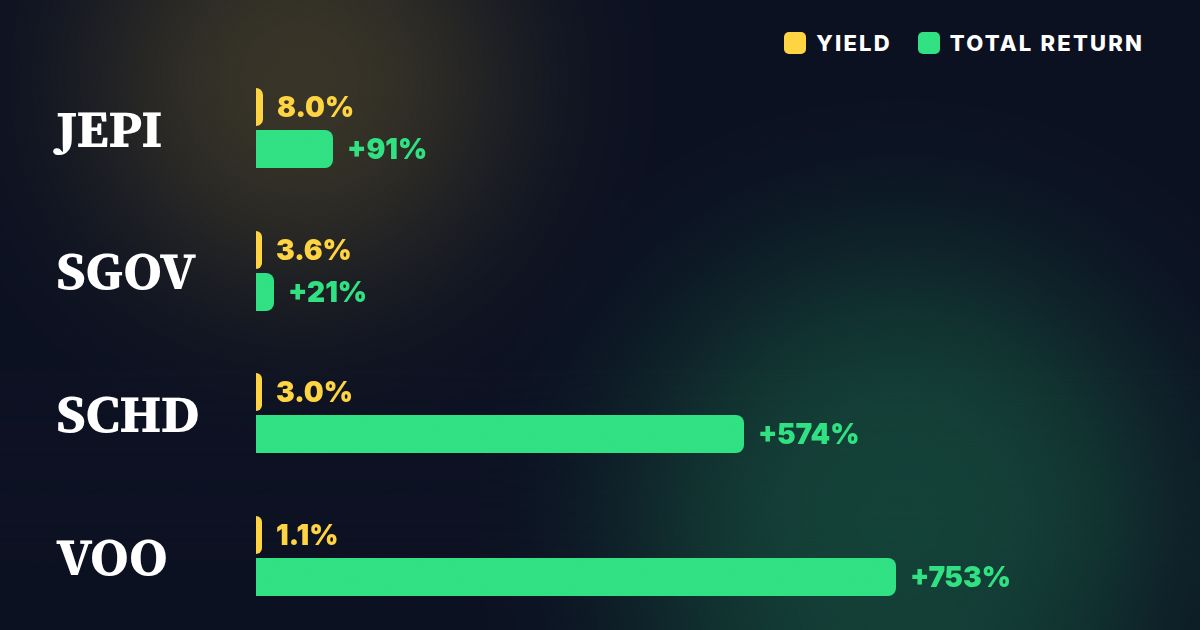
Bond funds often redeem partly or fully in cash, because bonds are harder to hand out in a neat basket. When cash is used, the fund may have to sell bonds and realize gains or losses. Also, most of what a bond ETF pays is interest income, which is taxed as ordinary income and has nothing to do with the in-kind trick. For example, a Treasury bill fund like SGOV currently shows a yield of 3.6%, and that payout is interest, not a capital gain.
Active ETFs
An active manager buys and sells more often. Every sale at a profit is a realized gain. Many active ETFs still use in-kind redemptions to purge gains, but higher turnover means a bigger chance of a distribution than in a plain index fund.
Option-income and derivative-heavy funds
Funds that sell options, hold swaps or use leverage can generate gains inside the fund that aren't easy to wash out through baskets. Some of these funds distribute gains, and others pay out amounts that get classified differently at tax time. Leveraged funds such as TQQQ are a good reminder to read the fund's documents and distribution history. I'm naming it only as an example of a more complex structure.
Funds with cash creations or restricted markets
Some ETFs hold assets that can't easily be delivered in kind, for example certain foreign markets with local rules. They may use cash for creations and redemptions, which weakens the shield.
Index changes and mergers
Even a plain index ETF can be forced to sell when a company is acquired for cash, or when the index changes in a way the fund can't absorb through in-kind trades. This is usually small, but it's why a low number of distributions isn't a guarantee.
How to check whether an ETF is likely to distribute gains
- Identify the type of fund. A broad stock index ETF is the most likely to be clean. Bond, active, option-income and leveraged funds deserve a closer look.
- Open the fund's distribution history. Every issuer's fund page has a distributions tab. Look for any line labeled capital gains or long-term capital gain, and check several years, not just one.
- Check your account type. In an IRA or 401(k), capital gains distributions don't create a current tax bill, so this whole topic matters far less there. It matters most in a regular taxable brokerage account.
- Look at your 1099-DIV. Your broker reports capital gain distributions you received. If a fund you own keeps showing up there, that's your answer about its habits.
- Weigh it against cost. A slightly higher fee can still be worth it if a fund does something you want, but tax drag and fees both compound. I broke down the fee side in The Fee That Compounds Against You.
- Confirm current rules. Tax rates and rules change. Check the current figures or ask a tax professional about your situation.
Common mistakes
- Thinking ETFs are tax-free. They aren't. Dividends and interest are taxed, and you owe tax on your own gains when you sell.
- Assuming every ETF is tax efficient. The structure helps, but the strategy inside matters. A bond or option fund can look nothing like a plain index fund at tax time.
- Buying right before a distribution in a taxable account. With mutual funds especially, you can buy into a tax bill created by gains you never enjoyed. Check the distribution schedule before a big purchase.
- Ignoring account location. Putting a tax-heavy fund in a taxable account and a tax-light fund in an IRA is often backwards.
- Forgetting that reinvested distributions are still taxed. Reinvesting doesn't make the tax go away in a taxable account.
- Selling a good ETF just to avoid a small distribution. Selling creates a tax event of its own, often a bigger one.
Edge cases worth knowing
Some funds that aren't ordinary stock ETFs follow different tax rules. Commodity funds, currency funds and some trusts may issue different tax forms or tax gains differently, so don't assume the stock ETF logic applies. Read the fund's tax section.
Also, a fund with very little redemption activity doesn't get as many chances to wash out gains. Newer or small ETFs may behave differently from giant ones, so size and trading volume can matter. If you want a refresher on the mechanics, ETFs 101: How an ETF Actually Works and What Is an ETF? cover the basics.
Want to compare funds by cost and size while you're deciding? The TopETFs screener is a good starting point, and GrowthETFs.com covers growth-focused funds if that's your lane.
Quick checklist
- Taxable account? Then capital gains distributions matter to you.
- Broad stock index ETF? Usually the cleanest case, but verify the history.
- Bond, active, option-income or leveraged ETF? Check distribution history before you buy.
- Look at last year's 1099-DIV for gain distributions you already received.
- Remember you still owe tax on your own gain when you sell.
FAQ
Do ETFs ever pay capital gains?
Yes. Many broad stock ETFs pay little or none, but bond, active, option-income and leveraged funds can and do distribute gains. Check the fund's distribution history.
Are ETFs more tax efficient than mutual funds?
Usually, for stock funds, because of in-kind redemptions. The gap can be small or nonexistent for some strategies, and some mutual funds are very tax efficient too.
What is an authorized participant?
An authorized participant is a large financial firm that is allowed to create or redeem ETF shares directly with the fund. They exchange baskets of securities for ETF shares and help keep the market price close to the value of the holdings.
Do I pay capital gains tax if I just hold an ETF?
You don't owe tax on your own price gain until you sell. You may still owe tax on dividends, interest and any capital gains the fund distributes in a taxable account.
Do capital gains distributions matter in an IRA or Roth IRA?
Generally not. Distributions inside a tax-advantaged account don't create a tax bill in the year they happen, though the account's own withdrawal rules still apply.
Is a capital gains distribution the same as a dividend?
No. A dividend comes from income earned by the holdings, such as company dividends or interest. A capital gains distribution comes from the fund selling holdings at a profit, and it can be taxed at different rates.
Benjie's bottom line
The in-kind trick is one of the quiet reasons ETFs became so popular. A basket goes in, a basket comes out, and the fund can send its lowest-basis shares away without selling anything. For broad stock index funds in a taxable account, that's a real advantage.
But I don't want you to walk away thinking ETFs dodge taxes. They defer a lot of them, and some strategies don't get the benefit at all. Look at the fund type, check the distribution history, and think about which account holds what. This isn't a buy or sell signal, and tax rules depend on your situation, so do your own due diligence or talk to a tax professional.
ETFs in this story
How this article was made: Benjie picks every topic based on what he finds useful as a dividend investor and what readers ask about. Parts of this article were drafted with help from AI tools, then edited, fact-checked and shaped by Benjie. All fund numbers come from the TopETFs database and update daily.
Disclaimer: TopETFs.com is published by Dividend Empire LLC for educational and entertainment purposes only. We are not financial advisors, and nothing on this site is financial advice, a recommendation, or a solicitation to buy or sell any security. ETF data is compiled from public sources and fund issuers, may be delayed, inaccurate or outdated, and may differ from the fund sponsor's own figures. Yields are trailing distribution yields, are not guaranteed, and distributions may include return of capital, which reduces your cost basis and is not a measure of performance. Total returns are since each fund's inception unless noted and are not comparable across funds with different start dates. Past performance does not guarantee future results. Investing carries risk, including loss of principal. Read each fund's prospectus and consult a licensed financial advisor before investing. Dividend Empire LLC receives compensation from ETF issuers for sponsored placements, which are labeled as such.