What Happens to Bond ETFs When Interest Rates Fall (or Rise)?
Bond ETF when interest rates fall: prices usually rise, and how much depends on duration. See a $10,000 worked example and how to pick duration.
The short version
- When interest rates fall, bond ETF prices usually rise. When rates rise, prices usually fall. The size of the move is set by the fund's duration.
- A rough rule: price change is about duration times the rate move. A fund with a duration of 6 years loses about 6% if rates rise 1 point, and gains about 6% if they fall 1 point.
- Bond ETFs never mature, so the price risk never fully "expires" the way it does with a single bond. You pick your risk by picking duration, and you match it to when you need the money.
When interest rates fall, the price of a bond ETF usually goes up, because the older bonds it holds pay more than new bonds do. When rates rise, the price usually goes down for the opposite reason. How much it moves depends on one number called duration: the longer the duration, the bigger the swing.
That is the whole idea. The rest of this guide is about making it concrete: what duration really means, what a 1 point move does to a short fund versus a long one in dollars, why bond ETFs behave differently from individual bonds, and how to choose a duration that fits what you are actually saving for.
Why bond prices move opposite to rates
Picture a bond that pays 4% a year. Then the market changes and new bonds of the same quality pay 5%. Nobody wants to pay full price for your 4% bond anymore, so its price has to drop until the whole package looks competitive. That is why rising rates push prices down.
Flip it. If new bonds only pay 3%, your 4% bond looks great, and buyers will pay more for it. Rates down, price up.
A bond ETF holds hundreds or thousands of bonds, and its share price is the market value of that whole basket. So the ETF price moves in the same direction as the bonds inside it.
One more thing worth knowing: bond prices respond to market yields, not directly to the Fed's headline rate. Short-term bonds track what the Fed does fairly closely. Long-term bonds track what investors expect over many years, so they can sometimes go the other way on the day the Fed cuts. That is why "rates fall" is a little fuzzy. Which rates, and how far out on the curve, matters.
Duration explained in plain English
Duration is a measure of how sensitive a bond or bond fund is to a change in interest rates. It is quoted in years, but you do not need to think about calendar time. Just use this shortcut:
Approximate price change = duration x change in rates (in percentage points), with the opposite sign.
- Duration of 2, rates up 1 point: price falls about 2%.
- Duration of 7, rates up 1 point: price falls about 7%.
- Duration of 7, rates down 1 point: price rises about 7%.
It is an estimate, not a guarantee. It works best for small moves and gets less exact for big ones. But it is the number professionals reach for first, and it will get you most of the way there.
You can find a fund's duration (often listed as "effective duration" or "average duration") on the issuer's fund page. It changes slowly over time, so check it rather than assuming.
Worked example: a 1 point move on short vs long funds
Let's say you put $10,000 into each of three hypothetical bond ETFs. These durations are assumptions chosen to show the pattern, not data on any real fund.
| Fund type (assumed duration) | Rates down 1 pt | Rates up 1 pt | Swing on $10,000 |
|---|---|---|---|
| Short (2 years) | +2% | -2% | about $200 |
| Intermediate (6 years) | +6% | -6% | about $600 |
| Long (17 years) | +17% | -17% | about $1,700 |
Same $10,000, same 1 point move, and the outcome ranges from a $200 change to a $1,700 change. That is the entire reason duration matters.
Now add income, because that is the other half of the story. Assume for simplicity that each fund pays about 4% to 5% a year in interest. Over one year, a long fund hit by a 1 point rise could still be down roughly 12% after counting income (about minus 17% from price plus about 5% from interest). The short fund in the same scenario might be roughly flat to slightly positive (about minus 2% from price plus about 4% from interest). Those are hypothetical numbers, but the shape is real.
And a note on 2022: bond funds fell broadly that year when rates rose quickly, including many people's "safe" holdings. It is a good reminder that bond ETFs are not cash.
Why bond ETFs never mature (and why that matters)
An individual bond has a maturity date. Hold it to that date and you get your face value back, no matter what the price did in between. The price wobbles along the way, but it is pulled toward par as the end approaches.
A typical bond ETF does not work that way. It holds a rolling portfolio. As bonds get close to maturity (or fall below the index's cutoff), the fund sells them and buys new ones to keep the portfolio matching its target. So the fund as a whole never reaches a maturity date, and its duration stays roughly constant over time.
What that means for you:
- There is no guaranteed return of principal on a date. You get whatever the shares are worth when you sell.
- Rising rates are not only bad news. The fund keeps reinvesting at the new, higher yields, so its income climbs over time.
- A useful rule of thumb: if you hold a fund for about as long as its duration, the early price drop from a rate rise is roughly offset by the extra income you earn afterward. This is an approximation, not a promise.
There are also "defined maturity" bond ETFs that hold bonds ending in a specific year and then wind down. They behave more like a bond ladder. Check the fund's documentation to see which kind you are buying.
How to pick a duration for your goal
The question to ask is not "will rates go up or down?" Nobody reliably knows. Ask: when do I need this money, and how much of a dip can I live with?
- Write down the goal and the date. Emergency fund, house down payment in 18 months, retirement spending, or long-term balance for a stock portfolio.
- Match duration to the time horizon. Money you need within a year or two belongs in very short duration. Money you will not touch for 7 to 10 years can tolerate more.
- Decide how much price swing you can accept. Use the shortcut: duration x 1 point. If a 6% drop on that money would force you to sell at a bad time, the duration is too long for that job.
- Check the credit quality. Duration measures rate risk only. A high-yield bond fund also carries default risk, which behaves more like stocks in a downturn.
- Check the fee and the yield. Fees come straight out of your income. Compare similar funds on cost, and look at the yield alongside duration, not instead of it.
- Review once or twice a year. Your time horizon shrinks as the goal gets closer, so duration should usually come down with it.
A rough map:
- Needed within about a year: ultra-short Treasury or T-bill funds.
- Needed in 2 to 5 years: short-term bond funds.
- Ballast for a long-term portfolio: intermediate funds, accepting that prices will move.
- Long-duration funds: mostly a rate bet or a hedge against a recession, not a place for money with a fixed deadline.
What about ultra-short funds like SGOV?
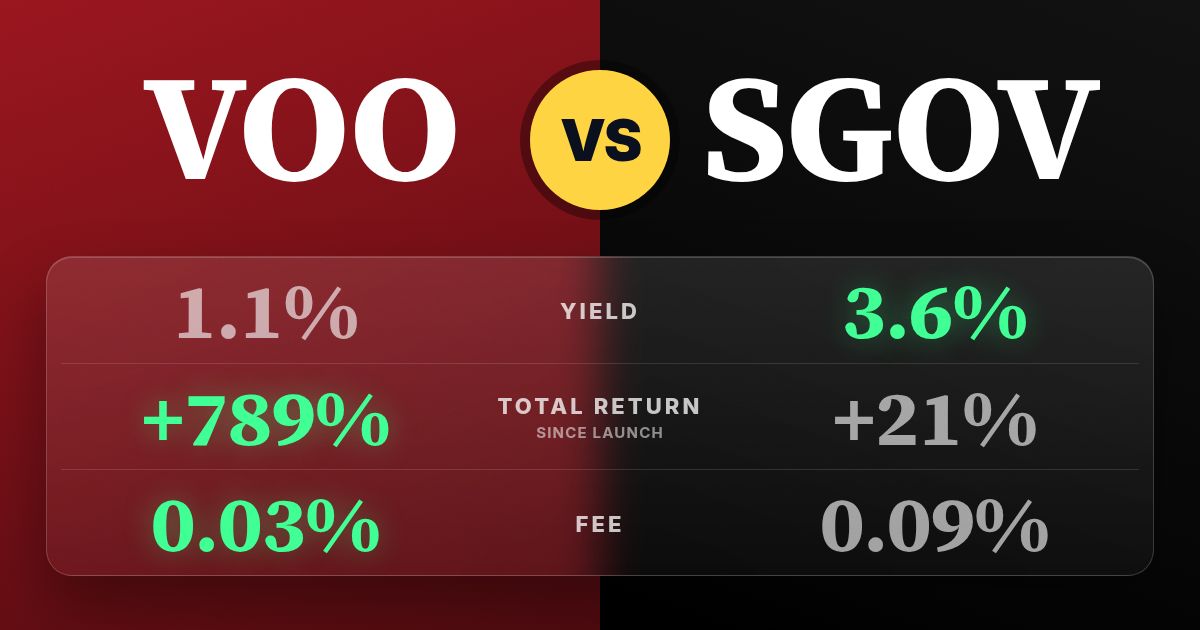
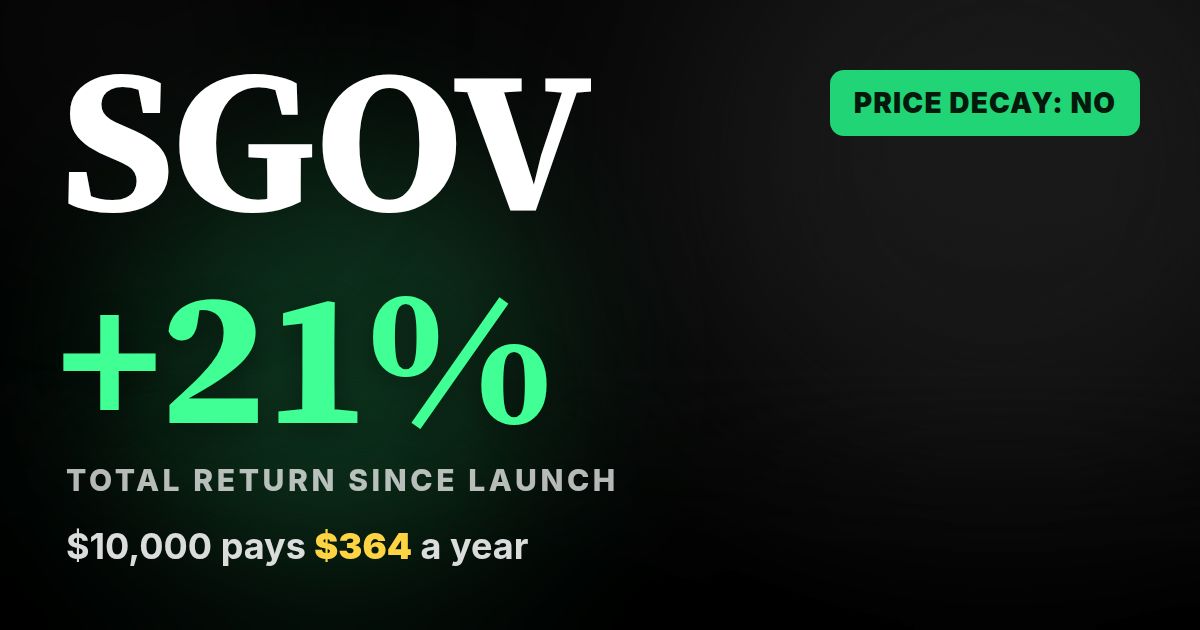
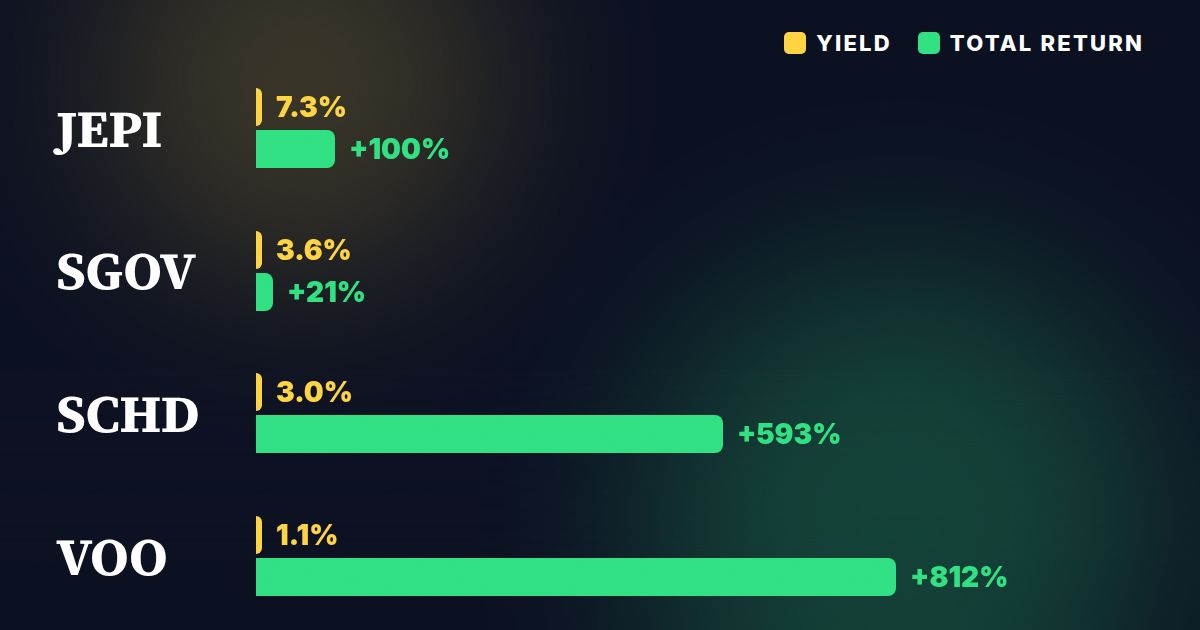
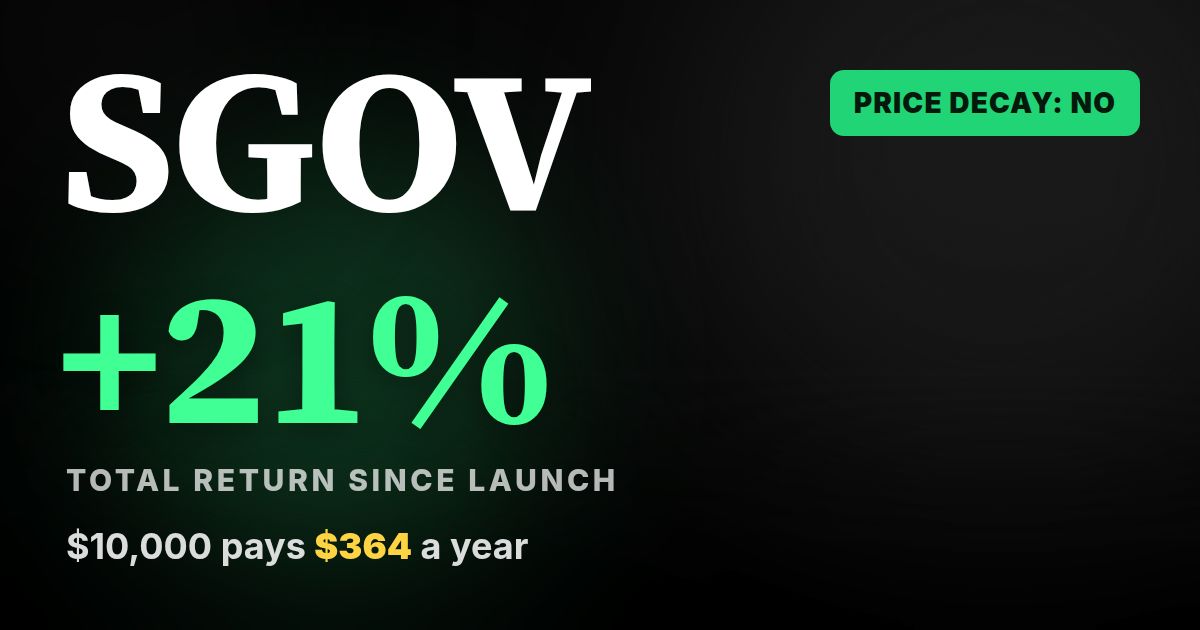
The extreme short end is worth its own paragraph. SGOV holds Treasury bills with 0 to 3 months left to maturity, so its duration is tiny and a rate move barely changes the share price. It shows a yield of 3.64% and an expense ratio of 0.09%, with $117B in assets.
The trade-off is the flip side of everything above. Because the bills roll over every few weeks, the income resets quickly when rates fall. You lose most of the price risk, but you also give up the chance to lock in today's rate for years. Ultra-short funds protect principal and give up the capital gain that longer funds get when rates drop. I compare that kind of fund with a savings account in Treasury ETF vs High-Yield Savings.
None of this is a buy or sell signal. It is about knowing what each tool does.
Common mistakes
- Chasing yield without checking duration. A higher yield often comes from longer duration or lower credit quality. Both carry risk that shows up when markets move.
- Assuming "bonds" means "safe." A long-duration bond fund can fall further in a bad year than many people expect.
- Selling after the drop. If you hold a fund close to its duration, selling after a rate spike locks in the loss and gives up the higher income that follows.
- Betting on a rate forecast. Even professionals miss the timing. Match the fund to the goal instead.
- Forgetting reinvestment risk. When rates fall, short funds pay less. That is a real cost, even though the share price stays steady.
- Ignoring taxes. Bond interest is generally taxed differently from stock gains, and the right account type can matter. Confirm the details for your situation or ask a tax professional.
How this fits into a retirement income plan
If you draw income from a portfolio, bonds are usually the part that funds the next few years of spending so you are not forced to sell stocks in a down market. Duration is how you size that risk. I walk through the idea in The 3-Bucket Retirement Strategy With ETFs, and the spending side is covered in How Much Can You Safely Withdraw in Retirement?. For turning cash into a payout stream, see How to Turn a Lump Sum Into Monthly Income With ETFs. You can compare funds on fees and yield in the ETF screener and run the numbers in the calculators.
Quick checklist
- I know the date I need this money.
- I looked up the fund's effective duration.
- I multiplied duration by 1 point and I can live with that loss.
- I checked credit quality, not only yield.
- I know whether the fund is a rolling or a defined-maturity ETF.
- I compared fees against similar funds.
- I have a plan to review duration as my goal gets closer.
FAQ
Do bond ETFs go up when interest rates fall?
Usually yes. Existing bonds with higher coupons become more valuable, so the fund's share price tends to rise. Longer-duration funds rise more than shorter ones.
Should I sell my bond ETF when rates rise?
Not automatically. The price drop is real, but the fund then reinvests at higher yields, so income rises. Whether to sell depends on your time horizon versus the fund's duration. This is not a buy or sell signal.
Can a bond ETF lose money even though it pays interest?
Yes. If the price drops by more than the interest you collect over the period, your total return is negative. That is what happened to many bond funds in 2022.
What is a good duration for a bond ETF?
There is no single answer. A rough guide is to keep duration at or below the number of years until you need the money, and to use shorter durations if a drop would be hard to live with.
Do short-term bond ETFs have no risk when rates change?
Much less price risk, but not zero. They still carry credit risk (depending on holdings) and reinvestment risk, since their income falls when rates fall.
Is a bond ETF safer than an individual bond?
Different, not necessarily safer. An individual bond returns face value at maturity if the issuer pays. A rolling bond ETF has no maturity date, but it gives you diversification and easy trading.
Benjie's bottom line
Bond ETFs are not magic and they are not cash. When rates fall, prices usually rise, and when rates rise, prices usually fall, with duration setting the size of the swing. Pick duration to match when you need the money, not to guess where rates go next. If you want to dig into the details for your own situation, check the fund's current duration, fees and holdings, and consider talking to a tax professional about the account you will hold it in. Do your own due diligence.
ETFs in this story
How this article was made: Benjie picks every topic based on what he finds useful as a dividend investor and what readers ask about. Parts of this article were drafted with help from AI tools, then edited, fact-checked and shaped by Benjie. All fund numbers come from the TopETFs database and update daily.
Disclaimer: TopETFs.com is published by Dividend Empire LLC for educational and entertainment purposes only. We are not financial advisors, and nothing on this site is financial advice, a recommendation, or a solicitation to buy or sell any security. ETF data is compiled from public sources and fund issuers, may be delayed, inaccurate or outdated, and may differ from the fund sponsor's own figures. Yields are trailing distribution yields, are not guaranteed, and distributions may include return of capital, which reduces your cost basis and is not a measure of performance. Total returns are since each fund's inception unless noted and are not comparable across funds with different start dates. Past performance does not guarantee future results. Investing carries risk, including loss of principal. Read each fund's prospectus and consult a licensed financial advisor before investing. Dividend Empire LLC receives compensation from ETF issuers for sponsored placements, which are labeled as such.