The 3-Bucket Retirement Strategy With ETFs: A Worked Example
The bucket strategy for retirement withdrawals, step by step: how much goes in cash, bonds and stocks, and how to refill, with a $1,000,000 example.
The short version
- The bucket strategy splits your retirement money by when you will need it: Bucket 1 is cash and T-bills for the next 1 to 2 years, Bucket 2 is bonds for years 3 to 7, and Bucket 3 is stocks for everything after that.
- In my $1,000,000 example with $40,000 a year of spending, that works out to about $80,000 in cash, $200,000 in bonds and $720,000 in stocks.
- The real skill is the refill rule: in good years you top up cash by trimming stocks, and in bad years you top it up from bonds and leave your stocks alone.
The 3-bucket strategy for retirement withdrawals means holding your next year or two of spending in cash or T-bills, the next several years in bonds, and the rest in stocks for long-term growth. You pay your bills from the cash bucket and refill it on a schedule, so you are never forced to sell stocks in a crash. Below I walk through a full $1,000,000 example with $40,000 a year of spending, using ETFs as the building blocks.
What the three buckets actually are
Think of it as sorting your money by when you will spend it. Money you need soon should not be in something that can drop 30% next quarter. Money you will not touch for 15 years can afford to ride out the bumps.
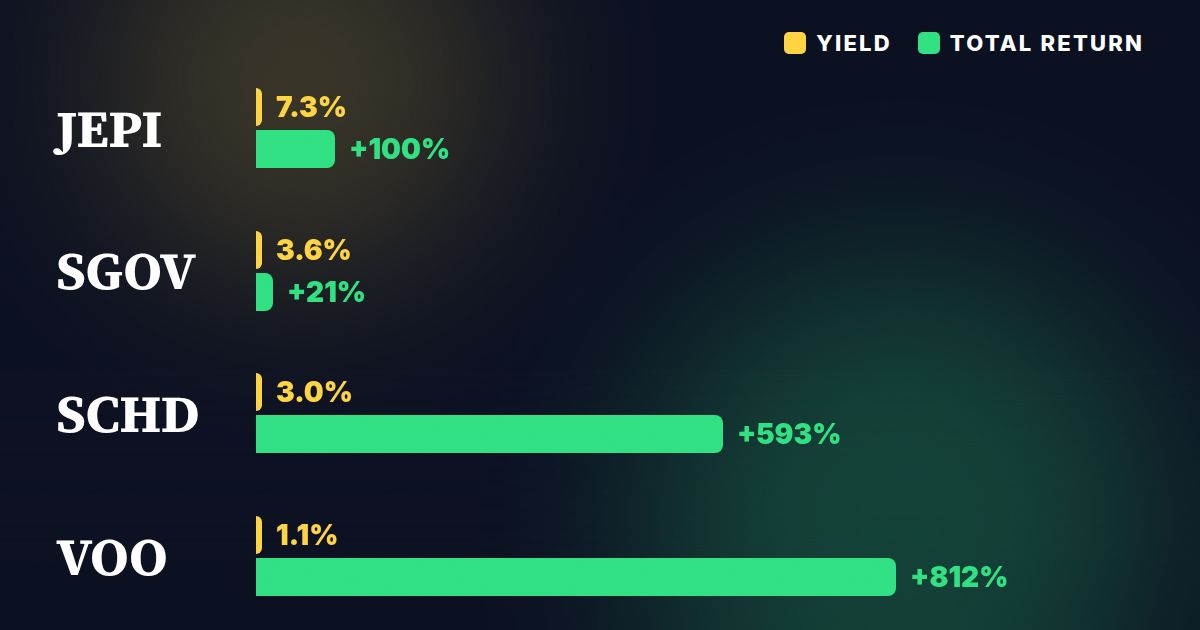
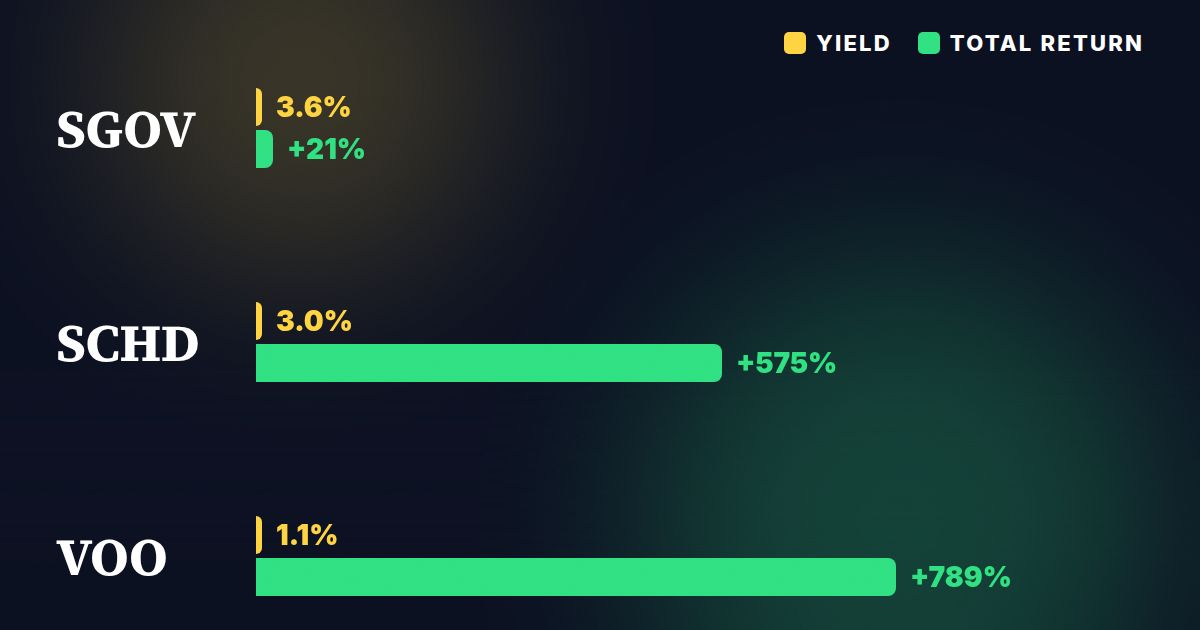
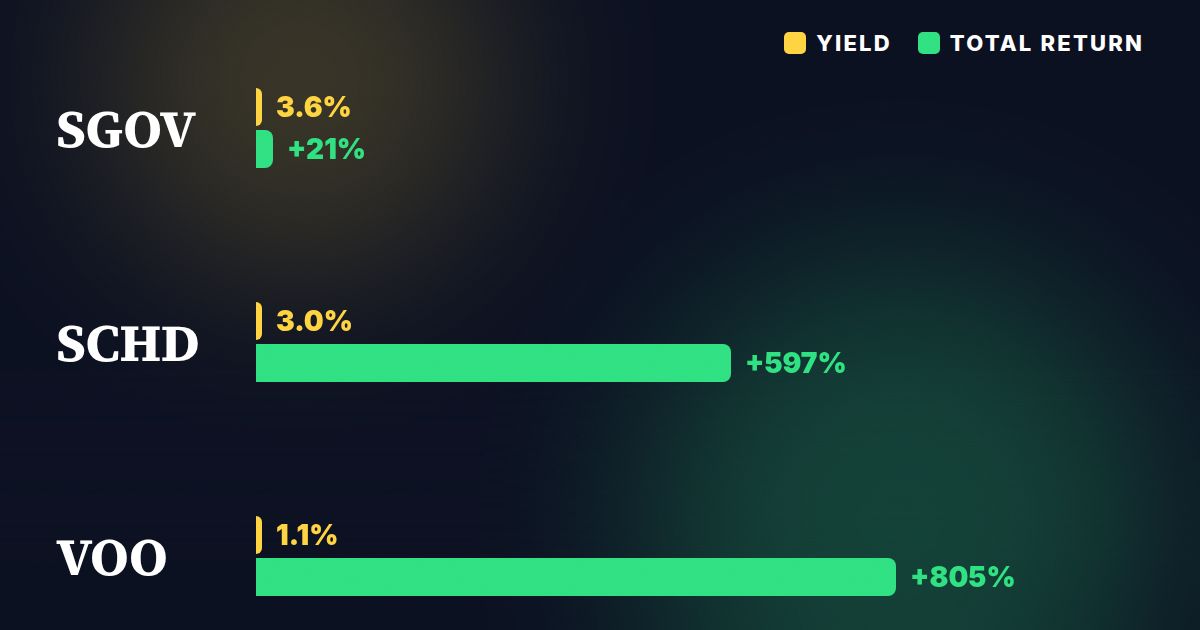
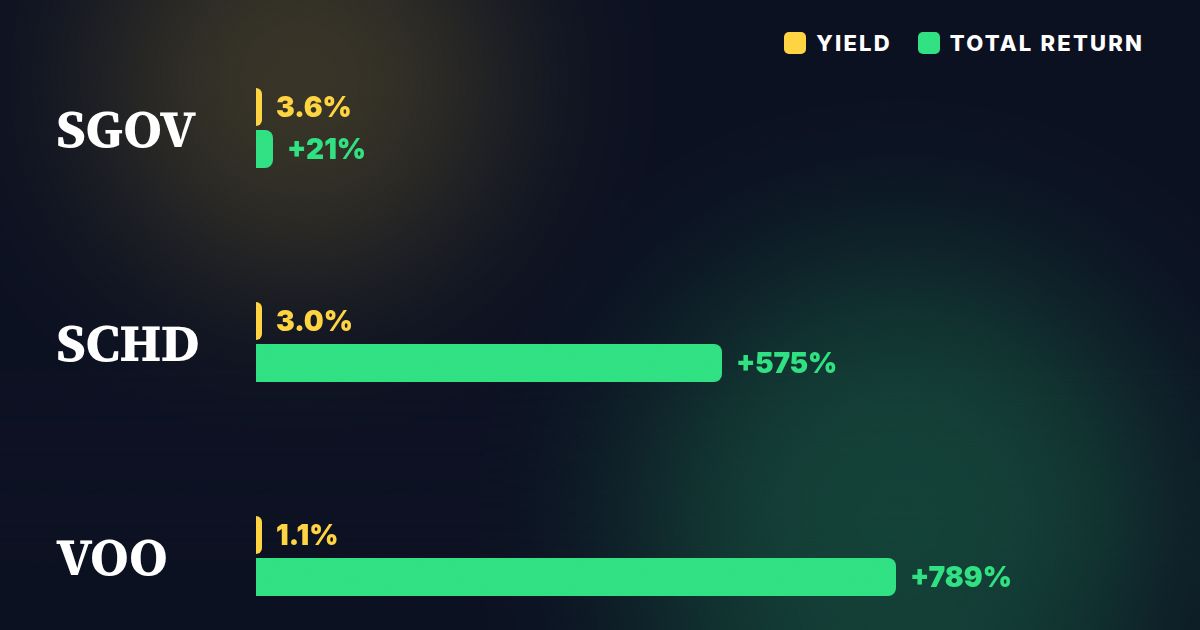
- Bucket 1, cash and T-bills (years 1 to 2): This is your paycheck replacement. A money market fund, a savings account, or a short Treasury ETF like SGOV fits here. SGOV holds very short-term U.S. Treasury bills, pays monthly, and currently shows a yield of 3.64% with a 0.09% expense ratio. That yield moves with short-term interest rates, so it will not stay there forever.
- Bucket 2, bonds (years 3 to 7): High-quality bonds or bond ETFs, usually short to intermediate term. Think broad bond market or Treasury funds such as BND or IEF (named only as examples, not recommendations). Their job is to be steadier than stocks and to pay some interest.
- Bucket 3, stocks (year 8 and beyond): Your growth engine. Broad index funds like VOO (expense ratio 0.03%) or dividend-focused funds like SCHD (expense ratio 0.06%) are common examples of what people hold here.
Funds in each bucket are examples of the type of holding, not a buy list. Your own mix depends on your situation.
How much goes in each bucket
There is no official formula, but the sizing method is simple: multiply your annual spending from the portfolio by the number of years each bucket should cover.
Here is the split I use in the worked example below:
- Bucket 1: 2 years of spending
- Bucket 2: 5 years of spending
- Bucket 3: everything else
Some people prefer 1 year in cash and 4 in bonds. Others want 3 years in cash because that helps them sleep. More in Buckets 1 and 2 means a smoother ride but less growth. More in Bucket 3 means the opposite. Neither is wrong, it is a trade-off between comfort and long-term return.
One more thing: spending means what you need to withdraw, not your total budget. If Social Security or a pension covers part of your costs, only size the buckets for the gap.
The worked example: $1,000,000 and $40,000 a year
Spending $40,000 from $1,000,000 is a 4% starting withdrawal rate. That is a common rule of thumb, not a guarantee, and it should be checked against your own age, taxes and time horizon.
| Bucket | Years covered | Math | Amount | Share |
|---|---|---|---|---|
| 1: Cash and T-bills | 1 to 2 | 2 x $40,000 | $80,000 | 8% |
| 2: Bonds | 3 to 7 | 5 x $40,000 | $200,000 | 20% |
| 3: Stocks | 8+ | Remainder | $720,000 | 72% |
| Total | $1,000,000 | 100% |
For illustration only, Bucket 3 could be split something like $504,000 in a broad index fund such as VOO and $216,000 in a dividend fund such as SCHD. That is a 70/30 split I picked for the example. It is not a recommendation.
So you start with seven years of spending sitting in cash and bonds. Even if stocks fall hard right away, you have a long runway before you must sell any of them.
Step-by-step: how to set it up
- Pick your annual withdrawal number. Add up what you need from the portfolio after Social Security, pensions or other income. In the example, $40,000.
- Choose your bucket lengths. I used 2 years of cash and 5 years of bonds. Adjust to your comfort level.
- Calculate the dollar targets. Multiply spending by years. Write them down. These are your refill targets.
- Assign accounts. If you have a taxable account, an IRA and maybe a Roth, decide which account holds which bucket. Cash for spending often sits where you can reach it easily, but taxes matter here (see below).
- Buy the holdings. Use ETFs or funds that match each bucket's job: short T-bills for Bucket 1, high-quality bonds for Bucket 2, diversified stock funds for Bucket 3.
- Set up a monthly transfer. Move $3,333 a month (that is $40,000 divided by 12) from Bucket 1 to your checking account. It works like a paycheck.
- Write down your refill rule and review it once or twice a year. More on that next.
How and when to refill the buckets
This is where the strategy earns its keep. A simple rule I like: review once a year, refill Bucket 1 back to its target, and decide where the money comes from based on how stocks did.
- Stocks had a good year: Trim Bucket 3 (sell some stock gains) and move the cash into Bucket 1. If Bucket 2 is also below target, top that up too.
- Stocks had a bad year: Do not sell stocks. Refill Bucket 1 from Bucket 2 instead. Your stocks get time to recover.
- Dividends and interest: You can send these straight to Bucket 1 instead of reinvesting them. They reduce how much you need to sell elsewhere. Whether the cash comes from dividends or from selling shares, it is the same pot of money, so do not treat dividends as free.
Some people only refill when stocks are above their prior high. Others use a fixed calendar date. Pick one rule and stick with it, because the point is to remove emotional decisions.
Year 1 example: two outcomes
All numbers below are hypothetical assumptions to show the mechanics. They are not forecasts. I assume bonds and cash stay flat for simplicity, and stock returns include dividends.
| Start | Good year (stocks +10%) | Bad year (stocks -20%) | |
|---|---|---|---|
| Bucket 1 after spending $40,000 | $80,000 | $40,000 | $40,000 |
| Bucket 3 after market move | $720,000 | $792,000 | $576,000 |
| Refill action | Sell $40,000 of stock, move to Bucket 1 | Move $40,000 from bonds to Bucket 1 | |
| Bucket 1 after refill | $80,000 | $80,000 | |
| Bucket 2 after refill | $200,000 | $200,000 | $160,000 |
| Bucket 3 after refill | $720,000 | $752,000 | $576,000 |
| Total portfolio | $1,000,000 | $1,032,000 | $816,000 |
Look at the bad-year column. The portfolio is down 18.4%, which hurts. But you still have $240,000 in cash and bonds, which is six years of spending at $40,000, and you have not sold a single share of stock at a low. That is exactly what this setup is built to do.
The honest part: what this strategy does and does not do
Here is the thing most bucket articles skip. The bucket approach does not magically create extra return. Over time, a portfolio with 28% in cash and bonds will usually grow less than one with 100% in stocks, and it behaves a lot like a plain stock and bond portfolio that you rebalance.
What it does give you is a plan for where each paycheck comes from and a rule that keeps you from panic-selling. For a lot of retirees that behavior benefit is the whole point.
The trade-offs are real:
- Cash drag: Money in Bucket 1 earns less than stocks over long stretches. If interest rates fall, it earns even less.
- Bond risk: Bonds can lose value too, especially when interest rates rise. Short and intermediate high-quality bonds usually swing less than long-term bonds, but they are not risk-free.
- Long bear markets: If stocks stay down for 8 or more years, the buckets run low. The strategy buys time, it does not guarantee success.
- Inflation: Cash and bonds can lose buying power over many years. That is part of why Bucket 3 exists.
If you are choosing stock funds based on payout size alone, read why the biggest yield is not always the best return first. Bucket 3 should be judged on total return, not just dividends.
Taxes and account types
Where you hold each bucket changes how painful refilling is. I will keep this general because rules and brackets change, so confirm the current details or talk to a tax professional.
- Taxable brokerage account: Selling stock to refill Bucket 1 can trigger capital gains tax. Interest from T-bills and bonds is generally taxed as income. Planning which shares to sell matters here.
- Traditional IRA or 401(k): Moving money between buckets inside the account usually does not create a tax bill by itself, but withdrawals are generally taxed as ordinary income, and required minimum distributions may apply at certain ages.
- Roth IRA: Qualified withdrawals are generally tax-free, which makes it a popular place for long-term Bucket 3 growth. Many people spend from other accounts first, but that depends on your situation.
A common setup is to hold Bucket 1 and part of Bucket 2 in the accounts you will actually draw from first, and Bucket 3 wherever it has the most room to grow.
Common mistakes
- Never refilling. If you spend Bucket 1 down to zero and then have to sell stocks in a crash, the strategy failed. Put a yearly review on the calendar.
- Making Bucket 2 too aggressive. Chasing high yield in the bond bucket defeats its purpose. It should be the stable middle layer.
- Counting dividends as free money. A 3% dividend still comes out of the fund's price on the ex-dividend date. What matters is total return.
- Changing the plan after a scary headline. Write the rules down now, when you are calm.
- Forgetting taxes and fees. A low expense ratio helps. For reference, SGOV shows 0.09%, VOO shows 0.03% and SCHD shows 0.06% in our data.
- Ignoring other income. Sizing buckets on total spending instead of the withdrawal gap leaves you with too much sitting in cash.
Quick checklist
- I know my annual withdrawal number after other income.
- I picked bucket lengths (for example 2 years cash, 5 years bonds).
- I calculated dollar targets for each bucket.
- I know which account holds which bucket.
- I set a monthly transfer from Bucket 1 to checking.
- I wrote my refill rule: good years trim stocks, bad years draw from bonds.
- I scheduled a yearly review and checked the tax effect of any sales.
To see how different income levels and yields would play out, try the TopETFs calculators or project future income with Dividend Projection. If you are weighing stock funds for Bucket 3, SCHD vs VOO compares two popular options, and how much $100,000 in SCHD pays shows what dividend income looks like in plain dollars.
FAQ
How many years of expenses should be in cash for the bucket strategy?
Most people use 1 to 3 years in cash or T-bills, and my example uses 2. A bigger cash bucket feels safer but can drag on long-term growth, so pick the number that you can actually stick with.
What ETFs can I use for the cash bucket?
Short Treasury bill ETFs like SGOV are one example, along with money market funds and high-yield savings accounts. The goal is stability and easy access, not return. Check the current yield, because it changes with interest rates.
Should the bond bucket be short-term or long-term bonds?
Short to intermediate-term high-quality bonds are the common choice, since they usually swing less when interest rates move. Long-term bonds can drop more in price, which makes them a poor fit for money you may need within 3 to 7 years.
Do I need to sell stocks every year to refill the buckets?
No. In a down year you refill from bonds and leave stocks alone. You only trim stocks when they have done well, or when your dividends and interest do not cover the refill.
Is the bucket strategy better than the 4% rule?
They are not opposites. The 4% rule sets how much you withdraw, while buckets decide where the money comes from. You can use both, and the main benefit of buckets is behavioral: they help you avoid selling stocks at a low.
Benjie's bottom line
The 3-bucket strategy is not a secret formula for higher returns. It is a clear system for paying yourself in retirement while keeping your stocks out of the line of fire in bad years. That peace of mind is worth a lot, as long as you accept the trade-off of some cash and bond drag.
Run the numbers with your own spending, your own accounts and your own comfort level. Everything above is an example, not a buy or sell signal, so do your own due diligence and check with a tax professional or financial planner before you move real money.
ETFs in this story
How this article was made: Benjie picks every topic based on what he finds useful as a dividend investor and what readers ask about. Parts of this article were drafted with help from AI tools, then edited, fact-checked and shaped by Benjie. All fund numbers come from the TopETFs database and update daily.
Disclaimer: TopETFs.com is published by Dividend Empire LLC for educational and entertainment purposes only. We are not financial advisors, and nothing on this site is financial advice, a recommendation, or a solicitation to buy or sell any security. ETF data is compiled from public sources and fund issuers, may be delayed, inaccurate or outdated, and may differ from the fund sponsor's own figures. Yields are trailing distribution yields, are not guaranteed, and distributions may include return of capital, which reduces your cost basis and is not a measure of performance. Total returns are since each fund's inception unless noted and are not comparable across funds with different start dates. Past performance does not guarantee future results. Investing carries risk, including loss of principal. Read each fund's prospectus and consult a licensed financial advisor before investing. Dividend Empire LLC receives compensation from ETF issuers for sponsored placements, which are labeled as such.