How to Turn a Lump Sum Into Monthly Income With ETFs
Investing a lump sum for monthly income, step by step: split T-bill, bond and stock ETFs, pick payers, and see a $250,000 worked example with real math.
The short version
- Split the lump sum into three jobs: a T-bill ETF for the next year or two of paychecks, a bond ETF for steady interest, and stock ETFs for growth so your income can keep up with prices.
- You do not need every fund to pay monthly. Let dividends land in cash, then pay yourself the same amount on the same day each month.
- Living only on yield is simple but limits you. Mixing yield with selling a few shares gives you more room, as long as the total withdrawal rate stays sensible.
To turn a lump sum into monthly income with ETFs, divide the money into a cash-like T-bill ETF, a bond ETF and a stock ETF, collect the interest and dividends into one cash account, and send yourself a fixed amount every month. If the payouts fall short of your target, sell a small number of shares to fill the gap. Here is how I would set it up, with the math on $250,000.
Start with the real question: what is the money for?
Before picking any fund, write down two numbers. How much do you want per month, and how long does this money need to last? A 62-year-old who needs $833 a month for 30 years has a very different problem from a 45-year-old who wants a side income and plans to leave the principal alone.
Monthly income comes from only two places: what the funds pay out (interest and dividends) and what you get by selling shares. Every strategy is a mix of those two. The mix is what you are really choosing.
This is not a buy or sell signal. It is a framework you can check against your own situation.
The three-job portfolio: T-bills, bonds and stocks
I like to think of each type of ETF as having one job.
Job 1: T-bill ETFs cover the next 12 to 24 months
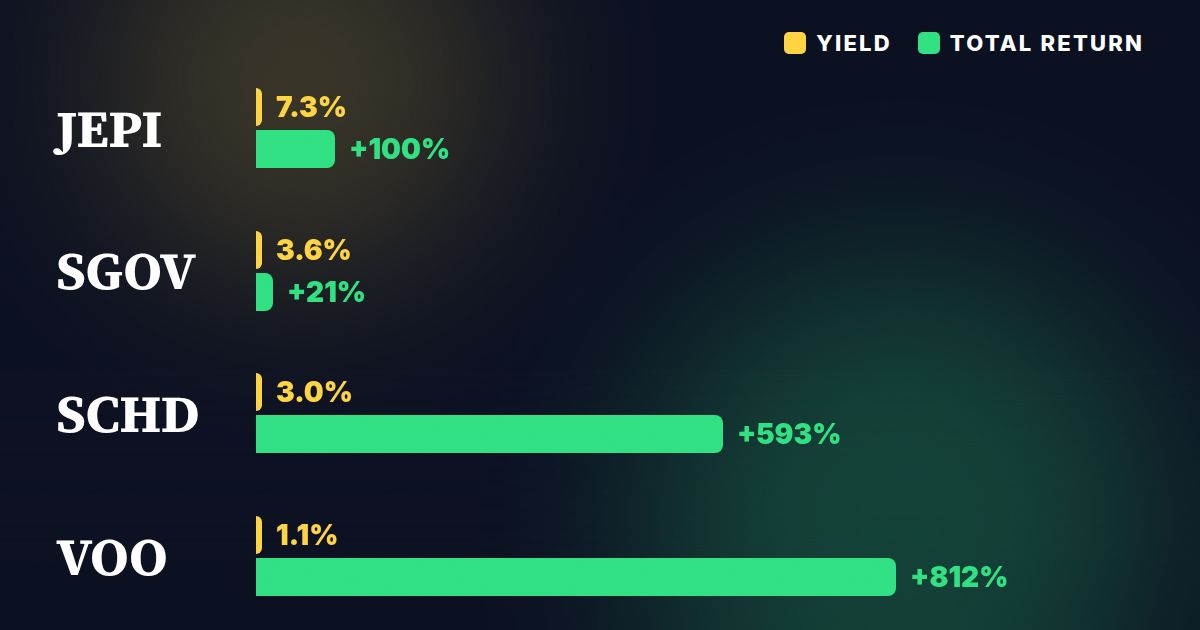
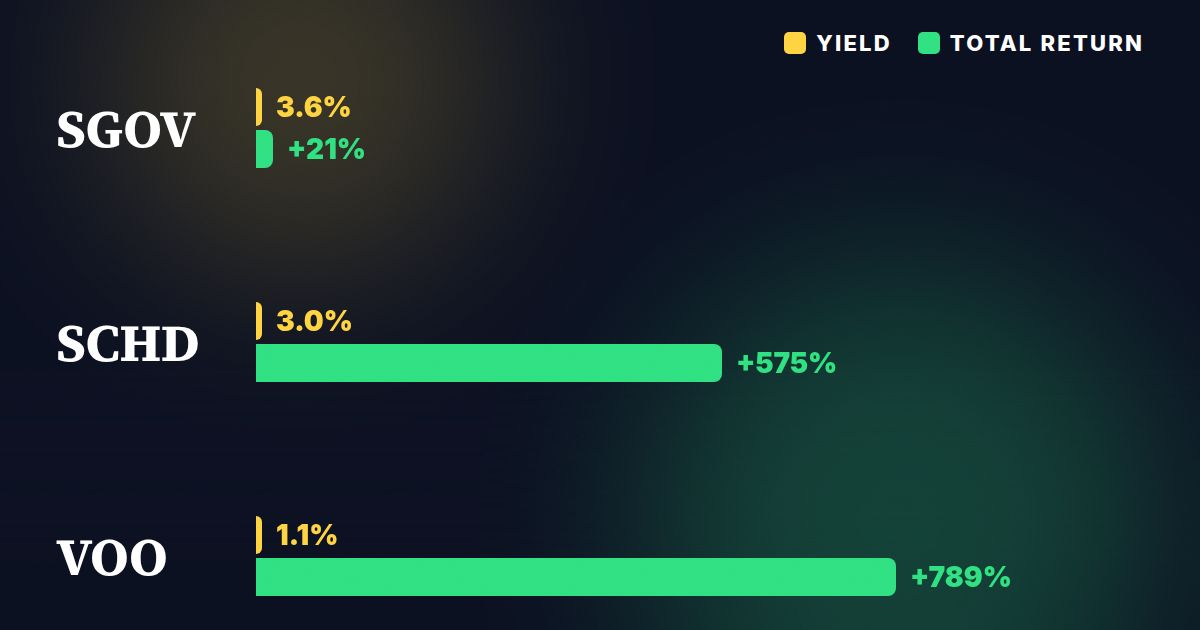
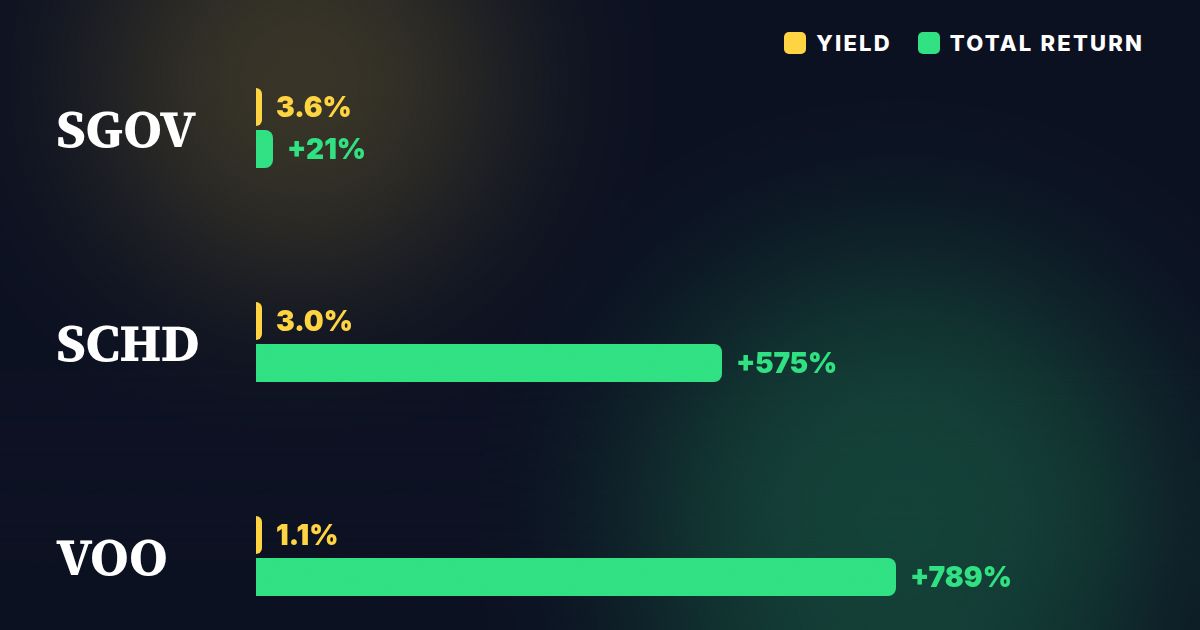
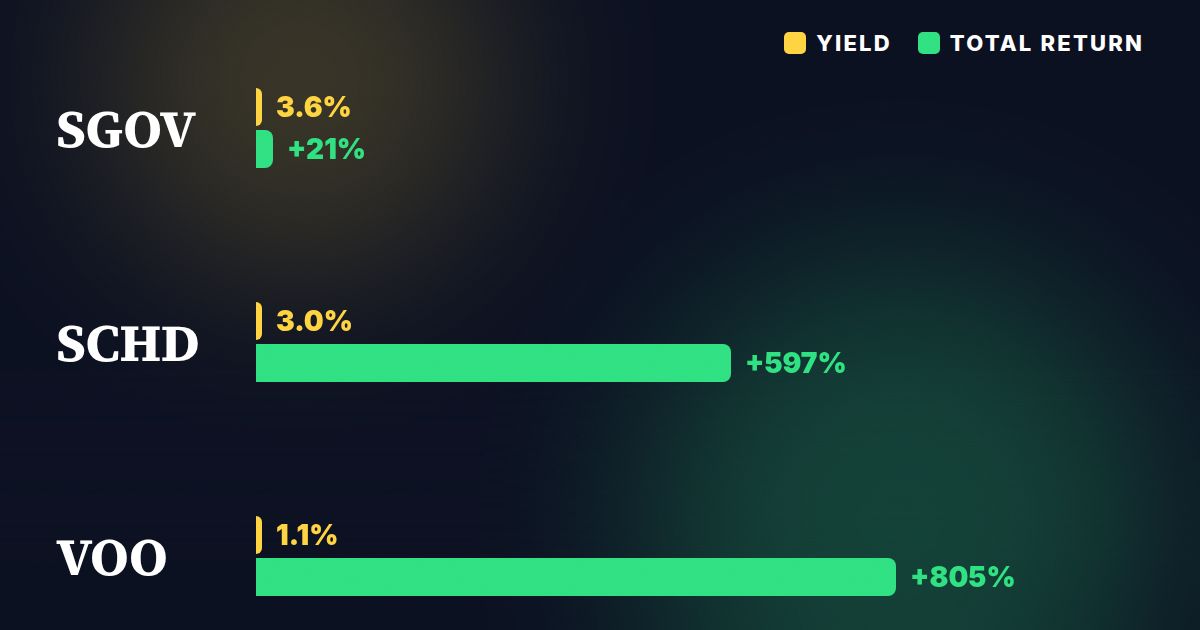
A T-bill ETF holds very short-term U.S. Treasury bills. Price barely moves, and the payout rises and falls with short-term interest rates. SGOV is a well-known example. It pays monthly, currently yields 3.64%, and charges 0.09% a year, with $117B in assets. Its total return since its 5/26/2020 inception is 21.0%, which tells you what this bucket is: stability and income, not growth.
This bucket is your shock absorber. If stocks drop 25%, you pay the bills from here and do not have to sell stocks at a bad price.
Job 2: Bond ETFs add steady interest
A broad bond ETF (for example BND or similar, named here only as a plain example) holds hundreds of government and corporate bonds. Many of them pay monthly. They usually yield more than T-bill funds when the yield curve is normal, but their prices move when interest rates change. That is the trade-off for the extra yield.
Job 3: Stock ETFs keep your income growing
Stocks are the part that can outrun inflation over long stretches. Two common examples are SCHD (dividend-focused, 3.00% yield, pays quarterly) and VOO (the S&P 500, 1.10% yield, pays quarterly). SCHD pays more cash today. VOO pays less cash but has a higher total return since its 9/7/2010 inception (789%) than SCHD has since its 10/20/2011 inception (575%). Those funds started on different dates, so treat that as a rough comparison, not a verdict. I go deeper in SCHD vs VOO.
The three example funds side by side
Monthly payers vs quarterly payers: does it matter?
Less than most people think. A fund that pays quarterly still produces the same yearly income. It just arrives in four chunks instead of twelve.
What matters is your cash flow. Your rent or mortgage is monthly, so you want a monthly paycheck. You can build that from any mix of payers:
- Let everything land in one cash account. Dividends and interest from every fund go to your brokerage cash or a linked savings account.
- Pay yourself on a schedule. Transfer the same amount to your bank on the same day each month, such as the 1st.
- Hold a buffer. One to three months of spending in cash smooths out the gaps between quarterly payments.
Monthly payers are nice for convenience, and a T-bill or bond ETF that pays monthly makes the buffer easier to keep full. But I would never pick a fund only because it pays monthly. Yield, fees, risk and total return come first. If you want to browse monthly payers anyway, see Best Monthly Dividend ETFs.
Selling shares for income vs living on yield
There are two ways to get paid from a portfolio, and both are legitimate.
Living on yield means you spend only the interest and dividends and never sell a share. It is psychologically comfortable. The downside is that to get a decent paycheck you may drift toward higher-yield funds, and a high yield can come with more risk or a falling share price. A shiny yield number does not tell you whether your principal is holding up. Always check total return alongside it.
Total return withdrawals means you spend the payouts and also sell a few shares when you need more. A fund that yields 1% but grows 8% a year can fund a bigger paycheck than a fund that yields 5% and shrinks. Selling shares is not the same as eating your principal, as long as the whole portfolio keeps growing and your withdrawal rate is reasonable.
My honest take: for most people a blend works best. Take the yield first, then sell from whichever bucket has grown the most to top up the difference. For how much is reasonable to pull out each year, see How Much Can You Safely Withdraw in Retirement?
Step by step: set it up in your account
- Set your target. Pick a monthly number and multiply by 12. Divide by the lump sum to get your withdrawal rate. If it is well above 4%, the plan needs more money, a lower target or a shorter time horizon.
- Choose your account. In a taxable account, interest and dividends are taxed in the year you receive them, and selling shares at a gain triggers capital gains tax. In an IRA or similar retirement account, the tax usually comes when you withdraw. Confirm the rules for your account with your broker or a tax professional.
- Split the money into buckets. A common starting point is something like 25 to 35% in T-bills, 25 to 35% in bonds and the rest in stocks. Younger or longer-horizon investors lean toward more stocks. Older or more cautious investors lean toward more T-bills and bonds.
- Decide whether to invest all at once. Putting the money in all at once has historically done as well or better than spreading it out in many cases, but spreading it over a few months can help you sleep. Either way, do T-bills and bonds first, since they are the low-risk part.
- Route all payouts to cash. Turn off dividend reinvestment for the funds that are paying your paycheck. Keep it on for any money you are not touching yet.
- Automate the paycheck. Set a monthly transfer from the brokerage cash to your bank.
- Review once or twice a year. If the cash buffer is low, sell shares from the bucket that has grown the most. If stocks have run far ahead, trim them back toward your target mix.
Worked example: $250,000 for monthly income
Let's say you want about $10,000 a year, or roughly $833 a month. That is a 4% withdrawal rate on $250,000.
The yields below are round-number assumptions for the math. They are not today's live yields, and real yields change. For reference, today's live yields are 3.64% for SGOV, 3.00% for SCHD and 1.10% for VOO.
| Bucket | Amount | Assumed yield | Yearly income |
|---|---|---|---|
| T-bill ETF | $75,000 | 3.5% | $2,625 |
| Bond ETF | $75,000 | 4.5% | $3,375 |
| Stock ETFs | $100,000 | 2.5% | $2,500 |
| Total | $250,000 | 3.4% | $8,500 |
The stock bucket assumes a blend of a dividend ETF and a broad index ETF, which lands between the yields of the two.
The yield alone gives about $8,500 a year, or $708 a month. To reach $10,000 you need another $1,500 a year, which is $125 a month. You get it by selling about $1,500 of shares once a year (or $750 twice a year) from whichever bucket is ahead.
Here is how the monthly cash flow looks in practice:
- The T-bill and bond ETFs pay monthly, roughly $500 combined in this example.
- The stock ETFs pay quarterly, about $625 each quarter.
- All of it lands in cash. You send $833 to your bank on the 1st of every month, topped up by the small annual share sale.
If you would rather live only on yield, drop your target to $708 a month or put more into higher-yielding holdings. Just be careful that chasing yield does not make the portfolio riskier than you intended. You can test your own numbers with the TopETFs calculators or project future income with Dividend Projection.
Common mistakes to avoid
- Picking funds by yield alone. A high yield with a falling share price can quietly shrink your lump sum. Check total return and the price decay flag.
- Putting everything in one fund. A single fund can cut its payout or fall in price. Spread the risk across buckets.
- Forgetting that T-bill yields move. When short-term rates fall, a T-bill ETF's payout falls too. Do not count on today's number staying put.
- Leaving reinvestment on by accident. If dividends keep buying new shares, your cash buffer never fills and you end up selling anyway.
- Ignoring taxes. Interest from T-bill and bond funds is usually taxed differently from qualified dividends, and rules vary by account and state. Check before you pick which account holds which fund.
- Selling stocks in a crash. That is exactly what the T-bill bucket is for. Spend from it first and let stocks recover.
- Setting the withdrawal too high. A 6% or 7% yearly draw can run a portfolio down faster than people expect.
Edge cases
- You have a pension or Social Security. Then your ETF income only covers the gap, so you can usually hold more in stocks.
- You need the money sooner. If the next five years of spending matters more than growth, put more in T-bills and bonds.
- Your lump sum is in a retirement account. You may have required withdrawals at a certain age. Confirm current rules with your plan provider.
- You are worried about timing the market. Splitting the stock purchases across several months is a reasonable compromise.
If you like the bucket idea, I walk through a longer version in The 3-Bucket Retirement Strategy With ETFs. And if you want to see what a single dividend fund pays on its own, try How Much Do You Need in SCHD to Make $1,000 a Month?
Checklist
- Monthly target and withdrawal rate written down
- Account type chosen and tax treatment confirmed
- Money split into T-bill, bond and stock buckets
- Reinvestment off for income funds
- Automatic monthly transfer set up
- One to three months of spending kept in cash
- Review date on the calendar
FAQ
What is the best way to invest a lump sum for monthly income?
There is no single best way, but a mix of a T-bill ETF, a bond ETF and stock ETFs is a sensible framework. It balances stability, interest and growth, and you can adjust the mix to your age and needs.
Do I need monthly dividend ETFs to get monthly income?
No. Quarterly payers work fine if the payouts go into a cash account and you transfer the same amount to yourself each month. The yearly income is the same either way.
Is it okay to sell shares for income?
Yes, many people do. Selling a small slice of a growing portfolio is fine as long as your total withdrawal rate is reasonable and you review it regularly. It also gives you more flexibility than living on yield alone.
How much income can $250,000 produce?
It depends on the mix and today's yields. With the round-number assumptions in the example above, the yield alone is about $8,500 a year, or around $708 a month. Real results will differ.
Should I put the whole lump sum in at once?
Historically, investing it all at once has often done as well or better than spreading it out. Spreading it over a few months can reduce regret if prices drop right after you buy. Pick the approach you will actually stick with.
Where can I compare these ETFs?
Use the TopETFs screener to compare fees, yields and total return, and see TopDividendETFs.com for dividend-focused rankings.
Benjie's bottom line
A lump sum becomes monthly income when you give each piece of it a job. T-bills cover the near term, bonds add steady interest, and stocks keep your paycheck from losing to inflation. Then you automate the payout so it feels like a salary.
The part I would not skip is checking total return, not just yield, and keeping your withdrawal rate honest. Nothing here is a recommendation to buy or sell anything. Your tax situation, account type and time horizon change the answer, so run your own numbers and talk to a tax professional or financial planner if the amount is large.
ETFs in this story
How this article was made: Benjie picks every topic based on what he finds useful as a dividend investor and what readers ask about. Parts of this article were drafted with help from AI tools, then edited, fact-checked and shaped by Benjie. All fund numbers come from the TopETFs database and update daily.
Disclaimer: TopETFs.com is published by Dividend Empire LLC for educational and entertainment purposes only. We are not financial advisors, and nothing on this site is financial advice, a recommendation, or a solicitation to buy or sell any security. ETF data is compiled from public sources and fund issuers, may be delayed, inaccurate or outdated, and may differ from the fund sponsor's own figures. Yields are trailing distribution yields, are not guaranteed, and distributions may include return of capital, which reduces your cost basis and is not a measure of performance. Total returns are since each fund's inception unless noted and are not comparable across funds with different start dates. Past performance does not guarantee future results. Investing carries risk, including loss of principal. Read each fund's prospectus and consult a licensed financial advisor before investing. Dividend Empire LLC receives compensation from ETF issuers for sponsored placements, which are labeled as such.